
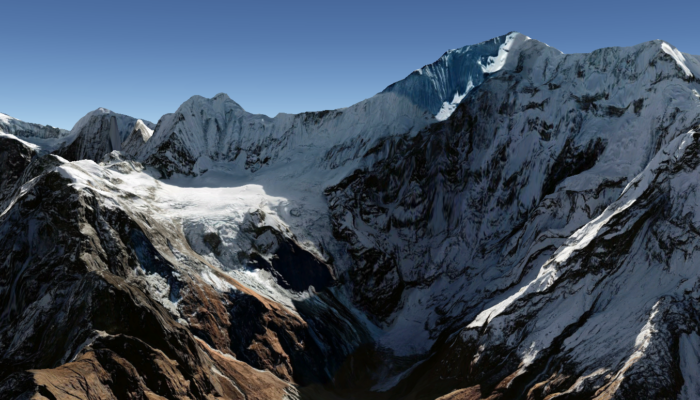
3D view in GoogleEarth, facing the cliff and glacier (on the left) at the source of the event
At the time of preparing this blog entry, we are less than 48 hours after the catastrophe which has hit the Himalaya. While the flow of new information continues, it is useful to summarize and clarify the key points around this event.
- WHAT? The massive destruction was caused by a flash flood. It was such a high energy that is rarely seen. Numerous videos can be found online.
- WHERE? The cause of the flash flood was a major glacier collapse and landslide, on the North slope of Langtang Lirung (7234 m) and Tsangbu Ri (6781 m) mountains in Nepal. The side valley reaches the valley along which lies the Tibet–Nepal border: the river is called Donglin Tsangpo in Tibet and Lhende Khola in Nepal. After reaching the ill-fated Gyirong/Rasuwa border post, the flood re-entered Nepal and swept down the Trishuli River valley, across the entire country, and then to India.
- A GLOF? Before and after satellite photo comparison such as this one show no trace of a glacial lake prior to the event. Hence there seems to have been no glacial lake outburst flood (GLOF). The flash flood was made of river water, ice and lots of rocks and debris. In the aftermath of the main event of August 26th, a smaller lake grew behind a new dam of debris, yet the water level is already sinking.
- AN EARTHQUAKE? Initial reports said the mass movement was triggered by a magnitude 4.4 earthquake. Subsequent analysis by the USGS shows that there was no tectonic event, instead it is the mass movement itself that has triggered ground vibrations. Its energy is equivalent to a magnitude 5.2 earthquake, later reduced to 4.2 – these numbers mean over 1000 (respectively 40) times more energy than following the 2025 Blatten event in Switzerland.
- VIBRATIONS. Seismic records from Nepali observation stations show that the flash flood caused ground vibrations that lasted for over two hours. Here is a seismogram example from a station that is 60 km away from the source of the event, and at the closest point still 20 km away from the Trishuli River. Further seismic analyses are ongoing.
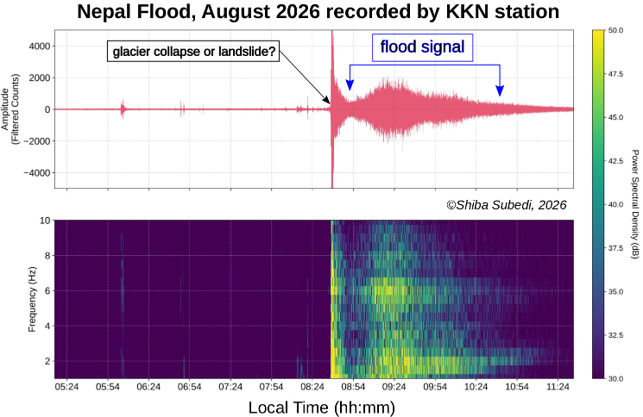
- FAR REACHING. The long duration and far-reaching impact of the flood is unfortunately confirmed by casualties in the Chitwan district, in the southern foothills of Nepal, too. This district is at over 100 km distance downstream. It has been reported that flood alert stations were simply swept away before they could send a message.
- POWER. If you ever wondered how big boulders are transported and arrive to surprising locations in a mountain landscape, this video provides a relevant yet shocking answer.
- VOLUME. For now, there are only preliminary estimates of the volume of the initial mass movement, on the order of a half to 10 million cubic metres. How much additional material was swept away along the flood’s path has not yet been estimated. For comparison, the gigantic Flims rockslide about 10 thousand years ago moved approximately 12’000 million cubic metres of rock.
- IMPACT. The flash flood’s consequences on Nepal and also Tibet are terrifying: the number of casualties will be high, and the environmental and economic impact long-lasting. We commend the efforts of the rescue teams for their relentless efforts, and hope and pray for their success in the field.
Together, the two authors, Shiba and György have designed and implemented the Seismology at School in Nepal program starting 2017 (website). The program offers direct training to schoolteachers, free educational materials, and has built a school seismic network with fully open data. The program is effectively increasing awareness and preparedness of the population.
Edited: B. Schaefli