Tarun Goswami, an archaeologist from India, asks: How is a tuff formed? and more specifically… Why do some deposits have more ash than others? We are paraphrasing – the questions are specifically about the tuffs formed in the Toba supereruption. So… you asked, we answer! First of all, modern definitions generally describe a tuff as …[Read More]
Geochemistry, Mineralogy, Petrology & Volcanology
Ask us (almost) anything: Were Chixculub and Deccan related?
Doc Rock from twitter asks Has anyone investigated the hypothesis that the Deccan Traps basalt flows came after, and were the result of, the Chixculub impact event, based on the DT basalts being on the exact opposite side of Earth at the time of the event? For context, the Chixculub crater is buried under the …[Read More]
GMPV ECS online talk series 2: 4th August
We’re back! After a short break, the Geochemistry, Minerology, Petrology and Volcanology division’s early career scientists talks will return on Tuesday 4th of August at 10am CEST. We have another four fascinating talks, covering a broad range of disciplines, methodologies and field locations! • Artur Ionescu (Babes-Bolyai University) – “Fluid geochemical studies in the Balkans: …[Read More]
That’s us! – The new GMPV ECS Team 2020/2021
Usually our blog posts are about fancy minerals and cool science, but today we want to use this platform to introduce you to our new GMPV ECS team for the term 2020/2021! First of all, what exactly are we doing here in the GMPV ECS team and why are we even existing?! – Well, the …[Read More]
#MINERALMONDAY: Bismuth
It’s not so common for us to think about pure metals as minerals, or even crystals, but just like pinocchio could be a real boy, pure metals can be minerals too. This is because, if the metal cools down from a melt very slowly, layers of metal atoms can add onto previously solidified atoms, forming …[Read More]
#MINERALMONDAY: Zdenĕkite, way too pretty to mine
One of the saddest things for mineralogists is to see beautiful minerals crushed to extract their valuable contents, but often, without mining, we don’t get to see these minerals in the first place. Mineral hunters often scrounge around in the big piles of waste rock from mines, because the machines used for smashing up rock …[Read More]
Volcanic Lightning: Impacts on plume-suspended ash particles
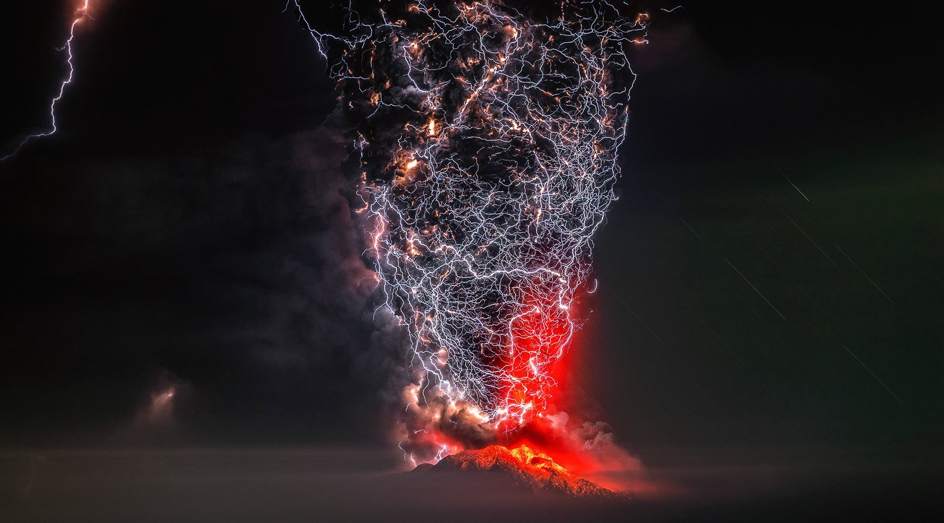
Volcanic lightning is a common phenomenon related to explosive volcanism, often rattling down in a spectacle of hundreds of lightning strikes within a single eruptive event. Apart from its spectacular appearance, lightning can also be used as helpful tool to detect and monitor volcanic activity in remote locations on Earth and potentially on other planets, …[Read More]
#MINERALMONDAY – we’re back with baksanite!
#MINERALMONDAY: your weekly dose of minerals every* Monday (* excluding the last few months of Mondays…). A lot of bad things have happened since the start of the year, but perhaps the least important of these is the complete lack of minerals every Monday. Don’t worry, we are back, and what better way to start …[Read More]
The inaugural GMPV webinar: 29th June
The EGU’s GMPV Early Career Scientist committee is delighted to invite you to our first ever webinar, with contributions spanning the whole range of topics encompassed by the GMPV section. The webinar will be hosted on zoom (apologies if you already have zoom fatigue…) at 16:00 Central European Summer Time, on Monday 29th June. There …[Read More]
Call for presentations: Early Career Scientist Webinar series
The EGU GMPV ECS** committee are pleased to invite you to contribute to a new series of webinars, highlighting new research by early career scientists. These webinars will be one hour long, made up of four talks (8-10 minutes each) from across the breadth of GMPV, with time for discussions. Whilst the exact timings are …[Read More]