
The Rare Earth Elements, or REEs, are really important. This is a group of elements including neodymium (used to create strong magnets), cerium (used in catalytic converters), lanthanum (used in electric car batteries), lutetium (used in oil refinery), with the uses of REEs increasing continuously. At the moment, the majority of the world’s supply of REEs comes from a single deposit in Inner ...[Read More]
vEGU21: Monday GMPV highlights
Welcome to vEGU21 week 2! If you are a GMPVer, this will be a solid and interesting week of presentations. Each presenter will talk for two minutes, then there will be breakout text chats, and simultaneous live video chats. So be ready to be thinking about 7 things at once… No idea where to go or what to do? Try out this itinerary (all times in CEST): After a hearty breakfast of whatever you ...[Read More]
The *real* mineral cup: wavellite vs. kernowite / devon versus cornwall
Kernowite: In November 2020, approximately two major world events occurred. Firstly, Joseph R. Biden Jr. and his dog Major were elected as the 46th president and president’s dog of the United States of America. Secondly, the International Mineralogical Association approved a new mineral, kernowite, Cu2Fe3+(AsO4)(OH)4⋅4H2O, which was described by M. Rumsey from the Natural History Museum in L ...[Read More]
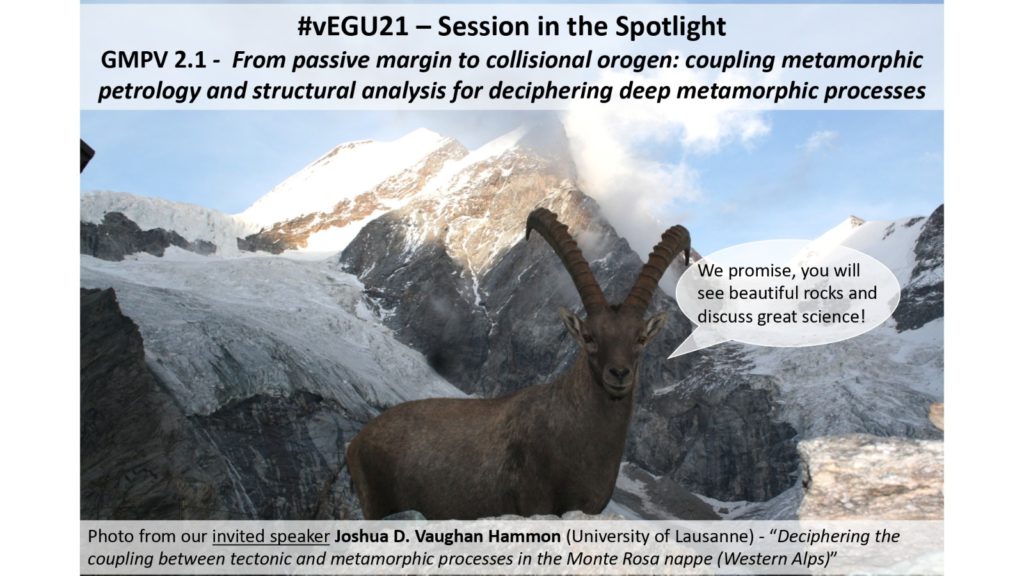
#vEGU21 Session in the Spotlight: GMPV2.1
The vEGU21 abstract deadline is approaching as fast as anything happens in 2020 (which is either really fast or really slow, depending on who you are…). Have you chosen a session to submit to? Whatever else happens, we promise this will be the cheapest trip to Vienna you will take all year! Whether you aren’t stressed at all (like a passive margin), or super stressed (like a collision ...[Read More]
Ask us (almost) anything: how is tuff formed?
Tarun Goswami, an archaeologist from India, asks: How is a tuff formed? and more specifically… Why do some deposits have more ash than others? We are paraphrasing – the questions are specifically about the tuffs formed in the Toba supereruption. So… you asked, we answer! First of all, modern definitions generally describe a tuff as a volcaniclastic rock composed of solid volcanic ...[Read More]
Ask us (almost) anything: Were Chixculub and Deccan related?
Doc Rock from twitter asks Has anyone investigated the hypothesis that the Deccan Traps basalt flows came after, and were the result of, the Chixculub impact event, based on the DT basalts being on the exact opposite side of Earth at the time of the event? For context, the Chixculub crater is buried under the Yucatan peninsula in Mexico, and resulted from a meteorite impact that is widely believed ...[Read More]
GMPV ECS online talk series 2: 4th August
We’re back! After a short break, the Geochemistry, Minerology, Petrology and Volcanology division’s early career scientists talks will return on Tuesday 4th of August at 10am CEST. We have another four fascinating talks, covering a broad range of disciplines, methodologies and field locations! • Artur Ionescu (Babes-Bolyai University) – “Fluid geochemical studies in the Balkans: from planning up t ...[Read More]
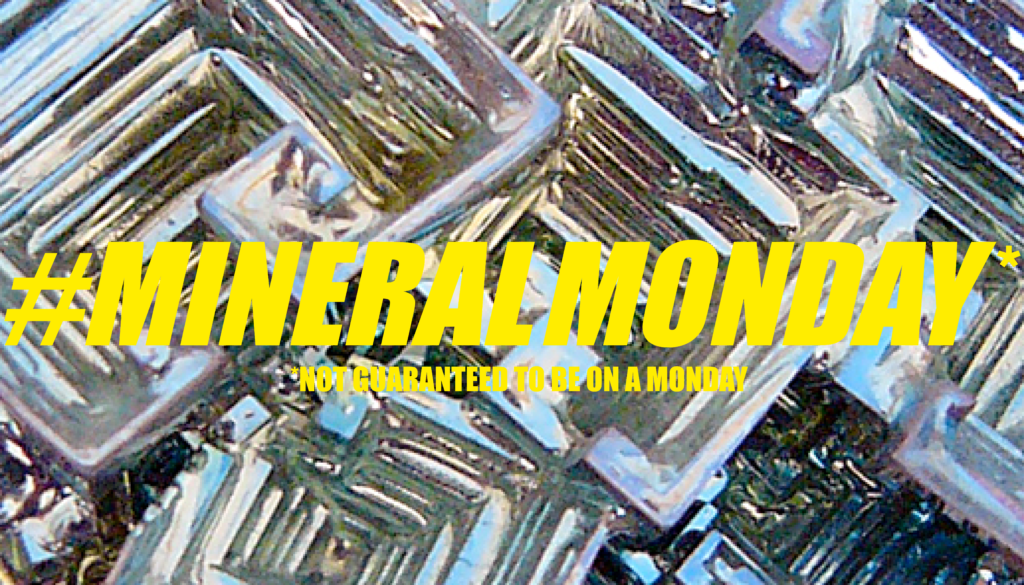
#MINERALMONDAY: Bismuth
It’s not so common for us to think about pure metals as minerals, or even crystals, but just like pinocchio could be a real boy, pure metals can be minerals too. This is because, if the metal cools down from a melt very slowly, layers of metal atoms can add onto previously solidified atoms, forming a defined lattice of atoms, and ta-dahh, it’s a single crystal! This is different from m ...[Read More]
#MINERALMONDAY: Zdenĕkite, way too pretty to mine
One of the saddest things for mineralogists is to see beautiful minerals crushed to extract their valuable contents, but often, without mining, we don’t get to see these minerals in the first place. Mineral hunters often scrounge around in the big piles of waste rock from mines, because the machines used for smashing up rock do a much better job of exposing minerals than a geological hammer ...[Read More]
#MINERALMONDAY – we’re back with baksanite!
#MINERALMONDAY: your weekly dose of minerals every* Monday (* excluding the last few months of Mondays…). A lot of bad things have happened since the start of the year, but perhaps the least important of these is the complete lack of minerals every Monday. Don’t worry, we are back, and what better way to start than with baksanite, Bi6Te2S3. Why baksanite? Well, for the sake of sounding ...[Read More]