Why do we need ice shelf-ocean models?
The Antarctic ice sheet is losing mass through the ice shelves fringing the continent, contributing to global mean sea level rise. The warm ocean brings heat towards the floating ice shelves and into the ocean beneath them, called ice shelf cavities. The ocean heat melts the ice from beneath, which then allows the ice sheet to slide forward into the ocean and raise sea levels. However, the processes that happen at and below ice shelves are complex and involve both small and large spatial and temporal scales. They are also hard to observe due to their remote nature (if you are curious about observing the interface between ice and ocean, check out this post). Therefore, it is important that we invest in developing robust and reliable models of ice shelf processes to accurately predict their influence on future climate and sea level.
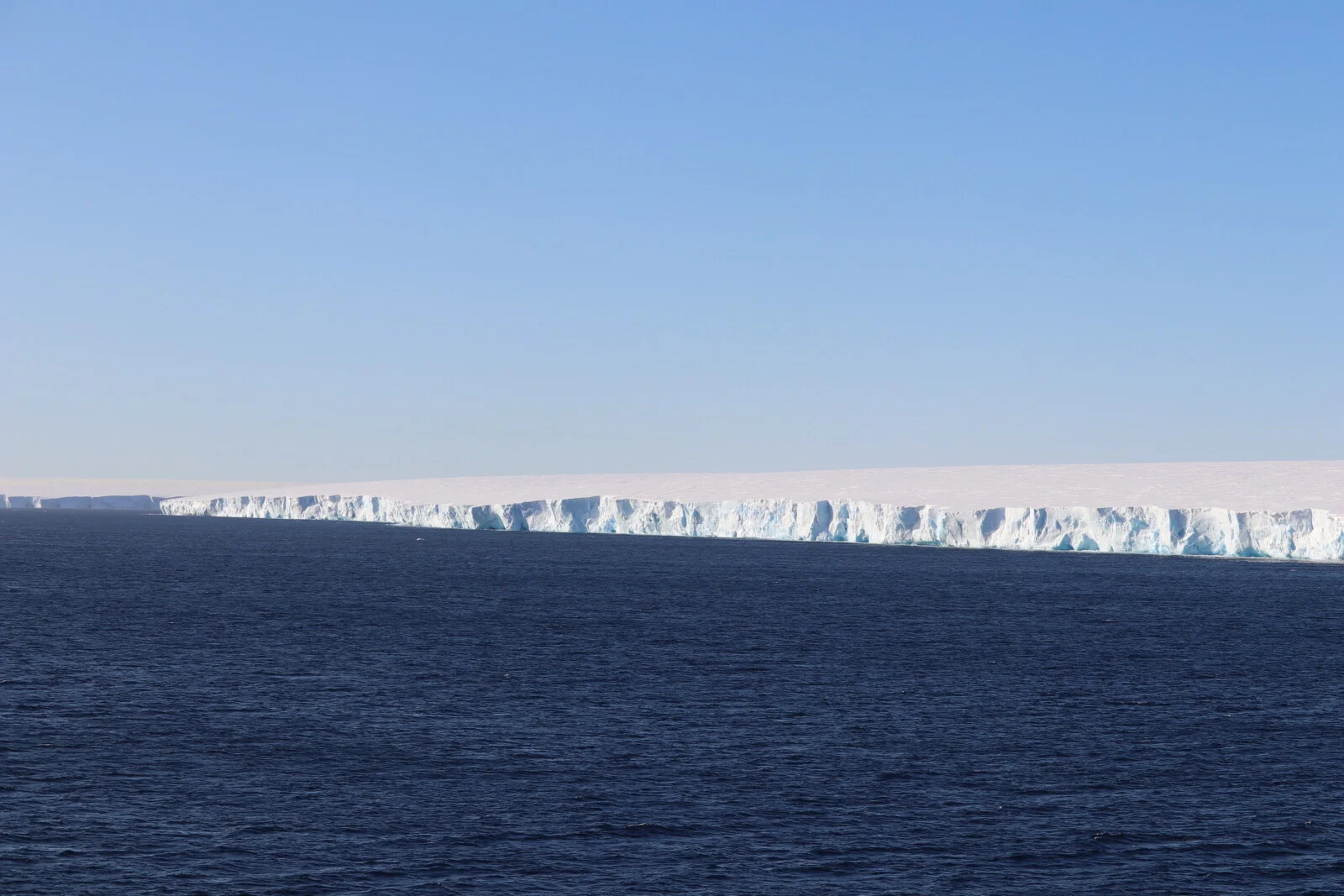
Figure 2. The Denman Glacier ice front (Antarctica) as observed from the RSV Nuyina, March 2025. The ice extends to a depth nine times the visible height! [Credit: Claire Yung]
An idealised model intercomparison project
In the ISOMIP+ project (the second Ice Shelf Ocean Model Intercomparison Project), published earlier this year in The Cryosphere, we evaluated one aspect of modelling ice sheet mass loss: how ice shelves melt in ocean models. Modelling ice shelf melt in ocean models was technically challenging in the past as many models weren’t originally designed to allow for hundreds of metres of ice on top of the ocean. Now, fortunately, many ocean models can simulate ocean flows beneath ice shelves, which allows different teams around the world to use these ocean models to study ocean circulation near Antarctica and make predictions about future ice shelf melting. However, model codes and infrastructures used by these teams can differ greatly, so it is important to compare these models.
We compared twelve different model configurations with the same, idealised setup (Figure 3). This simple setup uses a smooth bottom topography and ice shelf shape and simplified ocean temperature and salinity conditions. Whilst not a real Antarctic ice shelf cavity, this setup allowed us to systematically assess the similarities and differences between models and see how the system responds to warm or cold ocean conditions. The ice shelf shape was fixed in time for simplicity (in reality, we would expect it to evolve as it melts and the ice sheet moves), but there is a parallel intercomparison experiment that explores the coupled ocean-ice sheet response: how the ice shape changes in response to the ocean and vice versa (MISOMIP1, Asay-Davis et al. 2016).
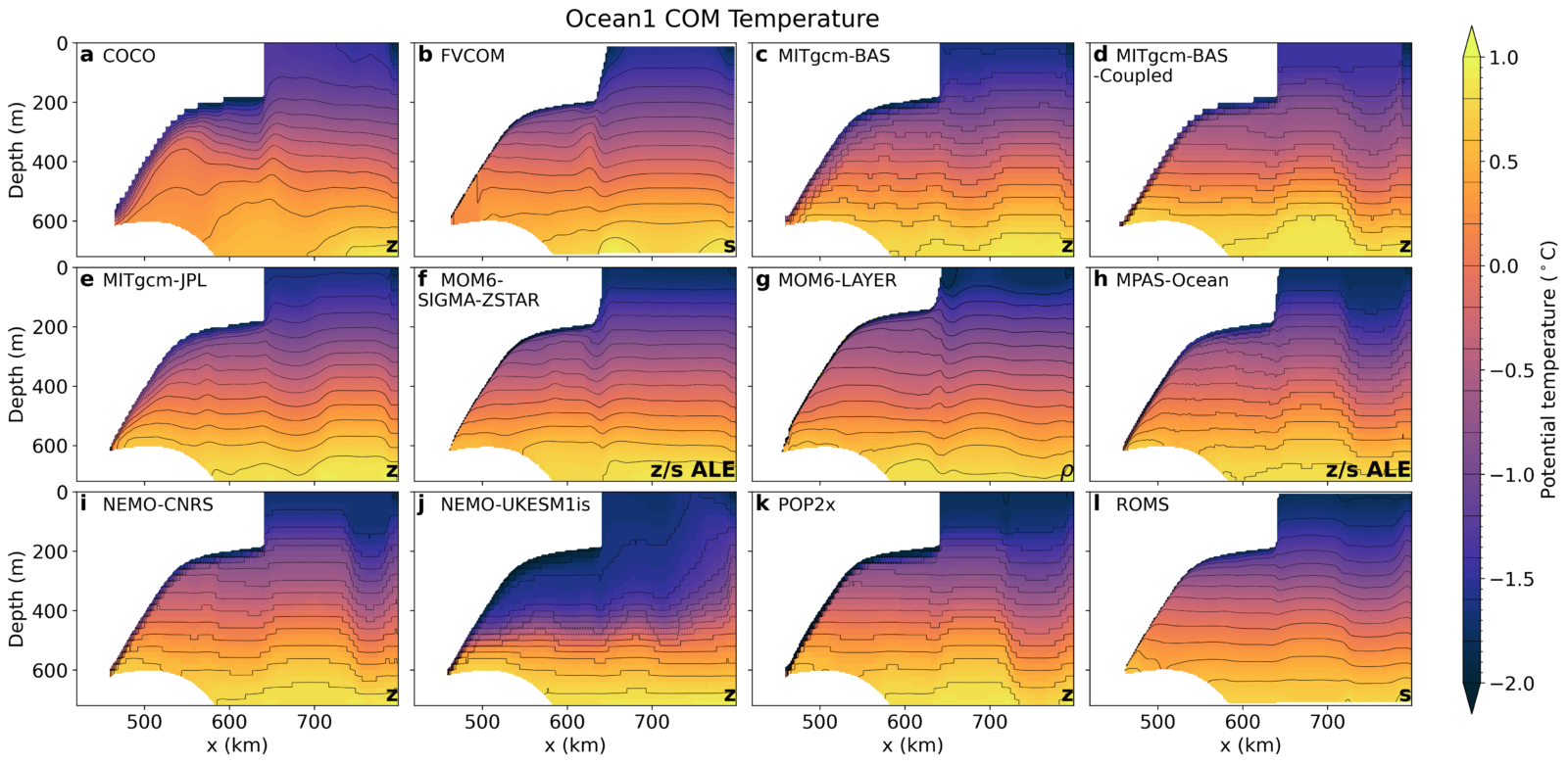
Figure 3. Temperature profiles through a cross-section of the ice shelf cavity, showing the twelve different model configurations. [Credit: Figure 2 of Yung et al., 2026]
Similarities in ice shelf circulation
In one of the modelled experiments, warm water flows into the ice shelf cavity at depth and enhances the ice shelf melting near the grounding zone, conditions that are similar to many ice shelves in West Antarctica. Since meltwater from ice is fresher and less dense than the salty seawater, a buoyant meltwater current rises upwards along the ice shelf until it exits the ice shelf cavity, creating an overturning circulation (Figure 4). The models simulate similar overturning circulation strength in response to the warm ocean forcing: we show that the relationship between melt rate and overturning circulation at each time during the spin-up of this circulation produces a shared linear relationship across models (Figure 4). This result gives us confidence that the models represent the same physical processes, even if they vary a little in the finer details.
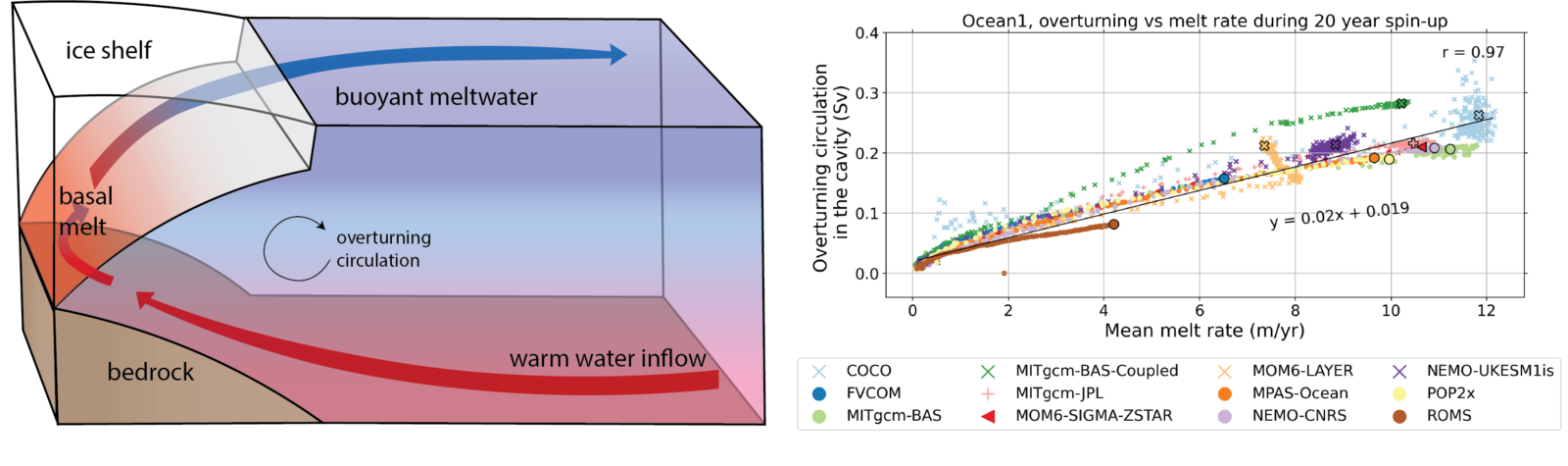
Figure 4. Left: Idealised schematic of ice shelf basal melt and overturning circulation [Credit: Claire Yung]. Right: Model overturning circulation and melt rate during the spin-up of the model, where each scatter point is a different model at a different time [Credit: Fig. 13 of Yung et al. 2026].
Models differ near the ice shelf-ocean interface
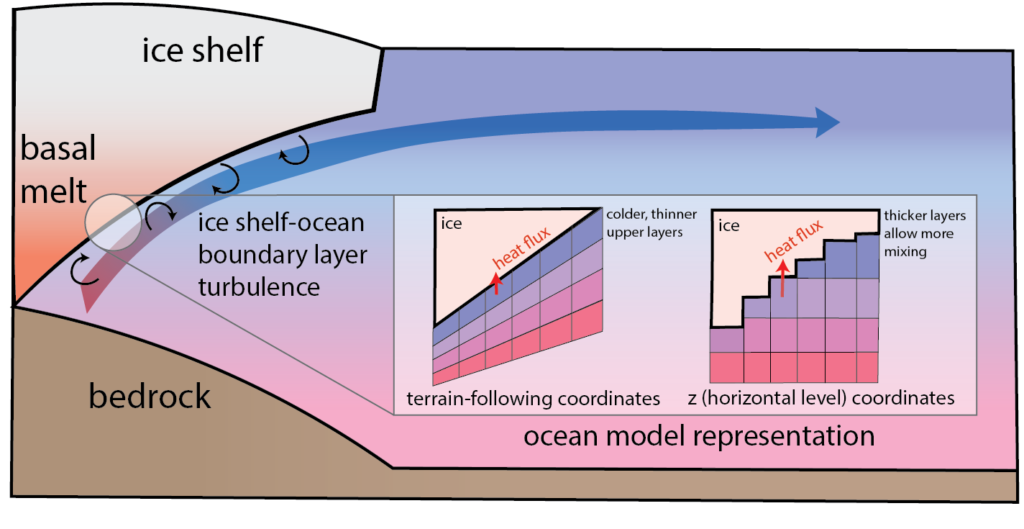
One ongoing challenge for ice shelf-ocean models is modelling the boundary layer between ocean and ice, where the ice shelf basal melting happens. This basal melting is driven by small-scale processes like turbulence which can be as small as millimetre-scale. These processes are much smaller than the grid-boxes of our ocean models, typically 1 to 20 m in vertical thickness and hundreds of metres to kilometres in the horizontal. Making the grid-boxes small enough while still simulating a regional or global domain would require immense computational resources. Since we can’t resolve the small-scale processes, we instead make approximations of what the melt should have been according to the ocean conditions that we can simulate, such as the temperature in each grid box. These methods are called parameterisations. In our model intercomparison, we tuned the melt rate parameterisation so that the models had the same total melt rate (in parts of the ice shelf deeper than 300 metres below sea level, where melt rates are greatest) and could be fairly compared. To achieve the same melt, the tuning parameters varied significantly (by an order of magnitude!) between models.
Some of the variability in tuning parameters can be explained by the choices of vertical coordinate in the different ocean models. Some ocean models are built using horizontal layers, whereas others have tilted layers that follow the ice shelf and bottom topography more smoothly (Figure 1). How these layers are defined is known as the vertical coordinate. The vertical coordinate (as well as the total number of layers) controls the vertical size of the grid boxes near the ice and how the meltwater and the warm, ambient ocean mix within this layer (see Gwyther et al. 2020 for more details). However, the choice of vertical coordinate does not explain all of the variability between models. Additionally, there is still work to be done to make the boundary layer parameterisations more accurate, such as incorporating more complex physical processes into the parameterisations that have been recently observed beneath real ice shelves (Rosevear et al. 2025), and making the parameterisations less sensitive to model choices or coordinates.
What’s next?
Our model intercomparison showed good agreement between models in many aspects, but since our configuration is idealised, we cannot validate the models against observations. It is important that future model intercomparison efforts also use realistic model configurations with real Antarctic topography and ocean and atmospheric conditions (as well as we know them – we still have a scarcity of observations beneath Antarctic ice shelves!) so that the models can be compared to observations and assessed in future climate scenarios. Some of these intercomparison efforts have already been performed (Galton-Fenzi et al. 2025) or are ongoing (De Rydt et al. 2024) and will also include coupling with dynamic ice sheet models to fully represent the Antarctic ice sheet mass loss processes.
ISOMIP+ has demonstrated that idealised model intercomparison projects are very useful for assessing the state of our models in a standardised way. The project was also a catalyst for model development across the world, as well as sensitivity studies that have allowed us to better understand ice shelf-ocean interactions. It is important that our community continues to work together to improve ice shelf-ocean models and produce more accurate future sea level projections.
Read the paper: Yung, C. K., Asay-Davis, X. S., Adcroft, A., Bull, C. Y. S., De Rydt, J., Dinniman, M. S., Galton-Fenzi, B. K., Goldberg, D., Gwyther, D. E., Hallberg, R., Harrison, M., Hattermann, T., Holland, D. M., Holland, D., Holland, P. R., Jordan, J. R., Jourdain, N. C., Kusahara, K., Marques, G., Mathiot, P., Menemenlis, D., Morrison, A. K., Nakayama, Y., Sergienko, O., Smith, R. S., Stern, A., Timmermann, R., and Zhou, Q.: Results of the second Ice Shelf–Ocean Model Intercomparison Project (ISOMIP+), The Cryosphere, 20, 2053–2088, https://doi.org/10.5194/tc-20-2053-2026 , 2026.
Further references and reading
- Asay-Davis et al., 2016. Experimental design for three interrelated marine ice sheet and ocean model intercomparison projects: MISMIP v. 3 (MISMIP +), ISOMIP v. 2 (ISOMIP +) and MISOMIP v. 1 (MISOMIP1)
- Gwyther et al., 2020. Vertical processes and resolution impact ice shelf basal melting: A multi-model study
- Rosevear et al., 2025. How Does the Ocean Melt Antarctic Ice Shelves?
- Galton-Fenzi et al., 2025. Multi-model estimate of Antarctic ice-shelf basal mass budget and ocean drivers
- De Rydt et al., 2024. Experimental design for the Marine Ice Sheet–Ocean Model Intercomparison Project – phase 2 (MISOMIP2)