
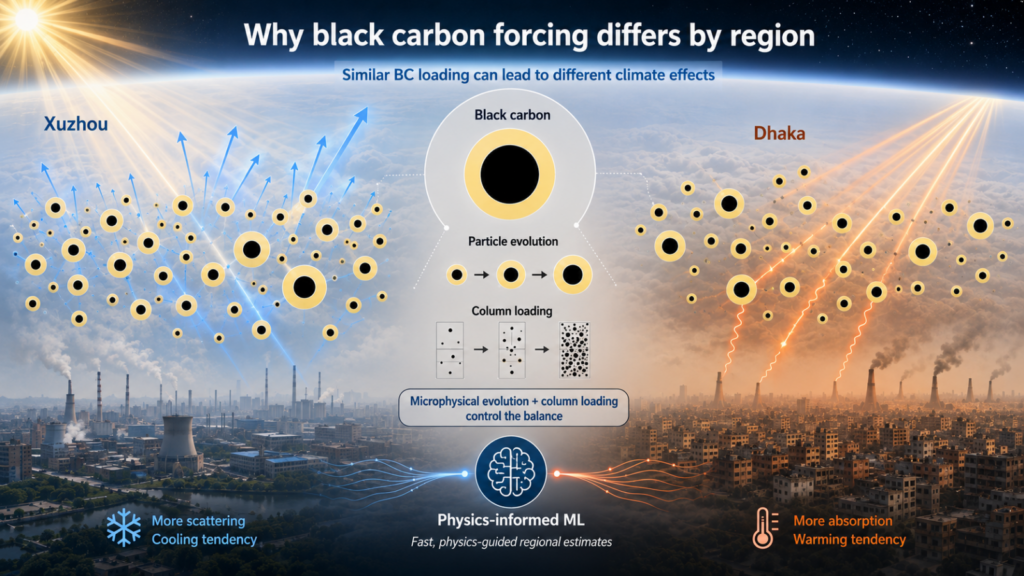
Every time something burns incompletely —whether in a car engine, a factory furnace, a cooking fire, an agricultural field set alight after harvest, or a vast wildfire sweeping through savanna grasslands— tiny particles of black carbon are released into the atmosphere. You might know these more simply as soot. These particles are so small that thousands of them laid side by side would barely stretch across the width of a human hair. Yet despite their minuscule size, black carbon (also known as aerosols) are one of the most powerful and perplexing drivers of climate change on the planet.
But here is the puzzle that scientists have been wrestling with for decades: how much are they actually warming the planet? Estimates in the scientific literature vary widely. That is a troubling level of uncertainty when trying to understand – and ultimately manage – our climate future.
Our new study, recently posted at Atmospheric Chemistry and Physics, attempts to explore a key reason for this confusion: the same amount of black carbon can behave in fundamentally different ways depending on where it is and what it looks like at the microscopic level. And those differences matter enormously for regional cooling or warming.
From the Sky to the Particle
When sunlight hits a black carbon particle floating in the atmosphere, two things can happen: the particle can absorb the light or scatter. Which effect dominates depends not just on how much black carbon is present, but on its shape, size, and what it is coated with. Fresh soot emerges from a combustion source as a relatively bare particle. But as it ages in the atmosphere over hours and days, it accumulates coatings of other materials (sulfates, nitrates, or organic compounds). This coating acts as a lens, concentrating more sunlight onto the absorbing core. The thicker the coating relative to the core, the more this “lensing effect” amplifies heat absorption. At the same time, heavily coated particles scatter more light. The net radiative outcome (warming versus cooling) depends on the delicate balance between these two competing processes.
Current climate models largely sidestep this complexity. Many assume that black carbon particles are simple, externally mixed spheres with fixed optical properties, or that the relationship between the amount of black carbon in the atmosphere and its radiative effect is linear. Our study challenges both of these assumptions.
A Tale of Two Cities
We investigated black carbon aerosols over two very different urban environments: Xuzhou, China (a major industrial hub on the North China Plain), and Dhaka, Bangladesh; a rapidly expanding megacity in a tropical river delta, fed by traffic, brick kilns, and small-scale industries.
To characterize the black carbon particles in these cities, we combined observations from multiple satellites (including the TROPOMI instrument and MODIS) with ground-based sensors (e.g., sun-sky photometer networks such as AERONET and SONET). These observations constrain a physical model that treats each black carbon particle as a sphere with an absorbing carbon core surrounded by a scattering shell.
The contrast between the two cities was striking. In Xuzhou, black carbon particles tended to have smaller cores but thicker coatings, consistent with rapid secondary aerosol formation driven by diverse industrial co-emissions. In Dhaka, the cores were larger but more thinly coated, reflecting less efficient combustion and a less oxidative atmosphere. Even when the total amount of black carbon in the air column (as measured by its ability to block light) was comparable between the two cities, their microscopic differences produced different absorption-scattering balances, and therefore different climate effects.
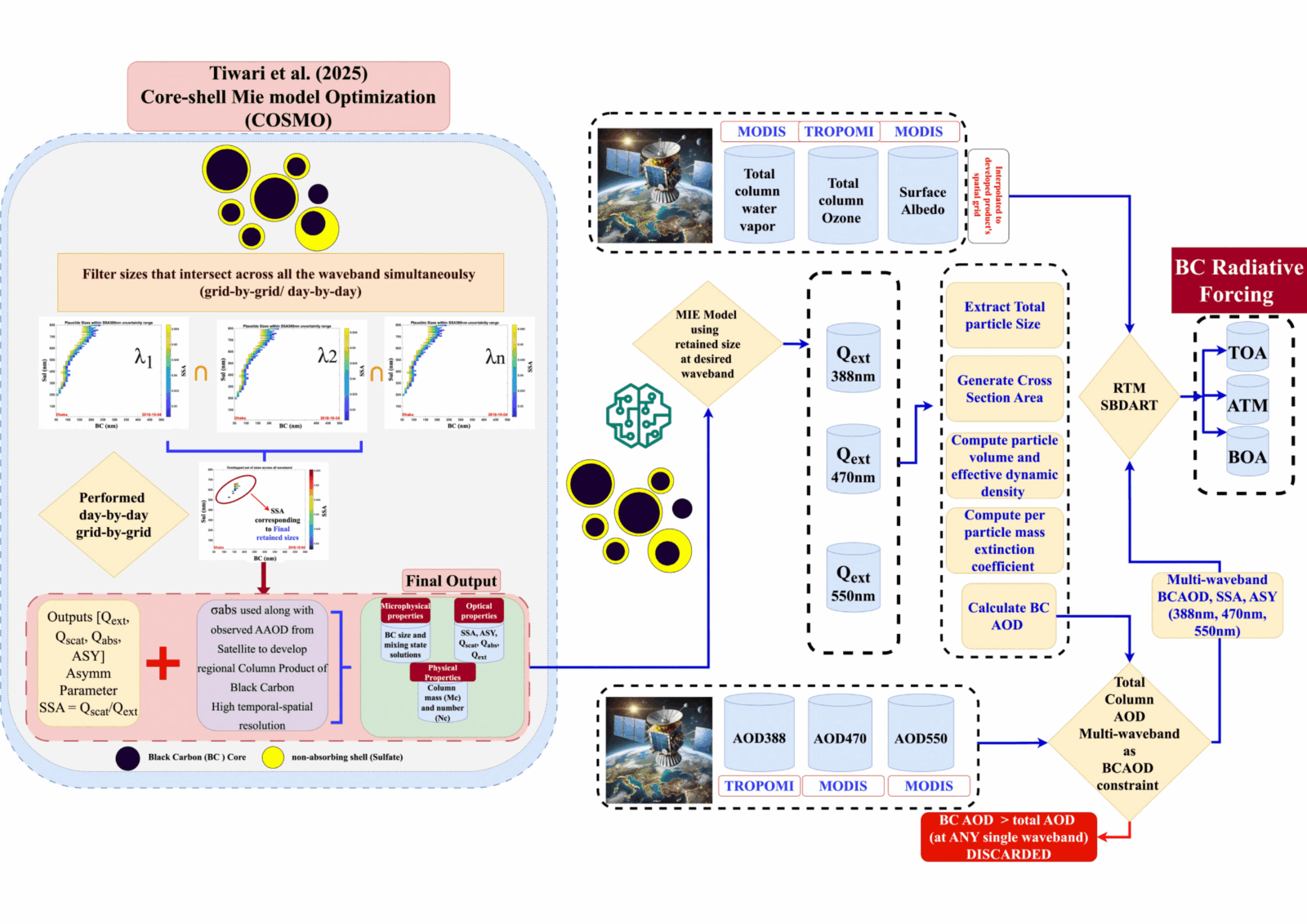
Figure 1. Conceptual workflow of the Core-Shell Mie Model Optimization (COSMO) framework for quantifying regional Black Carbon (BC) radiative forcing. The flow diagram details the retrieval of key regional column products (BC size distribution, mixing state, columnmass, and number concentration) by integrating multi-waveband satellite observations. Particle light-scattering and light-absorption properties and radiation interaction of pollutant particles (asymmetry parameter (ASY), and single scattering albedo (SSA)) are iteratively computed using a core-shell configuration optimization at 388, 470, and 550 nm. Following quality assurance (discarding physically inconsistent retreivals), the final optimized optical properties are ingested into the radiative transfer model (SBDART) to calculate the multi-level (TOA, ATM, BOA) BC radiative forcing.
A Machine Learning approach that keeps the Physics
Running detailed and complex radiative transfer simulations to calculate how light interacts with the atmosphere over large regions and long time periods is incredibly slow and expensive (computationally speaking). Because of this, many climate studies use simplified “forcing efficiency” formulas to estimate . We demonstrate that this approach misses critical information.
Instead, we trained a machine learning surrogate model (a model that mimics the behaviour of complex and expensive simulations), specifically, a random forest ensemble (a model prediction based in multiple decision trees), on more than 400,000 individual radiative transfer simulations, using microphysical properties retrieved from our observational constraint framework as inputs. This model learns the full non-linear relationship between particle properties, column loading, and radiative forcing, without needing to re-run expensive physics calculations each time.
The model achieved very high accuracy (explaining more than 95% of the variance in our physically derived forcing values) and, crucially, provides interpretable insights into what drives the forcing in each region. Using a technique called SHAP analysis (borrowed from cooperative game theory), we quantified how much each input variable contributed to top of the atmosphere forcing estimate. The results reveal a world that simple parameterisations cannot capture: the same amount of black carbon loading in the atmosphere can contribute either to cooling or to warming, depending on how the particles are mixed and distributed. There is no universal threshold that separates the two regimes. This non-linearity is not a modelling artefact; it reflects real-world physics.
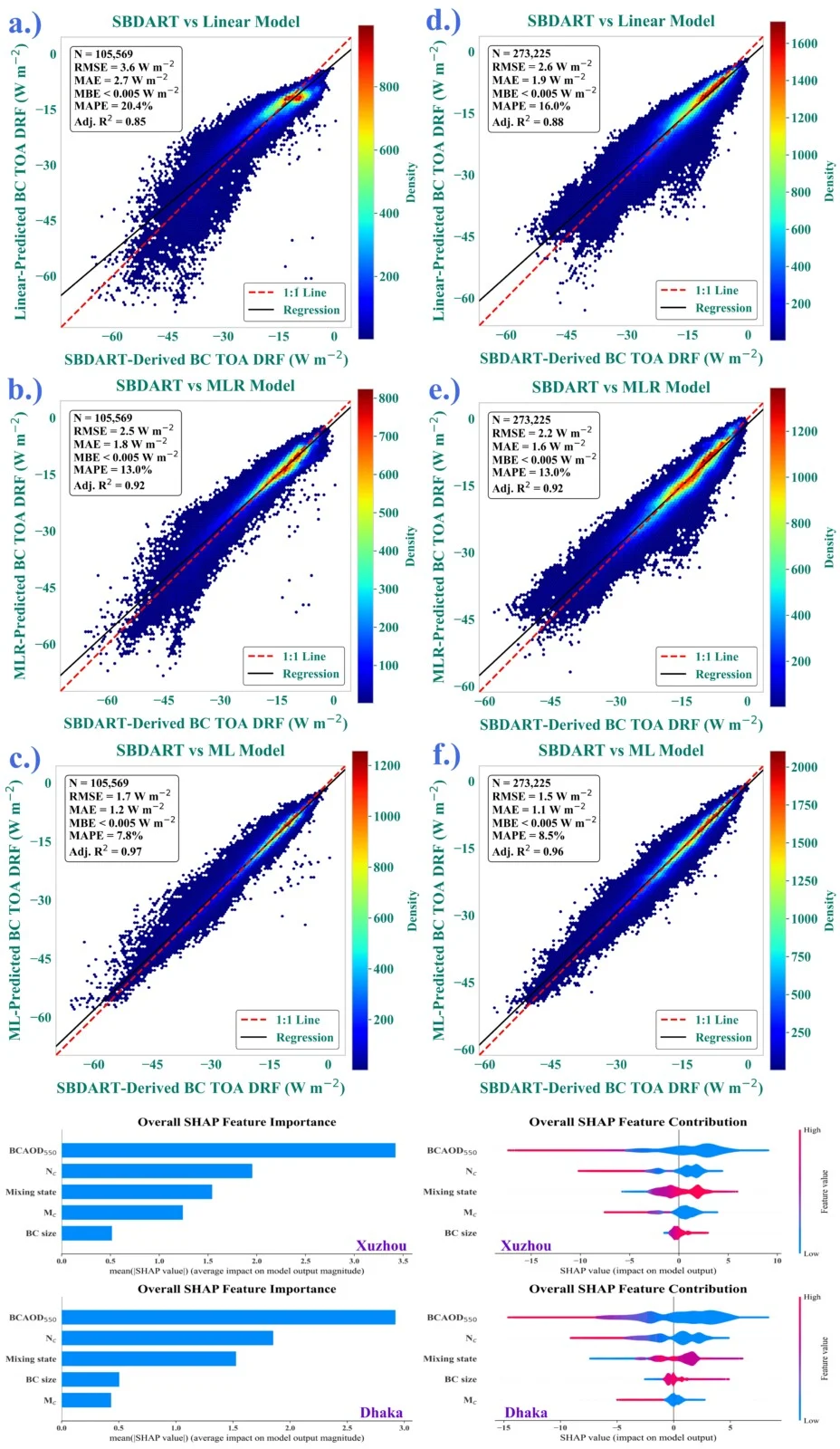
Figure 2. Performance evaluation and feature importance analysis of predictive models for Black Carbon (BC) Top-of-Atmosphere (TOA) Direct Radiative Forcing (DRF). Panels (a–c) show the performance for Xuzhou and panels (d–f) show the performance for Dhaka. Density scatter plots compare the physics-based SBDART model (x-axis) against three predictive approaches (y-axis): (a, d) a standard Linear Model, (b, e) a Multiple Linear Regression (MLR) model, and (c, f) a Machine Learning (ML) model. The dashed red line represents the perfect 1:1 agreement, while the solid black line shows the actual regression fit. Statistical metrics (R2, RMSE, MAE, MBE, MAPE) are provided in the inset boxes, with warmer colors indicating a higher density of data points. The bottom rows display the interpretability analysis for both regions using SHAP (SHapley Additive exPlanations). The horizontal bar charts (left) rank the overall importance of input features (e.g., BCAOD550, Nf, Mixing state, BC size) based on their average impact on the model’s output magnitude. The corresponding beeswarm plots (right) illustrate how high (red) or low (blue) values of these features specifically contribute to increasing or decreasing the predicted DRF.
Crossing Borders: Does the Model Transfer?
A critical test for any scientific tool is whether it works somewhere it was not explicitly designed for. We applied our combined machine learning model (ML**) trained only on data from Xuzhou and Dhaka to two completely new regions: Delhi, India, during the autumn crop residue burning season, and Mongu, Zambia, during the peak savanna fire season.
The transfer to Delhi worked reasonably well. This is perhaps not surprising: Delhi’s black carbon, while heavily influenced by agricultural burning, shares enough microphysical similarity with the urban environments the model was already trained.
Mongu, however, was a different story. Here the model systematically underestimated the radiative forcing by around 4 W m-2 on average, a large error. The root cause? Savanna fire black carbon is physically distinct from urban black carbon. The particles emitted by these remote fires tend to have smaller cores and thinner coatings, and occur in very high column abundance, all outside the range the model had previously seen.
This is not just a technical finding. It suggests that the current practice in global climate models, which often group all “biomass burning aerosols” into one generic category, may be fundamentally inadequate. The particles produced by savanna fires in Zambia behave differently from those produced by agricultural fires in India, which in turn behave differently from industrial urban soot in China. Once we re-trained the model with data from Mongu and Delhi, its accuracy drastically improved.
The result was a large improvement at the biomass burning sites, reducing the error at Mongu by 68%, while maintaining accuracy at the original urban sites. The lesson is that machine learning tools for regional black carbon forcing need to be built on a training dataset that adequately represents the diversity of aerosol types they will encounter.
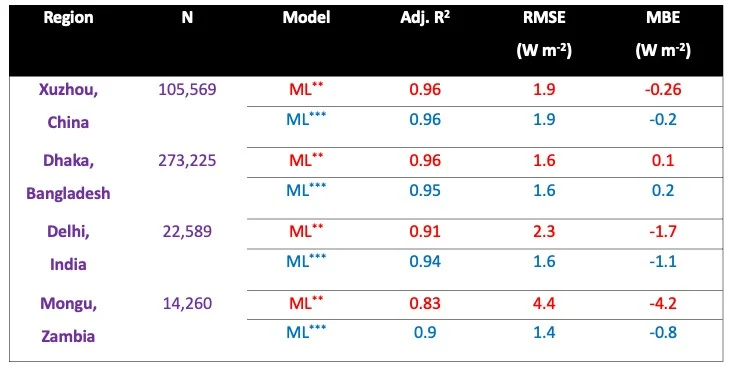
Figure 3. Statistical performance and transferability metrics of the machine learning surrogates across distinct regional aerosol regimes. The table contrasts the predictive capabilities of the baseline two-region combined model (ML**, trained only on Xuzhou and Dhaka data) against the expanded four-region model (ML***, incorporating Delhi and Mongu into the training domain). Performance is evaluated using, Adjusted Coefficient of Determination (Adj. R2), Root Mean Square Error (RMSE W m-2), and Mean Bias Error (MBE W m-2). Red values denote the baseline ML** framework, while blue values highlight the optimized ML*** framework. The comparative metrics demonstrate that expanding the training feature space dramatically mitigates the systematic underprediction bias observed over Mongu’s savanna-fire regime while maintaining or refining robust predictive accuracy within the native East and South Asian domains.
What This Means
Black carbon is a short-lived pollutant. Unlike carbon dioxide, which persists in the atmosphere for centuries, black carbon typically stays aloft for only one to two weeks. This means that reducing emissions can have immediate climate benefits, but only if we accurately know where the warming is happening and how large it is.
Our study provides a framework that is both physically rigorous and computationally practical: it uses satellite observations to constrain the microphysical state of particles, feeds these through detailed radiative calculations, and distils the results into an efficient and interpretable machine learning tool.
The broader message is one of irreducible regional specificity. The climate impact of black carbon cannot be read from a single number describing how much is in the air. It depends on what the particles look like, what they are coated with, how many of them there are, and where they sit in the atmospheric column. Understanding and ultimately mitigating black carbon’s role in climate change requires coming to terms with this complexity, not smoothing over it.
Read the full open-access study in Atmospheric, Chemistry and Physics here.
This post has been edited by the editorial board
References:
Tiwari, P., Cohen, J. B., Gao, H., Lu, L., Wang, J., Dubovik, O., and Qin, K.: Microphysical evolution and column loading drive nonlinear regional contrast in black carbon top-of-atmosphere forcing, Atmos. Chem. Phys., 26, 9149–9180, https://doi.org/10.5194/acp-26-9149-2026, 2026.



Vasu Singh
Excellent work and Well explained!!
Pravash Tiwari
Thanks 😊