Around 8,200 years ago, the climate of the Northern Hemisphere experienced an abrupt disturbance. In Greenland ice cores, the signal is unmistakable: a rapid drop in temperatures, followed by a gradual return to previous conditions. This episode, which lasted about 150 years, is known as the 8.2 ka event (“ka” meaning thousand years before 1950). It is often described as the most prominent climate perturbation of the Holocene (the last ~11,700 years).
The widely accepted explanation involves a massive release of freshwater from proglacial lakes (lakes formed at the margins of retreating ice sheets) in North America into the North Atlantic. This sudden freshwater input altered the isotopic composition (the ratio of different forms of oxygen atoms) of surface ocean waters and slowed the ocean circulation that transports heat northward, the Atlantic Meridional Overturning Circulation (AMOC). The result was rapid cooling over Greenland and surrounding regions. These changes were likely transmitted to Europe through atmospheric circulation, particularly via the westerly winds (i.e., strong prevailing winds blowing from west to east in the mid-latitudes).
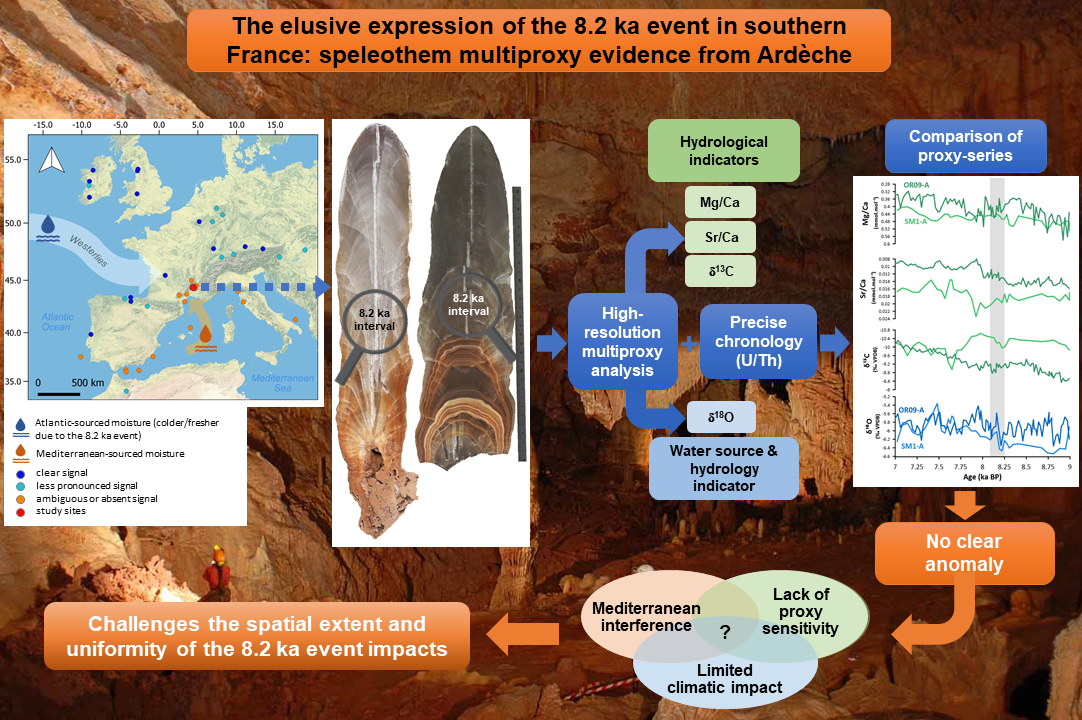
Yet one long-standing puzzle remains: the 8.2 ka event does not appear clearly everywhere. Along the European Atlantic margin (Iberian Peninsula, United Kingdom, western France), it is clearly recorded in multiple natural archives. Closer to the western Mediterranean, however, the signal often becomes weak, ambiguous… or absent.
Does this difference reflect a genuinely weaker climatic impact, or simply differences in how natural archives record climate signals?
In our study, published in Climate of the Past, we investigated this question using two high-resolution, multiproxy (multiple climate indicators) stalagmite records from southern France (Ardèche). We went in search for the 8.2 ka signal — but nothing stood out in our time series at this time. We therefore explored several possible explanations for this absence.
Reading climate in cave deposits
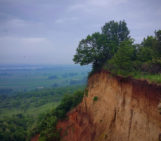
Our study is based on two stalagmites (mineral deposits that grow upward from cave floors) from neighboring caves in the Ardèche region of southeastern France: Saint-Marcel Cave and Aven d’Orgnac (Figure 1).
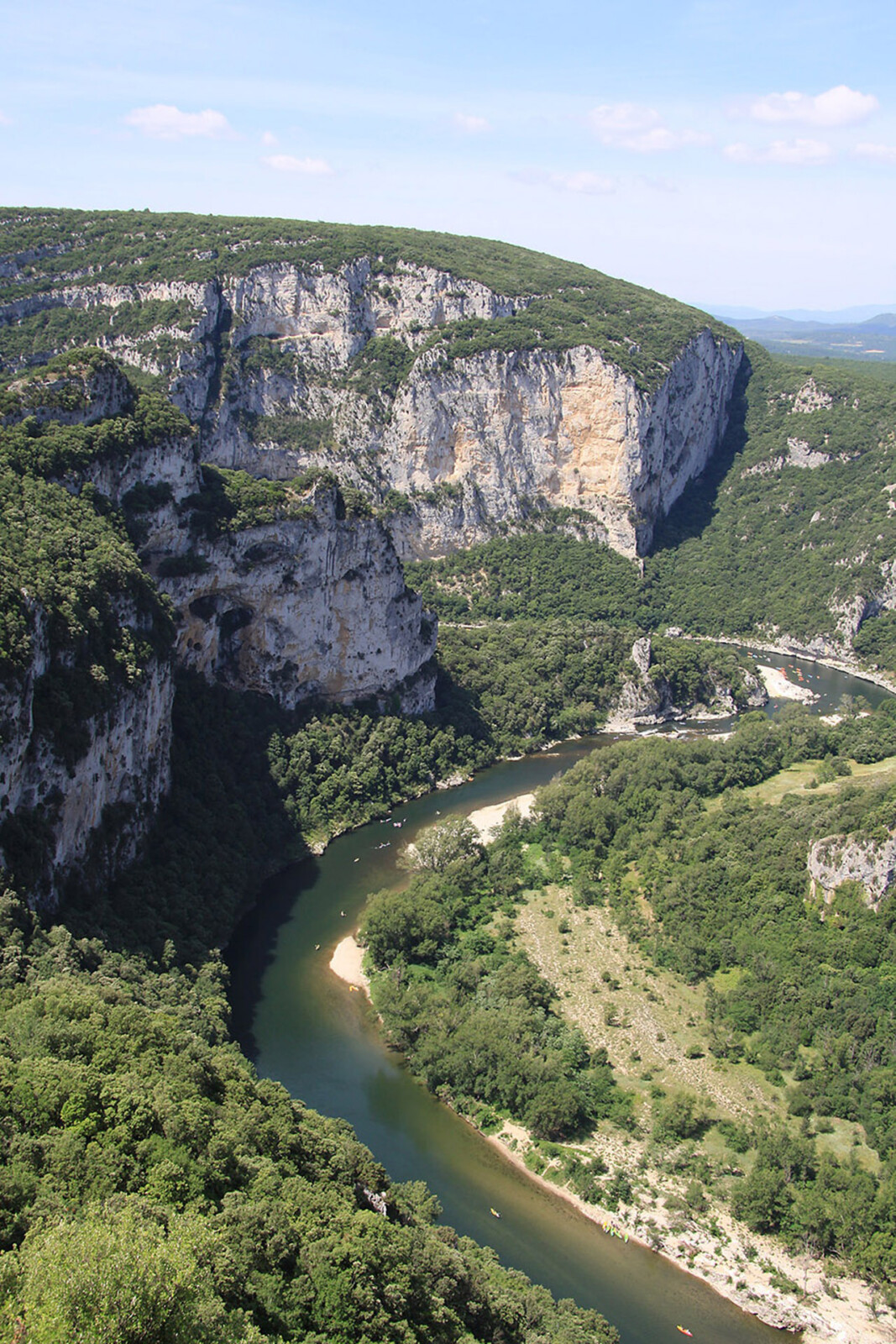
Figure1. View of the Ardèche Gorges. The studied stalagmites come from caves formed within the limestone plateau, incised by the Ardèche River. Photo by Wouter Tolenaars via PxHere (CC0 1.0 Universal Public Domain Dedication).
These caves are located on a limestone plateau roughly 100 km from the Mediterranean Sea. The region receives precipitation from both Atlantic air masses, transported by the westerlies, and Mediterranean systems, particularly during intense autumn rainfall events known locally as “Cévenol episodes.”
As rain water infiltrates the soil and hostrock above a cave, limestone is dissolved. When the infiltration water encounters a cavern in the hostrock, it drips from the ceiling onto the cave floor, where calcite layers are deposited to form stalagmites. The calcite preserves information about surface environmental conditions, including soil biological activity, hydrological balance, temperature, and the origin of precipitation.
By measuring a stalagmite’s geochemistry millimetre by millimetre along its growth axis, and determining its age using uranium-thorium methods, it is possible to reconstruct environmental and climatic variations at decadal to multi-decadal resolution. We applied this approach to the period between 11,500 and 5,500 years ago.
When we analyzed oxygen and carbon isotopes, as well as elemental ratios such as magnesium-to-calcium and strontium-to-calcium ratios, in both stalagmites, no clear disruption appeared around 8,200 years ago. Small variations are present, but they remain within the range of background fluctuations of the preceding millennium.
Why is the signal missing?
Several explanations are possible, and they are not mutually exclusive.
1. A genuinely limited climate impact in southern France
The 8.2 ka signal appears more strongly expressed in sites located near the North Atlantic Ocean and in mountainous regions. Local conditions at those sites likely enhance the clarity of the oxygen isotope signal transmitted by precipitation and/or amplify the climatic effects of the event.
Ardèche does not share these characteristics. Climate model simulations suggest that cooling in the Mediterranean region during the 8.2 ka event may have been modest (on the order of half a degree Celsius). Such a small change may have been insufficient to generate a significant response in our geochemical proxies.
Additionally, if the 8.2 ka event involved a southward shift of the westerly storm tracks, one might expect detectable hydrological changes. It is possible, however, that Ardèche remained under the influence of the westerlies despite a shift in their average trajectory. As a transitional zone, it may not have experienced significant hydrological change.
2. A Mediterranean “buffer” effect
A substantial proportion of precipitation in Ardèche originates from the Mediterranean. Because the 8.2 ka event was linked to changes in the North Atlantic, the Mediterranean component of cave recharge may have dampened or masked any oxygen isotope signal associated with altered Atlantic-sourced rainfall.
However, this explanation alone does not fully account for the absence of a clear climatic — particularly hydrological — signal in the other proxies we measured, such as carbon isotopes and trace elements.
3. An archive recording bias
A third explanation relates to the nature of climate archives themselves. Parameters such as temperature, and precipitation amount, source and seasonality, are not recorded directly or unambiguously. Instead, stalagmite proxies respond to a cascade of processes: infiltration through soils, residence time and mixing within the karst system (the network of fractures and cavities in limestone), water–rock interactions, and finally calcite precipitation inside the cave.
At each step, the original climate signal can be amplified or attenuated. A climate change may therefore go undetected if the proxies analyzed are not sensitive to the variable(s) that actually changed (for example, seasonality rather than annual precipitation totals).
In short, the absence of a clear signal does not necessarily mean the absence of climate change. It may also reflect how climate information is filtered and archived within the karst system.
Conclusion
By combining multiple proxies in two stalagmites from neighboring caves, our aim was to reduce the risk of biased interpretation by site-specific effects or by the limitations of a single proxy. In spite of this replicated high-resolution, well-dated multiproxy approach, the 8.2 ka event could not be identified in our speleothem records and thus its climatic impacts remain elusive in southern France.
This does not mean that the event had no impact in the region, or more broadly in the Mediterranean. Rather, it suggests that its expression was likely weaker, more seasonal, or more complex than is observed elsewhere.
Climate history is not uniform. It is shaped by regional contrasts and local filters, and is reconstructed from archives with different sensitivities. Understanding these nuances is essential not only for reconstructing past climate change, but also for anticipating how future perturbations may manifest differently across regions.
The 8.2 ka event — triggered by a massive freshwater input into the North Atlantic — resonates strongly with present-day concerns about the melting of the Greenland ice sheet and a potential weakening of the Atlantic Meridional Overturning Circulation. In this sense, it provides a valuable natural analogue for exploring how a future perturbation of ocean circulation might — or might not — translate into regional climate impacts across Europe.
This post has been edited by the editorial board.
References

Passelergue, M., Couchoud, I., Drysdale, R. N., Hellstrom, J., Hoffmann, D. L., and Greig, A.: The elusive 8.2 ka event in speleothems from southern France, Clim. Past, 22, 315–338, https://doi.org/10.5194/cp-22-315-2026, 2026.