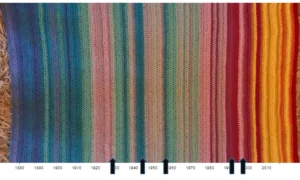

Why is our Earth not far hotter than it is? A deceptively simple question, with a crucial answer: our planet reflects a significant fraction of sunlight back into space. This reflectivity, known as albedo, determines how much solar energy is absorbed versus returned. On average, Earth reflects about 30 % of incoming sunlight, with the rest absorbed by the atmosphere and surface. Yet albedo is not uniform across the globe. It depends on two interacting features: the clouds above us and the surface beneath them. Clouds can block sunlight before it reaches the ground, while land, vegetation, snow, and ocean determine how much of the arriving sunlight is absorbed. Understanding this interplay offers a new way to think about a warming planet.
Clouds: Earth’s bright umbrella
Clouds are central to regulating Earth’s energy balance. Low clouds, especially marine cloud decks, reflect large amounts of sunlight and exert a cooling influence. High cirrus clouds allow sunlight through but impede the escape of infrared heat, with an opposite net effect. Clouds are not fixed in place. Atmospheric circulation shapes tropical rain belts and mid‑latitude storm tracks, shifting cloud regimes over time. Satellite observations (2001–2024) reveal that absorbed solar radiation has risen by ~0.45 W m-2 per decade, with ~0.37 W m-2 linked to contraction in the area coverage of highly reflective storm‑cloud systems (Tselioudis et al., 2025). This points to cloud‑regime change as a major driver of Earth’s declining reflectivity.
The surface: a dimmer mirror, but one humans can adjust
Surface reflectivity varies widely: snow reflects most sunlight; sand reflects a substantial fraction; in contrast, forests, dark soils, and oceans absorb sunlight. Human activities alter this balance. Vegetation change, farming practices, or even roof colour, can shift the absorption. These choices often carry dual consequences: planting trees sequesters carbon but darkens bright surfaces, creating opposing climate effects (Gottschalk et al., 2026). The balance depends on location, season, and timescale.
When the cloud cover changes, the surface matters differently
Imagine the same landscape under two skies (Figure 1, adapted from freepik). With thick, bright clouds, much sunlight is reflected before reaching the ground. With clearer skies, more sunlight reaches the surface, making its albedo far more influential. This coupling means cloud dynamics and land reflectivity cannot be treated as separate stories. They are interacting controls on Earth’s energy balance.
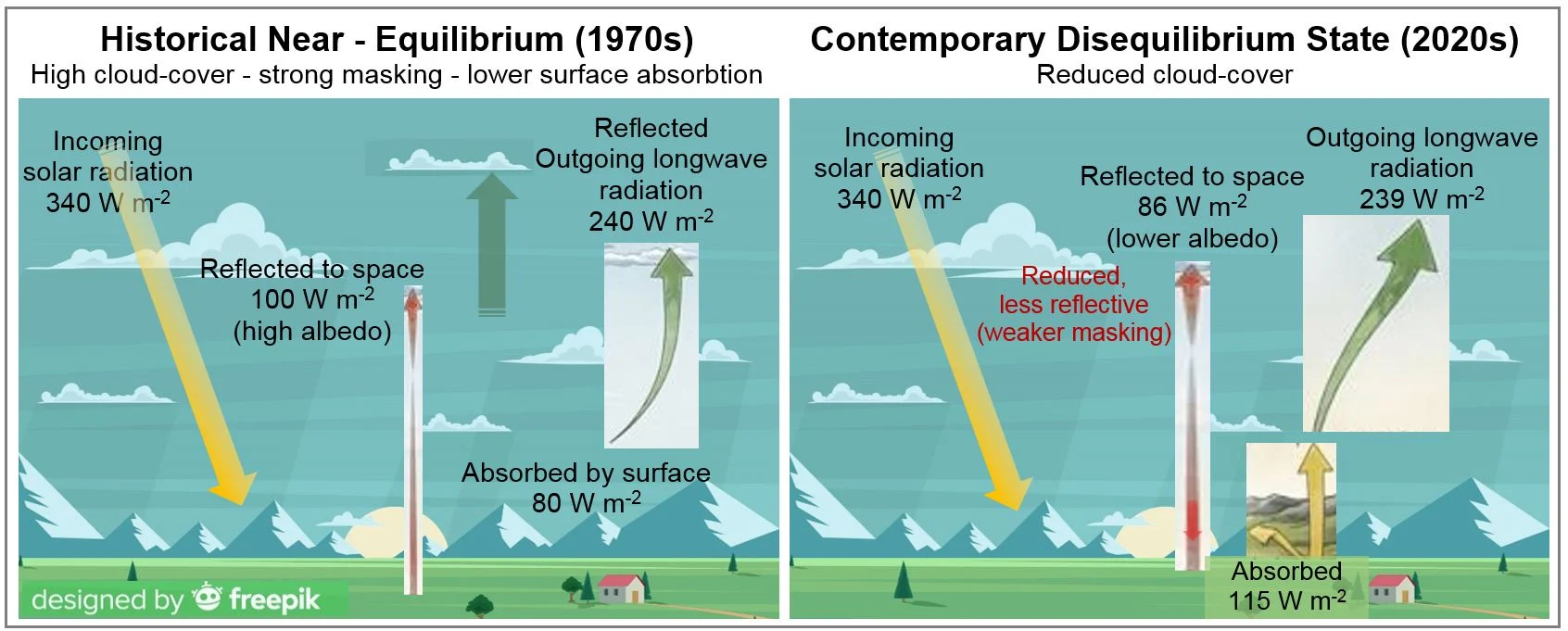
Figure 1: Fading cloud cover and surface absorption. Illustrative fluxes, not satellite retrievals. Under a thick low-cloud deck (left), much of the incoming sunlight is reflected before it reaches the ground. With thinner cloud cover (right), less sunlight is reflected by the atmosphere and more is absorbed at the surface. The point is the shift in leverage, not the exact round numbers. Adapted from freepik.
A longer view: the Mediterranean’s changing cloud cover
Satellite records span only decades, but historical reconstructions (drawing on historical sources such as weather diaries, ship logs, and agricultural recirds) extend the picture back centuries. In the Mediterranean, cloud cover has declined over centuries, with particularly low values in recent decades (Diodato et al., 2024, 2025). These records also reveal substantial multidecadal variability. Volcanic eruptions, solar cycles, and Atlantic circulation have all been proposed as influences, though their individual effects remain uncertain. The Mediterranean thus provides valuable context for understanding regional cloud changes, and whether its long‑term decline reflects mechanisms shared with global storm‑cloud contraction remains an open question.
How the puzzle arose
For some time, two lines of research pointed in apparently different directions. Satellite identified cloud contraction as the dominant driver of rising solar absorption: as reflective storm clouds retreat, more sunlight reaches Earth. Process‑based studies, meanwhile, emphasized surface reflectivity (the albedo of land and ocean), a key control on how much of that sunlight is ultimately absorbed. Both findings were correct, but incomplete on their own. The missing link is a dynamic one. When cloud cover contracts, the atmosphere casts less shadow over the surface below. This means surface reflectivity (previously masked by cloud) becomes a stronger influence on how much solar radiation is absorbed, especially in regions where skies are already relatively clear, such as the subtropics and the Mediterranean. Cloud retreat and surface albedo are not competing explanations: the first sets the stage for the second to matter more.
What this changes for climate thinking
Three consequences follow.
First, in clear‑sky regions, modest increases in surface reflectivity (reflective roofs, pavements, crop covers) can yield cooling effects far larger than the same measures would achieve under cloudy skies, where clouds already intercept much of the incoming sunlight. Second, Earth‑system models must better represent cloud–surface coupling to project energy imbalances accurately. Third, climate governance should integrate albedo management alongside carbon strategies, weighing both benefits together. In a world of shrinking cloud cover, the brightness of the ground is no longer a secondary detail. It is an active part of the radiation budget we can still influence.
Further reading
The full argument, including the satellite diagnostics, the long Mediterranean cloud reconstructions, and a proposed research agenda for monitoring, constraining and optimising surface reflectivity, is presented in our recent perspective in Environmental Research Letters.