
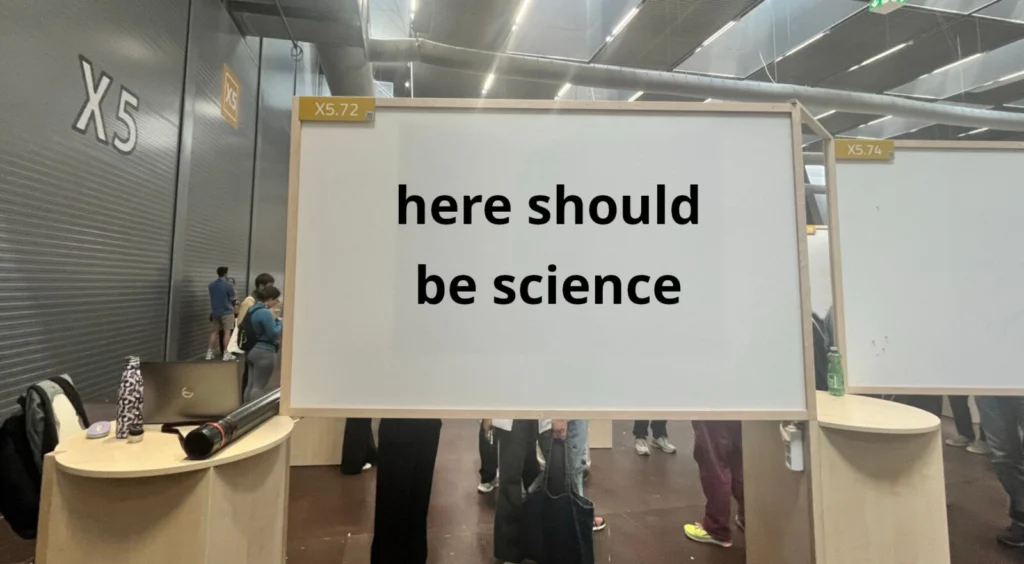
Do not get me wrong, EGUs General Assembly is a great conference and it’s a real pleasure to explore all the science on display, reconnect with colleagues from other institutes, cities and disciplines.
But, wandering the venue and seeing all the empty poster walls left a sad feeling. It’s not only singular gaps in an otherwise packed hall, it’s whole empty corridors and not only Monday morning or Friday afternoon. One might ask themselves, if that’s a symptom of how we value posters as a community?
Maybe authors do not bother to show up at all, if they got ‘just’ a poster instead of an oral talk? Standing in front of an empty wall, I bothered to check the online abstract: no indication of withdrawal. Is it not a thing to withdraw posters? (According to the official numbers, the retraction rates are similar for talks and posters, but maybe it’s not tracked (or marked) as rigorously for the latter ones.) Are ECSs discouraged to travel to a conference, where they did not get an oral? In a different occasion multiple posters were put down even before the attendance time slot ended. Maybe that was a personal conflict of schedule, but why not keep the poster on display for others to read during the non-attendance time? In fact, the guidelines emphasize the display time exceeding the attendance time.
I am a fan of posters!
As audience, I can flexibly decide on where to stroll by, where to read the key messages and where to stop, engage and discuss. I can easily identify posters I want to visit beforehand, even session hopping works like a breeze. Posters also benefit the presenters, they allow for detailed questions, in-depth discussion, feedback and development of ideas. There is just so much more time compared to the short talk time in oral sessions. Lastly, the poster spot serves as a contact point. At least during the attendance time people know where to find me out of the 20.000 other on-site participants (numbers from egu26.eu).
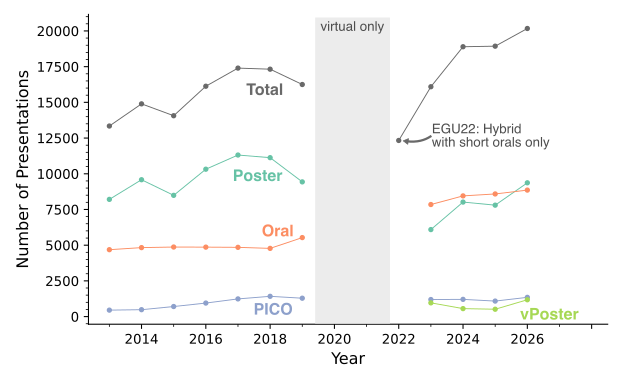
Development of presentation numbers per type. Data from 2013 to 2019 and 2022 to 2023 was retrieved from the respective website (eguYYYY.eu, eguYY.eu). Data since 2024 was provided by the EGU/Copernicus.
More of them, please
There is another problem, which poster are helping to address. Too many oral sessions with almost identical topics are happening in parallel.
As an individuum I have to decide on which of the equally interesting and relevant sessions I gift my attendance, as a community we are diluting audience for arduously prepared contributions.
At the same time poster walls remain empty. A look into the statistics after the conference actually supports that impression. Up to 2019, usually the number of posters was double that of talks. Since 2024 it’s almost equal shares. Shifting the balance (back) from orals to posters will help to ease the scheduling conflicts. And if it’s about broadcasting your message: Why not having condensed poster pitches at each oral session? – Oh wait, maybe there is already an (equally undervalued) format for that: the PICOs.
For sure there are more ideas to advance the format of the general assembly, especially the poster sessions. To resume some of the threads from coffee break conversations: maybe the posters could be printed and displayed, even if the author cannot attend; or to improve the virtual poster presentations by having an open videocall next to the poster. Let’s have that discussion, but most importantly: care about your posters, embrace the poster sessions, make time for them. They are worth it!
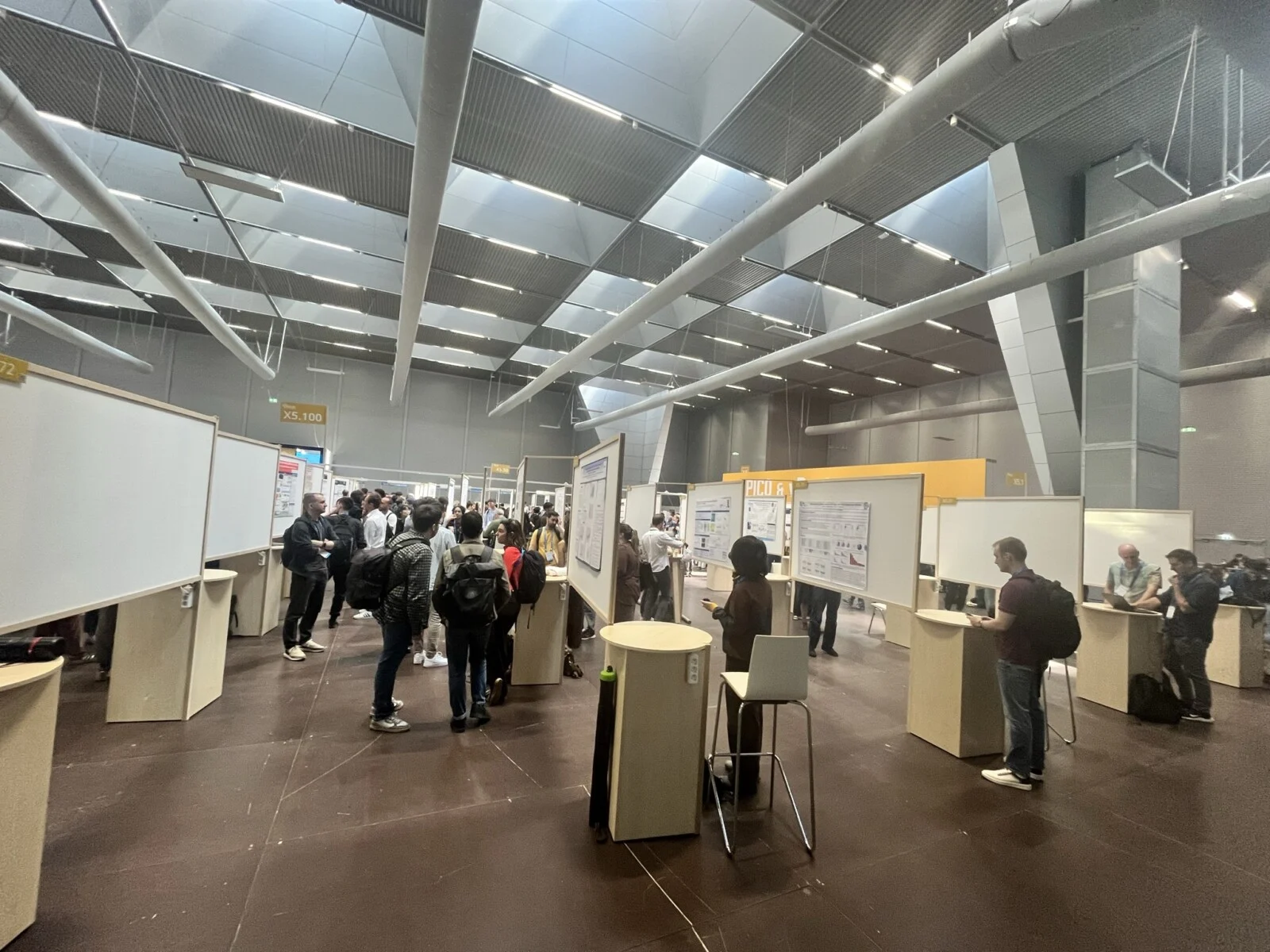
Photo taken by Roxana Cremer during EGU26 in Hall X5.


George Huffman
Martin – I am also a fan of posters. Even before orals were chopped to 10 minutes, discussion was sparse and frequently bypassed due to time, and posters are where you get to actually engage in science with the author(s). I like the idea of poster introductions, but the issue with PICO sessions is that a) they are divorced, both in location and in the program from the oral session into which they should be integrated, and b) the electronic format of the subsequent poster is still a work in progress; I find it hard to hover in the background and just absorb the flow before you commit to a discussion with the author. In other venues some of us have been trying “30-second one-slide summary” introductions to all the posters as part of the companion oral session, sort of a pico-PICO that points to the paper (fabric, etc.) posters and gives the audience a head start on figuring out what to view.
There is indeed a strong institutional attitude that orals have higher standing, and I have to confess that I occasionally suffer from from “just a poster” syndrome. It’s an interesting question for EGU (AGU, AMS, …) how to handle the growth in participants, and I’d suggest (to echo you) that parallel similar oral sessions are not the answer.
One practical comment I’ll make is that putting a poster session on both sides of an aisle makes it easier to find the session, but if it’s well-attended, the mob scene can get in the way of viewing and discussion. Putting active sessions on only one side of an aisle would make traffic flow and human interaction a lot easier.
Paul Ockenfuß
Very interesting post, Martin! I agree that posters are undervalued and would even say that they are generally superior to talks. The most common argument I always hear when making this statement is the following:
‘If I get a talk at the conference, I’ll reach 100+ people; with a poster in a poster session, at most 10! Therefore, talks have a much greater range!’
That’s true. That’s likely also the main reason why posters are regarded as second-class contributions. But that has nothing to do with posters at all; it’s down to how we structure conferences. This becomes clearest when we shift our perspective from the ‘sender’ to the ‘receiver’ side.
If I attend a 1.5-hour oral session, I’ll hear about six talks. If I attend a 1.5-hour poster session, I can also discuss about six posters in detail. So there’s absolutely no difference. Where, then, does the apparent asymmetry come from?
This is because poster sessions are too short. At a conference consisting solely of talks, my talk gives me about 15 minutes of ‘receiving time’ with each participant (assuming I get 15 minutes of ‘broadcast time’ and all participants attend my 15-minute talk); for the rest of the week, I am the one receiving. If we were to organise a conference consisting solely of poster sessions, I could instead ‘broadcast’ for half the week, though I would only reach one participant at a time. I would spend the other half of the week ‘receiving’. So, the bottom line is that at a consequently organised poster conference, I reach 50% of the people I would reach at a purely talk-based conference. Not bad at all. That ratio gets even better, if I assume that more than one person at a time is able to visit my poster. And in return, I can then address that 50%+ people personally, engage with them directly, and so on. I believe this would make the poster conference superior to the traditional conference.