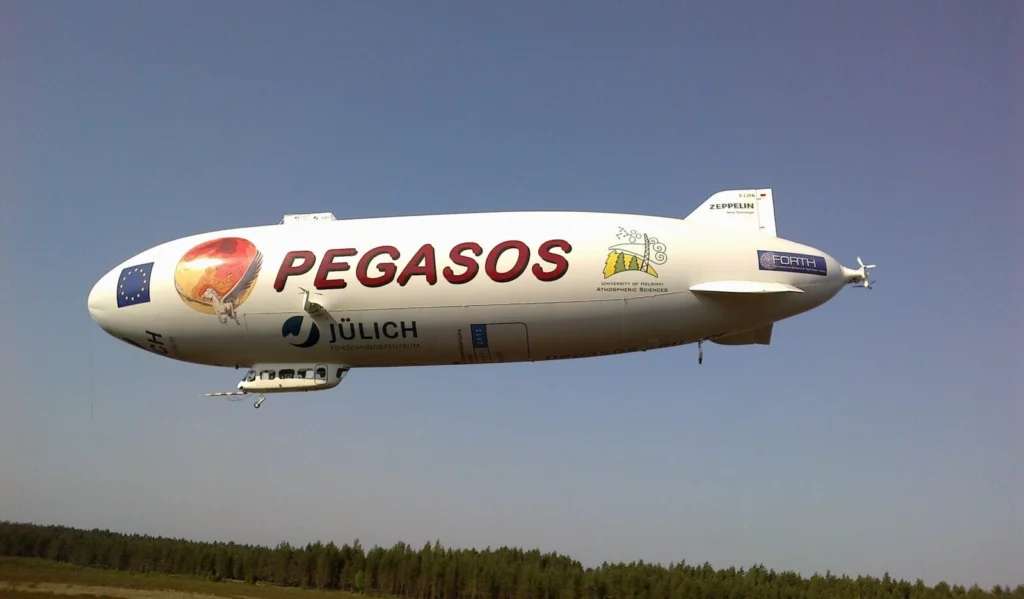
There is a slow-moving silver shape drifting over the forests and cities of North Rhine-Westphalia. From the ground, it looks almost ceremonial — a Zeppelin NT gliding through the air as though time had reversed by a century. Inside, sensors are humming. And Eva Pfannerstill is watching the data appear.
She is not there to admire the view, though the Rhine-Ruhr region from the air is something. She is there because a Zeppelin, of all things, happens to be one of the most perfectly suited platforms ever devised for measuring what forests and cities exhale into the sky.
A Chemist by Curiosity
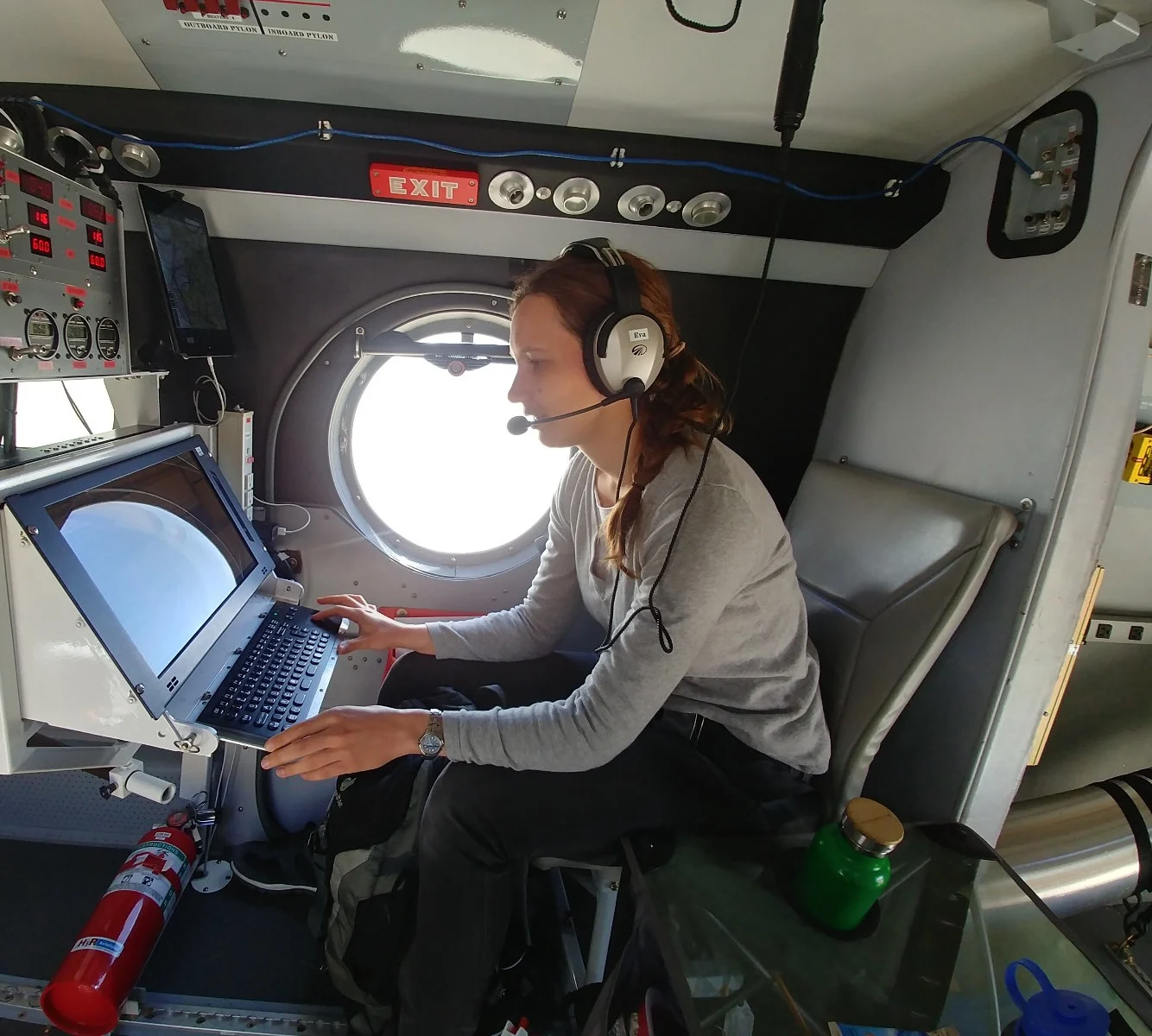
Eva Pfannerstill in a research aircraft. Photo provided by Robin Weber.
Eva Pfannerstill studied Chemistry at Friedrich-Schiller-Universität Jena. She spent an exchange semester at the Université de Montréal during her bachelor’s, and split her master’s in Chemical Biology between Jena and the NIOZ Royal Netherlands Institute for Sea Research. The sea, the lab, the open air: already the pattern was forming; science that could not sit still indoors.
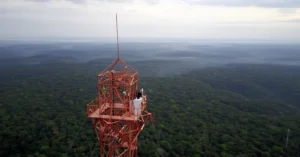
Her PhD followed at the Max Planck Institute for Chemistry in Mainz, where she focused on atmospheric reactivity in the Amazon rainforest. The Amazon is, in atmospheric chemistry terms, something like the beating heart of the planet. The forests there exhale vast quantities of volatile organic compounds (VOCs) molecules that are invisible, reactive, and consequential. They shape ozone levels, they seed clouds, they communicate throughout the forest.
Her pioneering work there included deploying proton transfer reaction mass spectrometry instruments during challenging field campaigns, where she succeeded in closing the OH reactivity budget and elucidating the impacts of El Niño events on tropical forest chemistry.
From the Arabian Gulf to Los Angeles
She did not stay in the jungle. Beyond her achievements in terrestrial environments, Pfannerstill led shipborne campaigns in the Arabian Gulf, assessing OH reactivity and ozone formation in regions affected by anthropogenic emissions. A striking contrast to the pristine rainforest canopy, and a deliberate one. Understanding how the atmosphere behaves at its extremes, both the wildest and the most human-altered, is how you begin to understand the middle ground where most people actually live.
Then came California. Until fall 2023, she was a Feodor Lynen Postdoctoral Fellow at the University of California, Berkeley, using aircraft-based measurements to map emissions. These years produced some of her most widely noticed work. Flying instruments over Los Angeles, she and her colleagues mapped the city’s chemical fingerprint from the air. Focusing on what is being actively emitted by the city into the atmosphere , in real time, at the scale of entire neighborhoods, excluding secondary processes and transport in the atmosphere. Her 2024 paper showed that temperature-dependent emissions dominate aerosol and ozone formation in Los Angeles. A finding with immediate implications for air quality policy in a warming world.
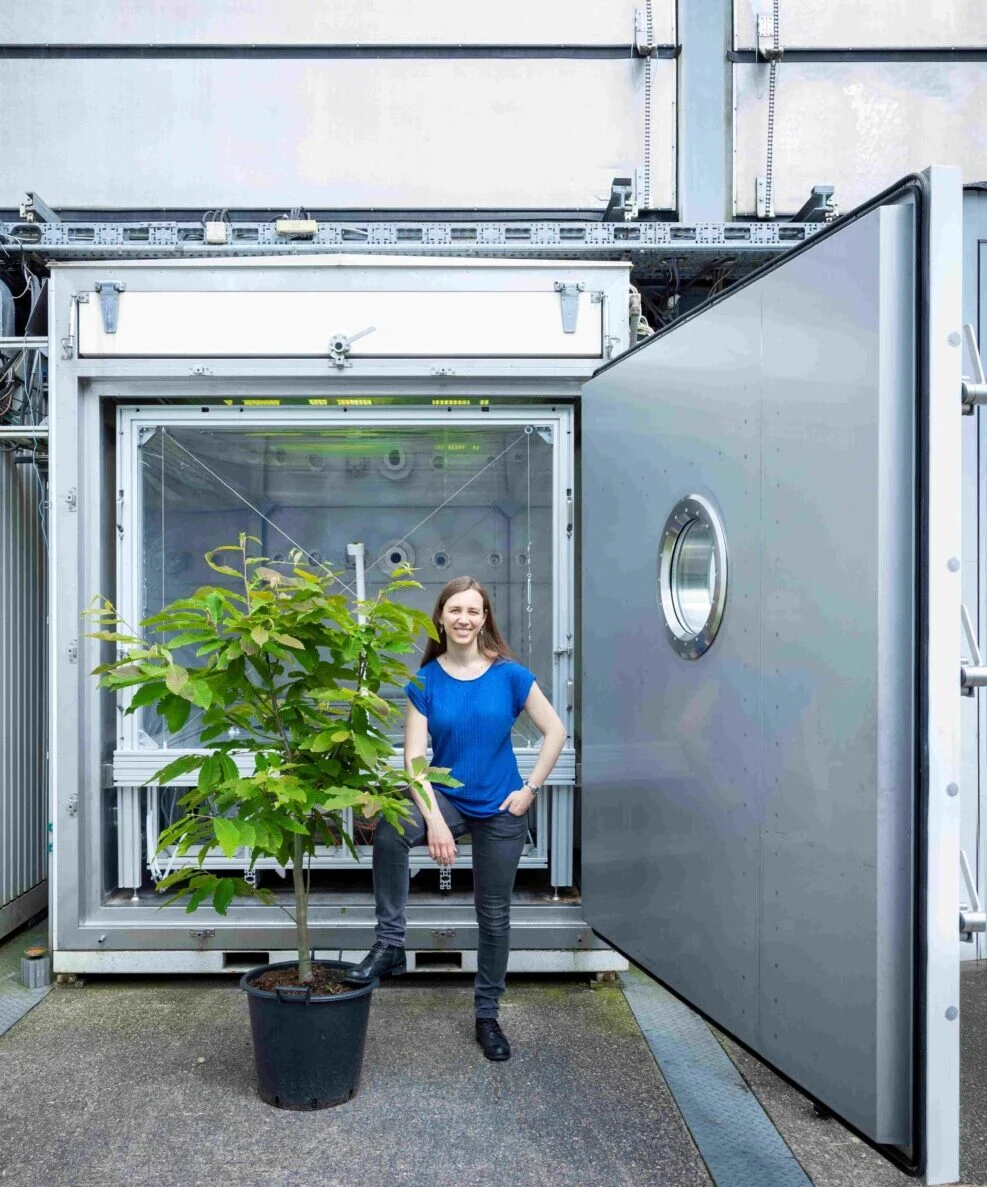
Photo provided by Sascha Kreklau.
As temperatures rise, the vegetation and human activity below breathe out more; and what they breathe out shapes the air that people breathe in.
Home to Jülich, and Up into the Sky
Since March 2024, she holds a W1 Junior Professorship at the University of Cologne under the Jülich Model—a tenure-track position—and since October 2024 she leads a Helmholtz Investigator Group at the Forschungszentrum Jülich. The Helmholtz Investigator Group is a competitive program designed to give exceptional early-career researchers the independence to build something genuinely their own. For Pfannerstill, that something involves a Zeppelin.
Her group is investigating how the increased frequency and intensity of drought, heat, and herbivory stress caused by global warming changes the composition and amount of gases that plants emit — and what that means for the atmosphere above our heads. The direction of that change is not obvious in advance. Stressed trees behave differently from healthy ones; they emit different molecules, in different proportions, and those differences cascade through atmospheric chemistry in ways that current models cannot yet reliably predict.
A Zeppelin is an ideal platform for this kind of research. It can fly low and slowly, carrying a lot of instrumentation just like a research plane, which makes it highly useful for airborne eddy covariance flux measurements: direct, real-time measurements of what the landscape below is actually emitting. You are not sampling the accumulated history of the air. You are catching the molecules as they leave.
During the first test flight in late 2024, Pfannerstill and her colleague Dr. Georgios Gkatzelis were on board to check the instruments. Among other things, they aim to investigate how household chemicals contribute to air pollution in the cities of the Rhine-Ruhr metropolitan region, and to compare the Zeppelin’s flux measurements with long-term measurements from weather towers. The pilots performed various maneuvers — rapid ascents and descents, pitch adjustments, circling — to test whether the airship’s own movements affect the data.
The major measurement campaigns are planned to start in 2026 and 2028, with the Zeppelin flying over North Rhine-Westphalia — and possibly also over Belgium and the Netherlands. The forests of NRW, the industrial Ruhr, the Rhine corridor: all of it will be read, chemically, from the air.

Photo by Oles Pata.
She is thirty-something, leading her own group, flying a Zeppelin over one of the most densely populated regions of Europe, and asking what the air above it is trying to tell us. It is, all things considered, a reasonable place to have ended up — for someone who could never quite stay indoors.
Dr. Eva Pfannerstill leads the Young Investigator Group “Biogenic Emissions and Air Quality Impacts” at Forschungszentrum Jülich and is a Junior Professor at the University of Cologne. Her group is recruiting — including a PhD position focused on Zeppelin-based airborne measurements.