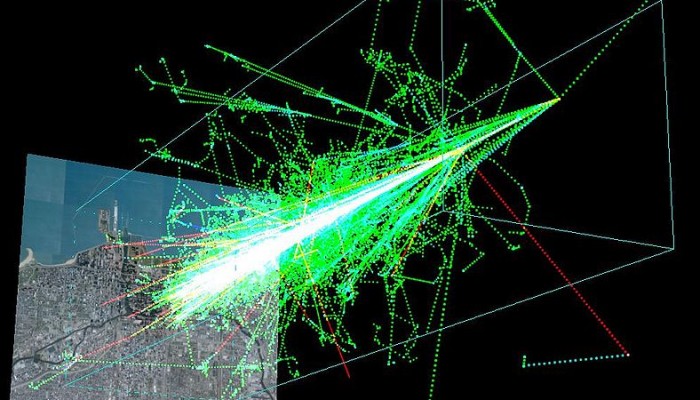
This post is kind of a continuation of Laura Roberts excellent guest post on the Solar Storms and the Earth’s Magnetic field. However, this is a bit of a different spin on it. I am not writing about what get’s kept out, but rather what slips by the shield and gets in. Of course, I am speaking about cosmic rays and the wonderfully useful isotopes they produce that rain down upon us. Yes ...[Read More]
GeoLog
Sci Comm at the 2013 General Assembly
Blogging GeoLog will be updated regularly throughout the General Assembly, highlighting some of the meeting’s most interesting sessions, workshops and lectures as well as featuring interviews with scientists attending the Assembly. Writers from the EGU Blog Network will also be posting about interesting research and sessions during the Assembly, so you can catch up on any sessions you’ve missed an ...[Read More]
GeoLog
PICO Presentations Explained
So you’re presenting with PICO? What does that mean exactly? Presenting Interactive COntent, or PICO, sessions highlight the essence of a particular research area – just enough to get excited about a topic without being overloaded with information. If a particular session piques your interest, you can look over the presentation in more detail at your leisure – straight after the session or at any ...[Read More]
Geology for Global Development
GfGD-CAFOD Placements – Successful Candidates
A while ago we advertised the opportunity to undertake a placement, organised by GfGD, with the international NGO CAFOD. These one week placements are designed to give geoscience students a preliminary, but important, insight into the development sector. They allow students to consider the role that geology already plays, and ways in which it could be further integrated to ensure effective and sus ...[Read More]
GeoLog
Imaggeo on Mondays: Alas, allases are abound!
The Lena River flows throughout Russia from its source in the Baikal Mountains out into the Arctic Ocean, where the delta’s landscape is dominated by ice-rich Yedoma and thermokarst lakes. Thermokarst lakes have been identified as a source of carbon release to the atmosphere and Yedoma-like lake sediments are known to release more methane than any other sediment due to their incredibly high carbon ...[Read More]
GeoSphere
Photo of the Week #27 – Someone’s had a few too many
The photo of the week came to me this morning on my walk to school. Yes, it is now warm enough in Ottawa to comfortably walk to school! All the melting ice and the slight smell of spring and undergrad panic in the air got me thinking about permafrost degradation and nights out during my undergrad. An odd combination of thoughts, I grant you. Well, what do these two very separate things have in com ...[Read More]
GeoLog
Photo exhibit at EGU 2013: The Andean Geotrail
The enormous space and time scales that Geology covers makes teaching it a challenge, one best overcome by field experience, but it’s a rare thing for a school to be able to explore Geological wonders on the other side of the world. So what if someone brought it to you? Olivier Galland (who we had the chance to interview in December), together with Caroline Sassier, set up an educational project ( ...[Read More]
Geology for Global Development
Interview: Jeannie Scott on Sharing Your Research
Jeannie Scott did her PhD at the University of Oxford on the Santiago volcano in Guatemala. She made some interesting findings, and has spent time translating her research into a format that is accessible to people with no scientific background. She also explains what her research findings mean for the people that live and work close to the volcano. Jeannie has produced both a poster and a booklet ...[Read More]
Green Tea and Velociraptors
Slicing up dinosaur embryos. For science.
Birds are living, breathing, tweeting dinosaurs. That is scientific knowledge backed up by overwhelming evidence, but the evidence basis for it grows strong all the time. We know that they are related from a host of morphological evidence from the last 150 million years or so. Our understanding of the origins of feathers and flight are developing too – each new finding is a piece that slots ...[Read More]
GeoLog
Geosciences Column: Tag – you’re it! Chasing atmospheric tracers
I’ve been ruminating over the idea for this post for some time now; since last October in fact, when the EGU Twitter Journal Club discussed a paper about tagging (You can find the Storify for the discussion here). Not tagging as in the playground favourite, but the idea of keeping track of certain molecules in your chemical transport model, so you can follow them as they move through the atm ...[Read More]