Usually our blog posts are about fancy minerals and cool science, but today we want to use this platform to introduce you to our new GMPV ECS team for the term 2020/2021! First of all, what exactly are we doing here in the GMPV ECS team and why are we even existing?! – Well, the …[Read More]
Latest posts
GeoLog
Imaggeo On Monday: Sunset in the Arabian basin
We know the topography of the moon better than the Earth’s seafloor, so we need to keep studying the ocean, and, for me, going to sea is the best way. Only twenty percent of the seafloor is already mapped (see the Seabed 2030 Project), leaving eighty percent of our ocean unmapped, unobserved, and unexplored. …[Read More]
GeoLog
GeoTalk: Hali Felt, author of ‘Soundings: The Story of the Remarkable Woman Who Mapped the Ocean Floor’
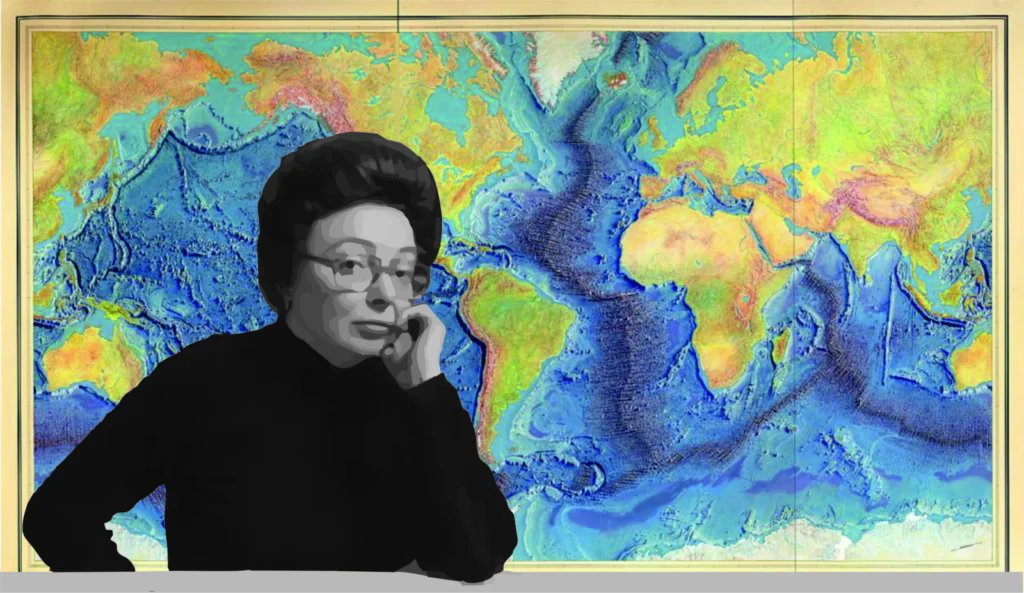
This month for GeoTalk, as we approach the centennial of Marie Tharp’s birth next week, we were lucky enough to speak with the author of her biography ‘Soundings: The Story of the Remarkable Woman Who Mapped the Ocean Floor‘; Hali Felt. Hali has a Master of Fine Arts degree from the University of Iowa and …[Read More]
Geodynamics
The Sassy Scientist – Of Codes And Cares
On the matter of code choices, Alexa could have asked Siri, but instead chose an old-fashioned medium of enquiry compatible across all operating systems and wrote in to ask: Should I perform my research with an in-house code, an open source code or a commercial code? Dear Alexa, As a famous novel does not quite …[Read More]
Geodynamics
What is FAIR for Geodynamics?
A very important part of science, which is getting more and more attention, is how to share and manage our data. This week, Adina E. Pusok, Postdoctoral Researcher at the Department of Earth Sciences, University of Oxford, shares thoughts and tips on how to make our science fairer. So, what is FAIR for Geodynamics? This …[Read More]
Nonlinear Processes in Geosciences
NPG Paper of the Month: “Correcting for model changes in statistical postprocessing – an approach based on response theory”
This month the NPG Paper of the Month award is achieved by Jonathan Deameyer and Stéphane Vannitsem for their paper “Correcting for model changes in statistical postprocessing – an approach based on response theory” (https://doi.org/10.5194/npg-27-307-2020). Jonathan did his PhD in statistical mechanics at the Université Libre de Bruxelles under the supervision of Pierre Gaspard and …[Read More]
GeoLog
Imaggeo On Monday: Watercolors- Nature’s talent
The photo was taken from the International Space Station (ISS), approx. 400 km above the Earth, in the educational project administered by NASA: Sally Ride EarthKAM, Mission 59, November 2017. The image was requested by a team of students from my college, coordinated by me. Even though we weren’t there, on ISS, to trigger the …[Read More]
Natural Hazards
In between Natural Hazards and Heritage, interview to Maria Bostenaru
In today’s interview, we talk with Dr Maria Bostenaru. Maria is an architecture engineer interested in the complex relationship between urban areas, natural hazards, and heritage. She tells us how she thinks that involving more humanities, which include, for example, the study of languages, literature, archaeology, together with information technology solutions, may result in new …[Read More]
Climate: Past, Present & Future
Glacier retreat and music
In virtually all parts of the world glaciers are retreating, and this is often considered to be one of the clearest signs of global warming (e.g. Leclercq and J Oerlemans, 2011). Glaciers started to shrink in the second half of the 19th century and, apart from some minor interruptions, this development has continued until today. …[Read More]
GeoLog
The benefits of online writing retreats in these weird times
The world shut down due to COVID-19, but PhDs did not. During these unfamiliar times, most PhD students have found themselves working from home trying more than ever to write as much as possible. Over the past few of months, I have led several online writing retreats in collaboration with doctoral research schools and universities …[Read More]