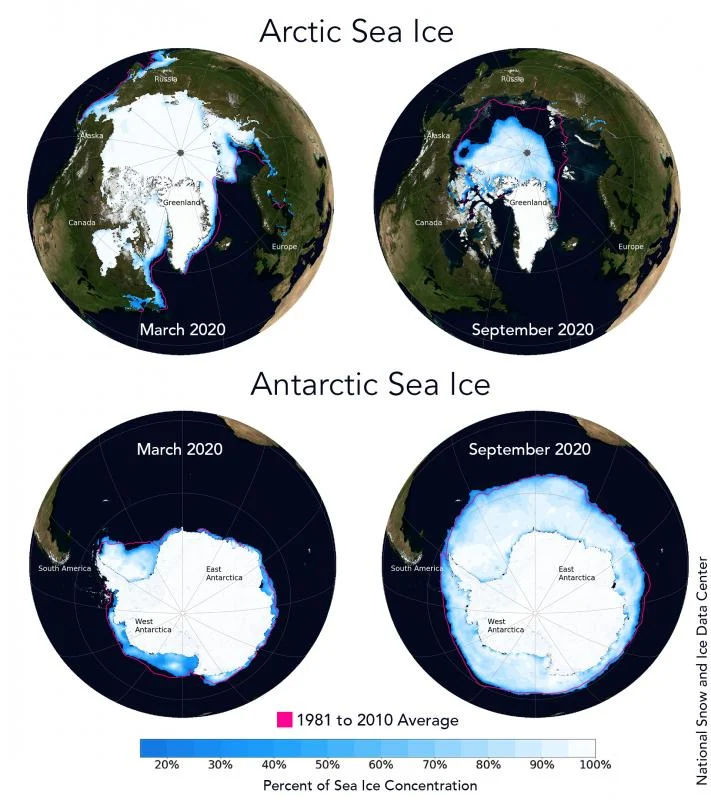
Eivind Straume a Postdoctoral fellow at the Department of Geological Sciences within the Jackson School of Geosciences explores how the opening and closing ocean gateways have influenced the Earth’s climate in the past. Changes in Earth’s geography due to tectonic plate motions and mantle convection influence climate evolution on geological timescales. Over millions of years, continen ...[Read More]
If you didn't find what you was looking for try searching again.
GeoLog
The EGU22 Mentoring Program could be just what your career needs
The countdown to EGU22 has officially begun! If you are participating in the General Assembly this year and want to support and connect with other researchers in or outside of your field, we encourage you to sign up for the EGU22 Mentoring Program. The program matches experienced conference participants (mentors) with those who have not previously participated in a large geoscience conference (men ...[Read More]
GeoLog
Discover the BASE of academic writing to become a better writer
Has anyone ever had a chat with you about your writing? Or their writing for that matter – and I don’t mean about their last publication but their writing process? Writing and in particular academic writing is one of those skills that people assume everyone has and picks up somehow by doing it – without ever really being properly shown how to write. I definitely haven’t been to any writing worksho ...[Read More]
Seismology
SENSORChat: Go with the UPFLOW – detecting powerful motions deep within Earth’s interior
“SENSOR” – stands for Seismological Experiments, Network Systems, Observations and Recovery In this blog series, curated by Chiara Civiero, we share news about recent or upcoming seismic experiments around the globe! Could you explain what your project is about? While downward mantle flow (subduction) is well constrained, a grand challenge in Earth sciences is to understand mid-plate, deep upward ...[Read More]
Cryospheric Sciences
Time & space of glaciers
People usually perceive space and time, comparing them to their own life Words such as “forever” and “until the end” appear in fiction But how can we imagine the space and time of the mountain glaciers whose existence goes beyond our usual perception? And why is it so important for us now? With this post, researcher Alexandra Rogozhina shares her thoughts on these suggestive topics. Mostly, ...[Read More]
GeoLog
EGUsphere preprints: moderators celebrate more opportunities and increased flexibility
Preprints are in the spotlight this month at EGU, with the newest feature of our Open Access repository EGUsphere now officially available! As we observe this new milestone, EGU is aware of the important role that its moderators will play in this process. This week, four EGUsphere moderators tell us what they look forward to in their new role and encourage other geoscientists to join in the experi ...[Read More]
WaterUnderground
AGU Hydrology Students talk JEDI, awards, and recognizing student success at AGU townhall
By David Litwin At the American Geophysical Union Fall Meeting in December 2021, the AGU Hydrology Section Student Subcommittee (H3S) convened a townhall “Coming Together After Being Apart…” where the AGU Hydrology Section leadership were available for questions from the community, updates on current activities, and plans for future section initiatives. The conversation seemed important to share w ...[Read More]
Geodynamics
The Sassy Scientist – The Nonsense Of Open Research
Enzo submitted his manuscript for review at one of those well-known, Earth science-niche journals. However, shortly thereafter he received an email by his editor that it was rejected. Reason being that not enough research was added in the manuscript. Furious, he bellows: When is my research open enough to be published? Dear Enzo, I know, right? It seems that over the past few years the need to giv ...[Read More]
Cryospheric Sciences
A place called home?
Welcome to Kongsfjorden in Svalbard. The front of the glaciers terminating into the sea is an ecological hotspot, home to many marine animals, like kittiwakes, who love to hunt here. They feed on small fish and shrimp, which at marine-terminating glacier fronts are brought to the surface by upwelling glacial meltwater. Retreating glaciers lose their contact with the ocean As the planet warms these ...[Read More]
Geodynamics
GeoLchat: el experimento de divulgación científica bilingüe hecho por tres geocientíficas colombianas
GeoLchat: A Bilingual Science Communication Experiment of Three Colombian Geoscientists Una de las cosas más importantes que se les enseña en la academia a los estudiantes de ciencia alrededor del mundo es aprender a usar el lenguaje científico. Sin embargo, nunca se les enseña a hablar acerca de ciencia en un lenguaje sencillo, y tampoco a comunicar y divulgar sus investigaciones en lenguajes dif ...[Read More]