Mesopotamia, an area rich in history and considered as the cradle of civilisation, with the first populations establishing themselves in the region some 6000 years ago,lies between two great rivers: the Euphrates and the Tigris. The ancient territory spans areas of modern-day Iraq, Kuwait, the northeastern section of Syria and small sections of southeastern Turkey and southwestern Iran. The histor ...[Read More]
If you didn't find what you was looking for try searching again.
GeoLog
Geosciences Column: The calamity of eruptions, or an eruption of benefits?
So here is a question: why would anyone want to live in the vicinity of an active volcano? The risks are well known, with hazards arising from lava flows, lahars, ash falls, debris avalanches, and pyroclastic density currents, with many often having deadly consequences. But despite the danger, more than half a billion people live in the direct vicinity of volcanoes. Could it be that communities pr ...[Read More]
GeoLog
The EGU Network blogs are looking for guest contributions
Are you a budding science writer, or want to try your hand at science communication? You might just be the person for our EGU network bloggers! A number of our network blogs would like to give their pages a bit of a boost and are seeking guest bloggers to contribute new, informative and engaging posts on an ad hoc basis. If you’ve recently been thinking about trying your hand at blogging, but aren ...[Read More]
GeoLog
Imaggeo on Mondays: The warming
Events of meteorological significance, such as thunderstorms, hurricanes, cyclones, jet streams and global-scale circulations can be described by a general term: atmospheric dynamics. When it comes to it, atmospheric dynamics deals with nothing more than air, which, in truth, is very difficult to directly observe, (with the exception of clouds and precipitation). This makes the study of atmospheri ...[Read More]
GeoLog
GeoEd: EGU General Assembly and GIFT 2015
The most recent issue (Winter/Spring 2015) of the Teachers Clearinghouse for Science and Society Education Newsletter includes a piece, by Earth Science Correspondent, Michael J. Passow, on the 2015 General Assembly and the GIFT (Geosciences Information For Teachers) Workshop. Passow gives an account of this year’s workshop, on the topic of mineral resources, and outlines the participating teacher ...[Read More]
GeoLog
Imaggeo on Mondays: Mountains, rivers and agriculture
This week’s Imaggeo on Mondays image blends a range of geoscience disciplines. The post, by Irene Marzolff, a researcher at Johann Wolfgang Goethe-Universitaet, explores how the mountains, rivers and soils of the High Atlas in Morocco are intrinsically linked to the agriculture of the region. The image was taken in the southern slopes of the Western High Atlas, north of the city of Taroudann ...[Read More]
GeoLog
GeoTalk: Deciphering the mysteries of the Mediterranean Sea with Katrin Schroeder
Geotalk is a regular feature highlighting early career researchers and their work. Following the EGU General Assembly, we spoke to Katrin Schroeder, the winner of a 2015 Arne Richter Award for Outstanding Young Scientists. First, could you introduce yourself and tell us a little more about your career path so far I am a physical oceanographer with a background in environmental science. I did my st ...[Read More]
GeoLog
Imaggeo on Mondays: Strombolian eruption
Jonas Kuhn, a researcher at Heidelberg University , took the photograph during a field campaign at Stromboli volcano in Italy. The objective of this campaign was to gather data from different gaseous compounds of the volcanic plume. Via emission fluxes of volcanic gases (e.g. SO2, CO2, halogen compounds…) or the ratio of emitted gases, one can retrieve information about the interior of the v ...[Read More]
GeoLog
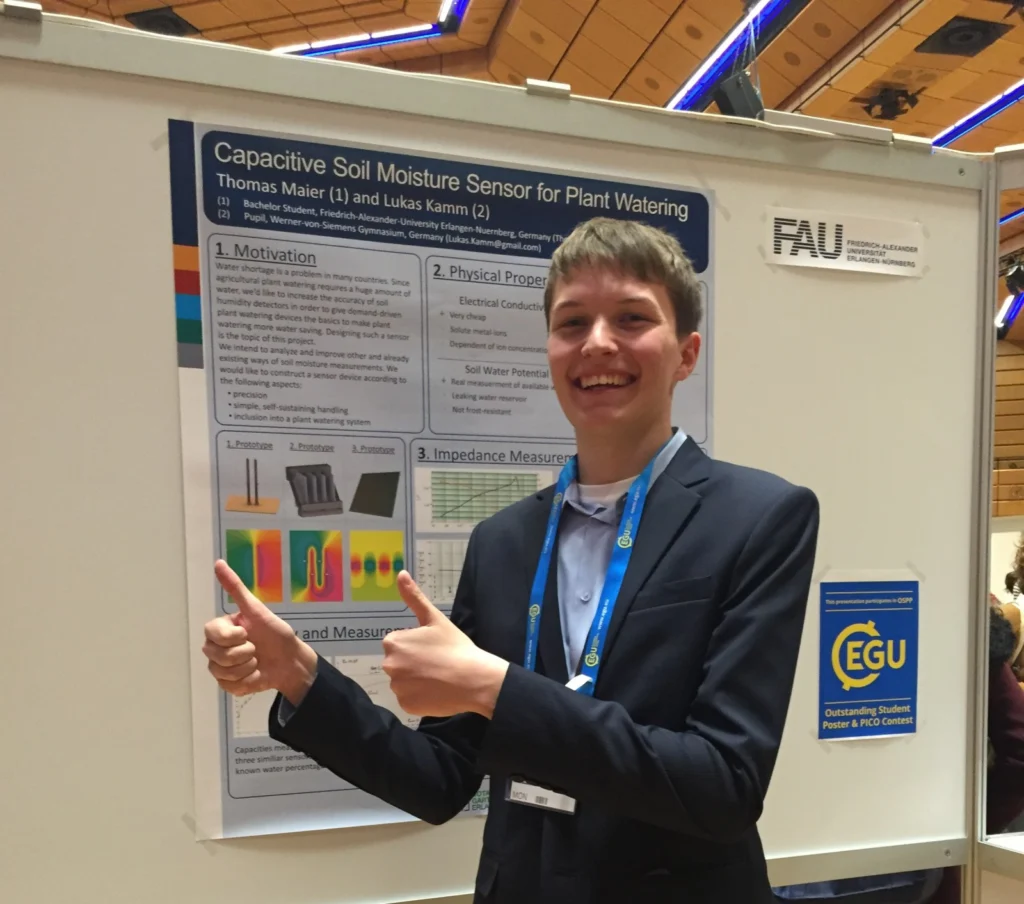
Geosciences Column: When water is scarce, understanding how we can save it is important
Supplies of water on Earth are running dry. The rate at which an ever growing population consumes this precious resource is not matched by our Planet’s ability to replenish it. Water scarcity is proving a problem globally, with regions such as California and Brazil facing some of the most severe water shortages on record. Used for drinking, agriculture and industrial processes, water forms an fund ...[Read More]
GeoLog
Imaggeo on Mondays: Late Holocene Fever
A huge ice fall off the Perito Moreno glacier in the Los Glaciares National Park, southwest Santa Cruz Province, Argentina, was voted one of the three best pictures entered into the EGU’s annual photo contest, by the conference participants at the 2015 General Assembly. Perito Moreno glacier is one of 48 glaciers feeding into the Southern Patagonia ice field, which combined with the Northern Patag ...[Read More]