“You can never step into the same river, for new waters are always flowing on to you.” —Heraclitus of Ephesus Rushing rivers, with their unremitting twists and turns and continuous renewal, are often used as a metaphor for life, but the analogy is just as appropriate for scientific research, I reflected as I walked along the banks of a sparkling, turquoise-blue river in the heart of th ...[Read More]
If you didn't find what you was looking for try searching again.
Geology for Global Development
Guest Blog: Could agroforestry do more to protect Rwandans from hazardous landslides?
Megan Jamer is a geoscientist from Canada, and an avid cyclist and explorer. Megan is currently travelling around East Africa on bicycle, taking in some remarkable sites and observing first hand the relationship between geoscience and sustainable development. Today Megan makes her debut on the GfGD blog site, writing on the relationship between agroforestry, landslides, and disaster risk reduction ...[Read More]
GeoLog
Conversations on being a woman in Geoscience
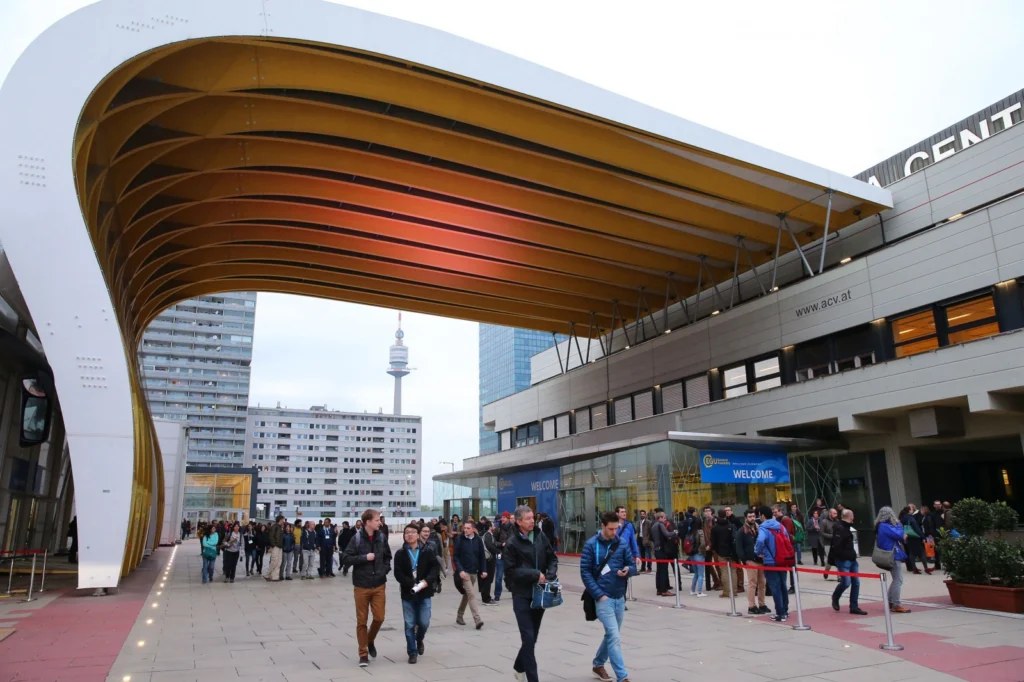
While at this year’s General Assembly in Vienna, Keri McNamara, one of the EGU’s press assistants, spoke to a number of female geoscientists (at different career stages), to get their perspective on what being a female in geosciences is like. At this year’s EGU General Assembly I decided to construct a blog out of conversations I had with several women in geoscience, to learn about the ...[Read More]
Cryospheric Sciences
Image of the Week – Antarctica’s Flowing Ice, Year by Year
Today’s Image of the Week shows annual ice flow velocity mosaics at 1km resolution from 2005 to 2016 for the Antarctic ice sheet. These mosaics, along with similar data for Greenland (see Fig.2), were published by Mouginot et al, (2017) last month as part of NASA’s MEaSUREs (Making Earth System Data Records for Use in Research Environments) program. How were these images constructed? The mosaics s ...[Read More]
GeoLog
Imaggeo on Mondays: Sneaking up from above
Take some ice, mix in some rock, snow and maybe a little mud and the result is a rock glacier. Unlike ice glaciers (the ones we are most familiar with), rock glaciers have very little ice at the surface. Looking at today’s featured image, you’d be forgiven for thinking the Morenas Coloradas rock glacier wasn’t a glacier at all. But appearances can be misleading; as Jan Blöthe (a researcher at the ...[Read More]
GeoLog
The publication issue: the opinions of EGU early career scientists!
The EGU’s General Assemblies have a long tradition of Great Debates – sessions of Union-wide interest which aim to discuss some of the greatest challenges faced by our discipline. Past topics have included exploitation of mineral resources at the sea bed, water security given an ever growing population and climate geoengineering, to name but a few. This year’s meeting saw the first Great Debate a ...[Read More]
GeoLog
April GeoRoundUp: the best of the Earth sciences from the 2017 General Assembly
This month’s GeoRoundUp is a slight deviation from the norm. Instead of drawing inspiration from popular stories on our social media channels and unique or quirky research featured in the news, we’ve rounded up some of the stories which came out of researcher presented at our General Assembly (which took place last week in Vienna). The traditional format for the column will return in May! Major st ...[Read More]
GeoLog
Imaggeo on Mondays: An epic ‘house’ move across the ice
In 2008 the NEEM Deep Ice Core Project was initiated by 14 partner countries in Northwestern Greenland (camp position 77.45°N 51.06°W) with the aim to drill from the very top of the Greenland ice cap to its base; obtaining ice from as far back as the last interglacial period- the Eemian – some 130,000 years old. At the start of the 2008 field season, the NEEM camp consisted of a single hea ...[Read More]
GeoLog
Extraordinary iridescent clouds inspire Munch’s ‘The Scream’
Edvard Munch’s series of paintings and sketches ‘The Scream’ are some of the most famous works by a Norwegian artist, instantly recognisable and reproduced the world over. But what was the inspiration behind this striking piece of art? The lurid colours and tremulous lines have long been thought to represent Munch’s unstable state of mind; a moment of terror caught in shocking technicolour. At the ...[Read More]
GeoLog
What’s on for early career scientists at the Assembly in 2017
This year, there’s a great line-up of early career scientist (ECS) sessions at the General Assembly. Not only that, but there are opportunities to meet those that represent you in the Union, get to know other ECS in your field, and make the most of both the scientific and social sides of the conference… Networking First up for ECS is the icebreaker event on the Sunday before the meeting, while thi ...[Read More]