EGU Blogs

2071 search results for "researcher"

GeoLog

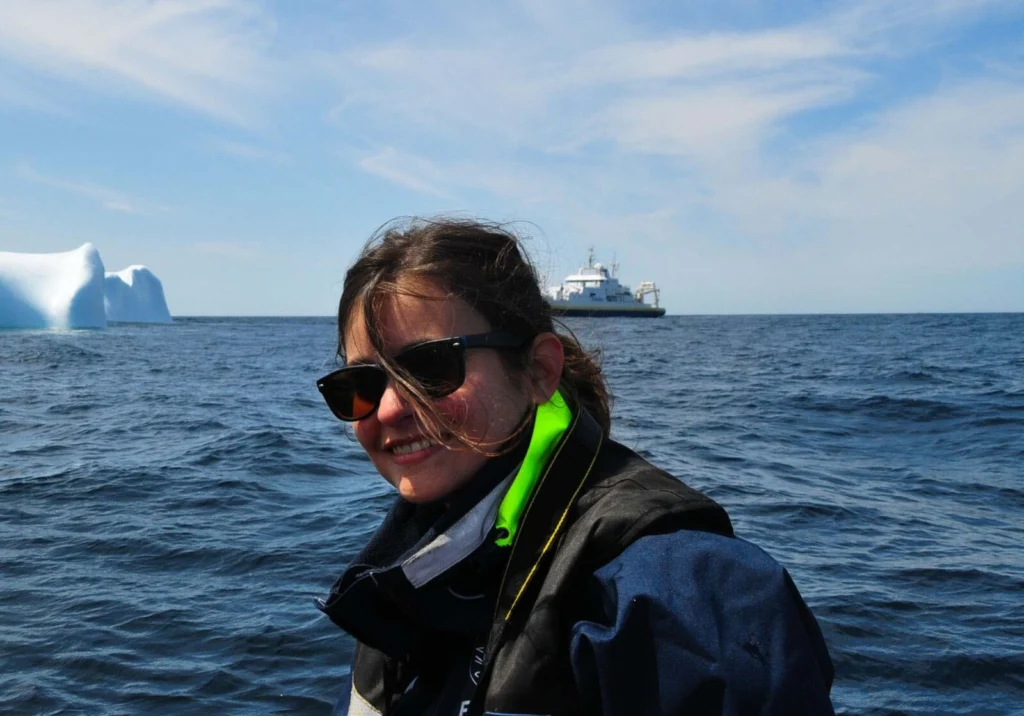
GeoTalk: Meet Marie Cavitte, policy officer for the Cryosphere Division, member of the EGU Climate Hazards Task Force, former Blue Book trainee

GeoTalk: Meet Marie Cavitte, policy officer for the Cryosphere Division, member of the EGU Climate Hazards Task Force, former Blue Book trainee

Welcome, Marie! Could you please introduce yourself to our readers? Hi, my name is Marie Cavitte. I’m a glaciologist and climatologist with a passion for the polar regions. I spent 10 years studying Antarctica. I started off during my Masters, then PhD, looking at the oldest ice on Earth, hunting for THE region of the ice sheet that might contain million-year-old ice. An ice core has been drilled ...[Read More]

OS
Ocean Sciences

From Signals to the Sea: Building an AI Sound Library for the Ocean

From Signals to the Sea: Building an AI Sound Library for the Ocean

We chatted with Bram Cuyx, an underwater acoustics AI research engineer at the Flanders Marine Institute (VLIZ) in Belgium, about his unique path from engineering into marine science. In this interview, he shares how he made the leap from signal processing in electronics to listening to the soundscape of the North Sea, what it’s like to build a sound library for AI, and why acoustics might b ...[Read More]

GM
Geomorphology

Highlighting Grace Nield, Royal Society Fellow

Highlighting Grace Nield, Royal Society Fellow

This blog post is part of our series: “Highlights” for which we’re accepting contributions! Please contact Emma Lodes and Anna van den Broek (GM blog editor, elodes@asu.edu, a.j.vandenbroek@uu.nl), if you’d like to contribute on this topic or others.  by Grace Nield, Assistant Professor (Research) – Royal Society University Research Fellow at Durham University. Email: grace.a.nield@durham.ac ...[Read More]

NP
Nonlinear Processes in Geosciences

New Editorial Voices at NPG

New Editorial Voices at NPG

As part of welcoming new members to the editorial team of Nonlinear Processes in Geophysics (NPG), we are pleased to present short interviews with two newly appointed editors, Dr. Kira Rehfeld and Dr. Jezabel Curbelo. They share their scientific backgrounds, motivations for joining the journal, editorial goals, and perspectives on emerging research directions in nonlinear geosciences. Their insigh ...[Read More]

GeoLog

International Day of Women and Girls in Science: Reflections from seismologist Simona Gabrielli

International Day of Women and Girls in Science: Reflections from seismologist Simona Gabrielli

Hello you, and happy International Day of Women and Girls in Science! My name is Simona Gabrielli, and I am a researcher at the INGV (Istituto Nazionale di Geofisica e Vulcanologia, Italy), where I study seismic attenuation (in other words: how earthquakes lose energy while passing through rocks), to understand the presence of fractures and fluids. My specialization in recent years has been in tec ...[Read More]

AS
Atmospheric Sciences

Building a library of observed air mass trajectories to study aerosol-cloud interactions

Building a library of observed air mass trajectories to study aerosol-cloud interactions

Marine low clouds, such as stratocumulus, play a central role in regulating Earth’s climate by reflecting incoming sunlight back to space. Yet these clouds are notoriously difficult to simulate and predict. One reason is that their evolution depends strongly on the surrounding atmosphere: temperature structure, moisture, winds, and aerosols all interact in complex ways. As a result, cloud response ...[Read More]

CL
Climate: Past, Present & Future

CYCLIM: cycle counting a faster way

CYCLIM: cycle counting a faster way

As we try to predict what will happen under increasing anthropogenic climate change, climate models can only get us so far. Another key is understanding past changes in the Earth’s climate. To do this, palaeoclimatologists turn to natural archives (e.g., sediment cores and speleothems) and extract records of past variability using their properties, such as chemical or physical composition. H ...[Read More]

GeoLog

GeoTalk: Meet Soil Microbiologist and Early Career Scientist Biogeosceinces Representative, Elsa Abs!

GeoTalk: Meet Soil Microbiologist and Early Career Scientist Biogeosceinces Representative, Elsa Abs!

Hello Elsa & welcome to GeoTalk! Before we dig deeper, could you introduce yourself to our readers? Hi! I’m Elsa (they/them). I’m a microbiologist/biogeochemist, and I just started a permanent position at the French National Centre for Scientific Research (CNRS) one month ago. I work with one PhD student, Elisa Richard, and two postdocs, Mathilde Bourreau and Thomas Cortier, on my ERC Starting ...[Read More]

GD
Geodynamics

The courage to be disliked: reflections on peer-review processes

The courage to be disliked: reflections on peer-review processes

Although often daunting and discouraging, every academic must navigate the inevitable process of peer review. In this week’s post, Jean-Baptiste Koehl, postdoctoral researcher at the University of Oslo (Norway), reflects on what the future of peer review might be. Author disclaimer: The reflections presented here reflect my perspective grounded in my own experience. While peer review is a key mech ...[Read More]

GeoLog

Geoscientific perspectives on global wetland systems: Between traditional knowledge and cultural heritage

Geoscientific perspectives on global wetland systems: Between traditional knowledge and cultural heritage

Today marks World Wetlands Day, and this year, the theme is Wetlands and traditional knowledge: Celebrating cultural heritage. Each year, February 2 is a day dedicated to recognising wetlands as places that store carbon, protect water, and hold complex cultural meaning. Wetlands such as mangroves, salt marshes, seagrass beds, peatlands, and floodplains are extremely good at taking carbon out of th ...[Read More]