
The Department of Geology at Jammu University, India (India’s second oldest University), as observed by Rosalie Tostevin (GfGD’s Deputy Communications Officer) during her recent reconnaissance trip. Rosalie is visiting key sites to help GfGD prepare for its contribution to the ‘Sustainable Development in the Himalayas’ Conference – organised by the Geological Society. ...[Read More]
VolcanicDegassing
Friday Field Photos: the Southern Volcanic Zone of Chile
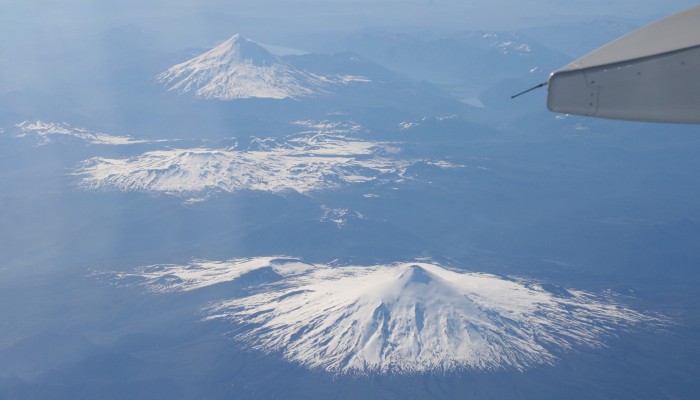
If you are ever in Chile and have the chance to take a mid-morning flight south from Santiago towards Puerto Montt or Concepcion, make sure you try and book a window seat on the left hand side of the plane. Once the early morning cloud has cleared, you could be in for a treat as you fly along the ‘volcanic front’, with spectacular views of Chile’s brooding volcanoes popping up f ...[Read More]
Between a Rock and a Hard Place
PhD profile #6 – Sorcha McMahon
Sorcha McMahon – 3rd year PhD student “New insights into deep mantle melts and the carbonatite-meliliitite connection” 1) The Twitter challenge: Your PhD in 140 characters Investigating how strange igneous rocks called carbonatites may have formed, using both natural samples and high-pressure experiments
GeoSphere
Goldschmidt 2013 – Day 2 – Carbon, Uranium, Litigation and London
Day 2 of Goldschmidt 2013 is done and what a great day it was. Hectic, but conferences always are. There is just so much to see and do, so many people to talk to and so many people to meet for the first time that it can be a bit overwhelming. The best thing to do is grab a coffee, and dive right in. My first talk of the day was by J. Schmitt and was called CF4 and CO2 – Coupling Weathering and Car ...[Read More]
GeoLog
Natural hazards workshop videos are online!
Every year, the EGU host a two day workshop for primary and secondary school teachers during the General Assembly. Geosciences Information For Teachers (GIFT) workshops aim to shorten the time between discovery and textbook, while providing teachers with material that can be used in the classroom. This year, the workshop was on natural hazards, with scientists from the fields of seismology, volcan ...[Read More]
Geology for Global Development
Guest Blog: What IF We Aren’t Helping?
Tim Middleton, GfGD’s Advocacy Development Officer, takes a critical look at this year’s IF campaign. This opinions expressed here are those of Tim, and not necessarily those of all involved with Geology for Global Development. As an organisation, however, we do believe that it is important to encourage debate on how best to undertake effective development. You’d be forgiven for having missed the ...[Read More]
GeoSphere
Goldschmidt2013 – Day 1 (Monday)
Wow! I have finally arrived at Goldschmidt 2013 and it is so, so great to be here! Day 1 was already a whirlwind. Unfortunately, I missed the icebreaker last night and arrived a bit late this morning due to scheduling conflicts so I missed a few talks, but I am here now and ready to listen, learn, discuss and blog! Talks I went to today: Sadly, I missed the first talk I wanted to see. My friend, E ...[Read More]
VolcanicDegassing
August Anniversaries: the eruption of Krakatoa
August 27th marks the anniversary of the culmination of the great eruption of Krakatoa (or Krakatau) in Indonesia in 1883. This devastating eruption has become the archetype of a volcanic catastrophe, even though it was a geologically modest example of a ‘caldera forming’ event. The eruption of Krakatoa quickly made the headlines around the world, in part because newly installed unders ...[Read More]
Soil System Sciences
Ladies and gentlemen: the Rolling Stones
Racetrack Playa is a plain without vegetation of a dry located above the northwestern side of Death Valley, in Death Valley National Park, Inyo County, CA, USA (click here to see in Google Maps). Although “playa” is the Spanish word for beach, it is also used in English to refer to a dry lake. Racetrack Playa occupies an area of 4.5 km (north-south) by 2 km (east-west) which is 1,130 m ...[Read More]
GeoLog
Imaggeo on Mondays: The perfect partnership
Pogonophores are deep sea worms that thrive in dark, deep sea conditions thanks to the presence of symbiotic bacteria. The bacteria are chemoautotrophic, that is, they fix carbon through oxidation processes, rather than using light to fix it, as is the case for photosynthesis. By utilising oxygen in the water, the bacteria can oxidise compounds such as hydrogen sulphide in order to fix carbon. The ...[Read More]