
Devastating supervolcanoes can erupt simply due to changes that happen in their giant magma chambers as they slowly cool, according to a new study. This finding marks the first time researchers have been able to explain the mechanism behind the eruptions of the largest volcanoes on Earth. Geologists have identified the roots of a number …[Read More]
Latest posts
Has climate change changed in the media?
Whether in a concerned, neutral, alarmist or sceptical tone, climate change is often reported in the media. But has the press approached this subject differently over the years? Marion Ferrat takes a look at the UK press coverage of the last two IPCC reports and investigates how the treatment of climate change has changed in …[Read More]
Were dinosaurs the masters of social integration?
Back in the Late Cretaceous, the USA was divided. Not politically, but by a vast continental sea called the Western Interior Seaway, splitting the continent into two separate landmasses. The western one of these, known as Laramidia, played host to some of the popular dinosaurs like Parasaurolophus, or ‘Elvis’ in Pete Postlethwaite dialect, and the …[Read More]
Guest Post: Hilary Dugan – Ice as a platform for understanding lake ecosystems
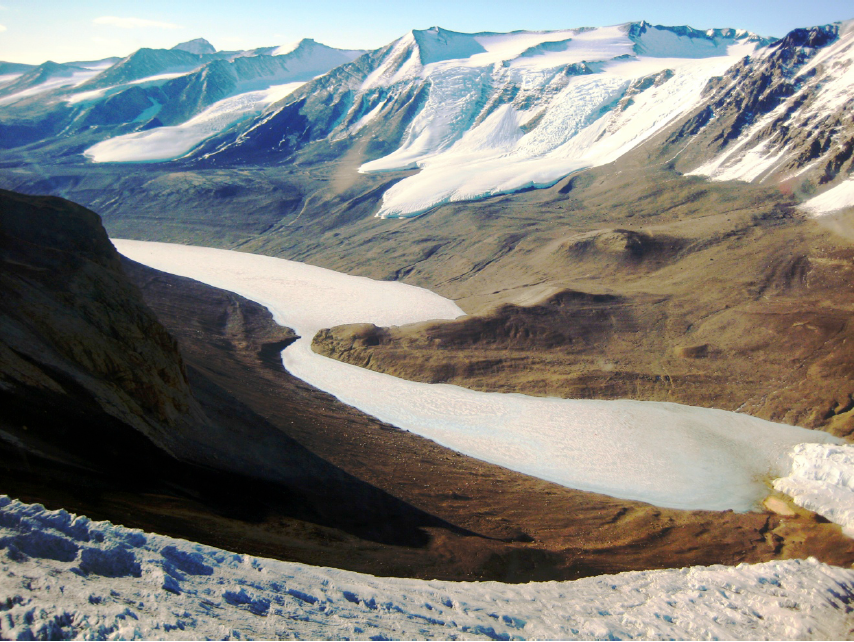
Today we have a new guest post written by current PhD candidate and Antarctic researcher on her very fascinating field work. Actually, she wrote this post while at McMurdo station. Hilary and I have known each other since our time at Queens University in Kingston, when she was one of my TA’s and was doing …[Read More]
Imaggeo on Mondays: Long live the lichen!
Lichens are amazing organisms. They are a composite of algae and fungi, each of which supports the other through the exchange of nutrients (fungi to algae) and carbon (algae to fungi). They are also capable of making a home out of seemingly inhospitable rock surfaces – and what’s more – making the most of these surfaces …[Read More]
Get Involved: Guest Blogs
We love the fact that our blog can be a forum for many different people to share their expertise and ideas. Our guest blogs are always very popular, giving people access to a much wider range of knowledge and opinion that just one or two authors can provide! We have had some great blogs from …[Read More]
Conference Diaries: VMSG Meeting 2014
James Hickey is a PhD student in the School of Earth Sciences at the University of Bristol. A geophysicist and volcanologist by trade, his PhD project is focussed on attempting to place constraints on volcanic unrest using integrated geodetic modelling. The Volcanic and Magmatic Studies Group (VMSG) is a combined specialist group of the Mineralogical …[Read More]
Monday paper: Changes in soil carbon stocks in Brazil due to land use: paired site comparisons and a regional pasture soil survey
Assad, E. D., Pinto, H. S., Martins, S. C., Groppo, J. D., Salgado, P. R., Evangelista, B., Vasconcellos, E., Sano, E. E., Pavão, E., Luna, R., Camargo, P. B., Martinelli, L. A. 2013. Changes in soil carbon stocks in Brazil due to land use: paired site comparisons and a regional pasture soil survey. Biogeosciences 10, 6141-6160. DOI: 10.5194/bg-10-6141-2013 Abstract In this paper we calculated soil carbon stocks in Brazil studying 17 paired sites where soil …[Read More]
EGU2014 SSS Best Flyer Award
It’s time to vote for your favourite EGU2014 SSS flyer! Votes will be received until March 31st 2014 (votes after that deadline will not be included). You can access the contest rules here: http://static2.egu.eu/media/filer_public/2013/11/27/egu-sssd_2014_bfa_awards.pdf. What’s your fav? Vote at:
Policy Focus: 1 – Creating value from Waste
Waste and recycling is a growing issue in a world where abundant resources are diminishing. This week Flo Bullough looks at recent policy activity in the area of ‘valuing waste streams’ and the geo-relevant example of Rare Earth Elements. This week, the House of Lords Science and Technology committee has been taking oral evidence on …[Read More]