
Public places such as airports are often designed to withstand strong earthquakes particularly in modern cities that are prone to earthquakes. When the ground shakes people have to be careful from objects falling off walls … or eagles falling from the roof! Two large eagles each having a wingspan of 15 meters and weighing 2 tonnes were …[Read More]
Latest posts
Monday paper: Soil organic carbon dynamics of black locust plantations in the middle Loess Plateau area of China
Lu, N., Liski, J., Chang, R. Y., Akujärvi, A., Wu, X., Jin, T. T., Wang, Y. F., Fu, B. J. 2013. Soil organic carbon dynamics of black locust plantations in the middle Loess Plateau area of China. Biogeosciences 10, 7053-7063. DOI: 10.5194/bg-10-7053-2013 Abstract Soil organic carbon (SOC) is the largest terrestrial carbon pool and sensitive to land use and cover change; its dynamics are critical for carbon cycling in …[Read More]
Friday Photo (114) – Aggregate Mining
Aggregate Mining in Rio San Francisco (Panajachel, Guatemala) The Rio San Francisco flows through Panajachel, one of the largest towns around Lake Atitlan, into the lake. In the current dry season, there is very little water, and you can see mining for aggregates occurring. Credit: Joel Gill (2014)
10 Minute Interview – Finding the right path
It turns out, I’m not so great at keep the promises I make our blog readers… I AM working on the next post for the Making the most of your PhD series. In the mean time, this 10 minute interview actually fits the theme of the Making the most of your PhD series quite well. …[Read More]
Science Snap (#18): Tragic Sinabung Eruption
James Hickey is a PhD student in the School of Earth Sciences at the University of Bristol. A geophysicist and volcanologist by trade, his PhD project is focussed on attempting to place constraints on volcanic unrest using integrated geodetic modelling. Last Saturday (1st February 2014) an eruption at Sinabung volcano in Indonesia claimed the lives of …[Read More]
Geosciences Column: Using tall trees to tot up tropical carbon
Forests in the tropics account for about half the above-ground carbon on Earth and as the trees grow older they are capable of storing more and more. In fact, their carbon-storing potential is so large that they are increasingly being viewed as a means of mitigating climate change. Take, for example, the United Nations effort to …[Read More]
GfGD Conferences – Help Us!
Do you remember our National Conference, in October 2013? It was a great event, gathering over 150 people from across the UK and beyond to explore how geologists can help fight global poverty. Don’t forget, you can find a series of photographs from the event on our Facebook page. Whether you attended this event or …[Read More]
The Water-Energy Nexus
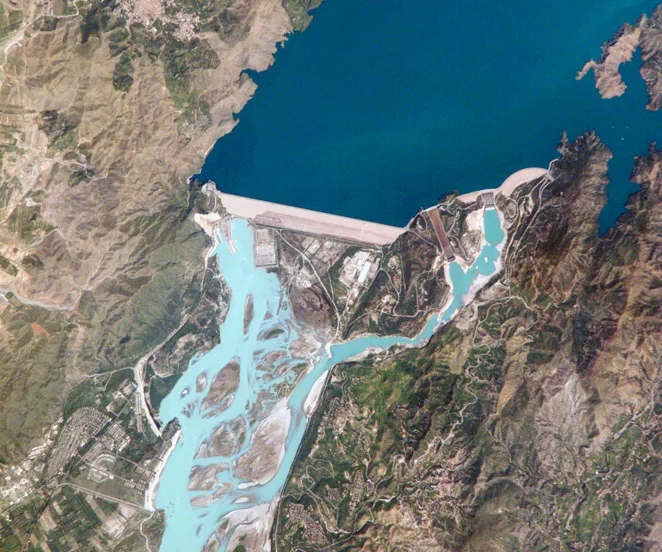
Flo Bullough writes on the concept of the water-energy nexus; its implications for energy and water security and the impact of climate change and future planning and regulation. I first came across the concept of the water-energy nexus when the former UK Chief Scientific Advisor John Beddington discussed the interdependence of food, water and energy …[Read More]
Imaggeo on Mondays: A fly by some fantastic farming
This week’s Imaggeo on Mondays is brought to you by Kristof Van Oost, a scientist from the Georges Lemaître Centre for Earth and Climate Research (UCL) in Belgium. He tells us how local organic farms are being managed to ensure a lot of carbon stays in the soil… This is a picture of the organic …[Read More]
Eruption of Mount Sinabung and Poverty Reduction
Last week Mount Sinabung, an active volcano on the island of Sumatra (Indonesia), erupted killing at least 16 people. It is reported that a number of the deaths were people going back into the evacuated zone to see the eruption up close and to check on properties and land. This is a sad reminder of …[Read More]