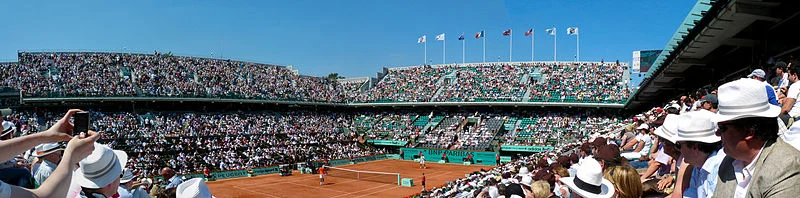
As part of the ‘What’s geology got to do with it?’ series, Flo takes us on a tour of the links between geology and tennis! Warning: You may not want to read this if you have no interest in Geology OR tennis…. Now the disclaimer’s out of the way, I thought it was about time …[Read More]
Latest posts
Geosciences Column: Could plants be a cheap solution to soil contamination in developing countries?
There are many ways to remove contaminants from the land, but it is a constant battle for scientists to find better and cheaper ways to the job. Recent research published in Soild Earth suggests plants may present a solution – one that’s particularly promising for poor areas. Jane Robb describes the findings… Bolivia has a …[Read More]
Friday Field Photo – St Vincent, 1902
Today’s field photo is by Tempest Anderson, of the ‘Roseau Dry River flowing with Boiling Mud’, a picture taken in the aftermath of the May 1902 eruptions of the Soufrière of St Vincent. The full published caption explains the origins of this boiling mud – a phenomenon we now call a lahar: ‘This is a small stream …[Read More]
Reminder: 2nd Annual Conference (19 Sept 2014)
A quick reminder about a date that you should all put in your calendars… Following the success of our first National Conference in October 2013, we are very pleased to announce that Friday 19th September 2014 has now been booked for our next conference… On Friday 19th September we hope to again gather over 150 young geoscientists …[Read More]
Climate-proofing the Netherlands
Emerging Leaders in Environmental and Energy Policy (ELEEP) fosters transatlantic relations, forges dialogue, and promotes leadership across energy and environmental policy landscapes. Former EGU Science Communications Fellow and ELEEP member Edvard Glücksman reports back from the Netherlands, where citizens manage the continuous threat of climate-related devastation through a combination of creatively adapted urban spaces and innovative …[Read More]
Your bite or mine?
It rises from the dark waters like some behemoth from the deep, and lets out a blood-curdling roar. It’s feeding time. One of the most iconic scenes from Jurassic Park III is where the long-snouted, sail-backed giant theropod dinosaur Spinosaurus emerges from underwater to try, yet again, to eat our beleaguered rabble of misfortunates. It’s …[Read More]
How NOT to write to an editor
Over on the Nature Methods blogs site, there are some interesting posts with advice for authors on how to prepare cover letters, rebuttal letters, appeal letters and the like. Here’s an example of ‘how NOT to write to an editor‘, based on a recent experience of mine. I shall let the author remain anonymous, but my hunch is …[Read More]
GeoPoll # 2 – What geologic attraction would you like to see most?
The first geopoll was a huge success!! I was completely floored by the overwhelming number of responses and the time and care people took to give their opinion. The results of the last poll showed, overwhelmingly, that field work is of paramount importance to a good geology education. In fact, the top two choices with 160 …[Read More]
Imaggeo on Mondays: Quartz lawns and crystal flowers
Petrologists spend a large part of their time peering down microscopes at wafer thin slices of rock to work out what they’re made of and how they were formed. What lies on the other side of the lens can be an incredibly beautiful pattern, a kaleidoscope of colour, or stark bands of black and white, …[Read More]
Animation comparing earthquake magnitude and energy release
Seismologists sometimes find it hard to explain to the general public the significance of the earthquake magnitude scale with relation to the energy release. Here is a very nice animation comparing the relative energy release of some 20th and 21st century earthquakes by their moment magnitudes.