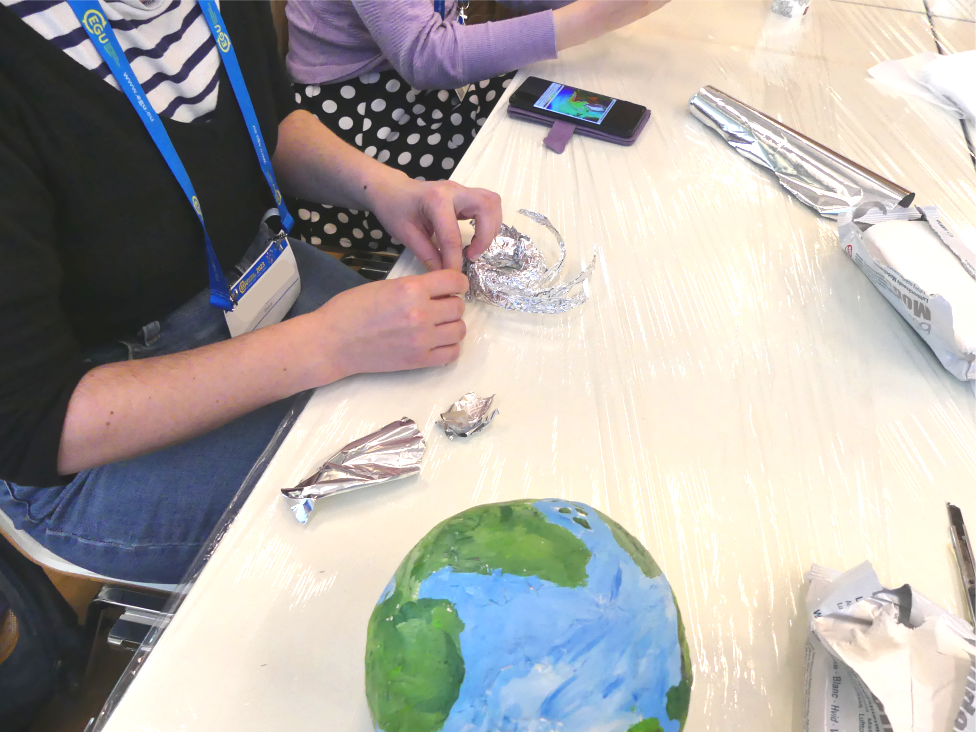
Early Career Scientists (ECS) – defined as a student, a PhD candidate, or a practising scientist who received their highest certificate (e.g. BSc, MSc or PhD) within the past seven years – compose about half of EGU’s members. Many of the sessions and events throughout the Assembly are built with our ECS attendees in mind, from introducing you to the Assembly and the Union as a whole or the numerou ...[Read More]
Nonlinear Processes in Geosciences
ECS Spotlight: When “Day Zero Drought” Dries the Tap: How Drought is Reshaping Water Scarcity in the Anthropocene
Extreme events are becoming increasingly observable, intense, and interconnected. Drought, traditionally viewed as a regional and temporary phenomenon, is now undergoing a fundamental shift. We introduce the concept of “Day Zero Drought” to describe a threshold where water demand exceeds available supply under persistent drought conditions. This study shows that water scarcity is no longer confin ...[Read More]
Cryospheric Sciences
From Finland to Switzerland: A Campervan Journey for Snow Research
Traveling by land within Europe is relatively easy, and for me it’s also a conscious choice to push back against the fast pace of modern travel and the normalization of flying. I chose to drive a van instead of taking the train mainly because of my dog, and because finding pet-friendly accommodation during the high season was challenging. I’m visiting the Snow Hydrology research group in WSL Insti ...[Read More]
GeoLog
GeoPolicy: Jump into Science for Policy at EGU26!
Each year, the EGU General Assembly offers a diverse programme of scientific and skills-focused sessions where participants can explore new research, grow their network, broaden their expertise, and build new skills. Among these are sessions that focus on science for policy, showcasing how researchers can start engaging in policymaking, connect with decision-makers, and create policy impact. This ...[Read More]
Ocean Sciences
New Unified Interface for Existing Ocean Carbonate Chemistry Data Products
Here is a great resource for anyone working on ocean carbon: Jiang et al. (2026) compiled a comprehensive synthesis of data products for ocean carbonate chemistry — all in one place for you! The paper provides a comprehensive synthesis of 68 existing ocean carbonate chemistry data products and data product sets, including: 🛳️ Cruise-based Compilations 📈 Time-series Datasets 🗂️ Gap-filled Observati ...[Read More]
Hydrological Sciences
Podcast Launch: History of Hydrology Interviews
“The number one piece of advice I would give anybody is to pick a problem and go after that problem. Ideally, you should pick a problem that requires a lifetime to solve.” Prof. Siva Sivapalan, episode 1 “A lot of greybeards telling us what we should be doing is absolutely the wrong way to do science. Science is anarchic, it’s bottom-up.” Prof. Mike Kirkby, episode 2 “I wr ...[Read More]
GeoLog
Organise your own events at EGU26 with the Pop-Up Networking Scheduler!
Pop-up networking returns for the #EGU26 General Assembly! Attendees can add their own events to the conference programme using the pop-up scheduling tool. Events can either be virtual or in-person, and include a number of tagging options to communicate the event theme to other attendees. The pop-up networking scheduling tool is live right now! Anyone attending EGU26 can organise an event using th ...[Read More]
Geodynamics
At the Mountains of Madness: Lovecraft Applied for Geology (and Failed)
“I am forced into speech because men of science have refused to follow my advice without knowing why. It is altogether against my will that I tell my reasons for opposing this contemplated invasion of the antarctic—with its vast fossil-hunt and its wholesale boring and melting of the ancient ice-cap —and I am the more reluctant because my warning may be in vain.” The opening lines from At the Moun ...[Read More]
Climate: Past, Present & Future
Winds of change – How can we reconstruct the directions of winds in the past?
Invited guest from the EGU 2025 Outstanding Student and PhD candidate Presentation (OSPP) Award Wind is not easily visible. On historical time scales, its directions and velocities have been measured and recorded by instruments. To some degree, these parameters can also be simulated by climate models. But how about winds in the more distant past? And why would we want to know about them? In many p ...[Read More]
GeoLog
Footprints reveal climate’s mark on mudflats
Tidal flats, the muddy reaches of estuaries unveiled at low tide, support rich ecosystems and fisheries worldwide. But these habitats are under threat from climate change, as sea level rise overwhelms the landscape and heavy rainfall scours away the sediment – impacts that scientists are only just beginning to explore. In an effort to understand how shellfisheries are affected by climate change, a ...[Read More]