GeoLog

GeoLog

Imaggeo On Monday: Crete- Diplono Petris (Διπλόνο Πέτρις)

Imaggeo On Monday: Crete- Diplono Petris (Διπλόνο Πέτρις)

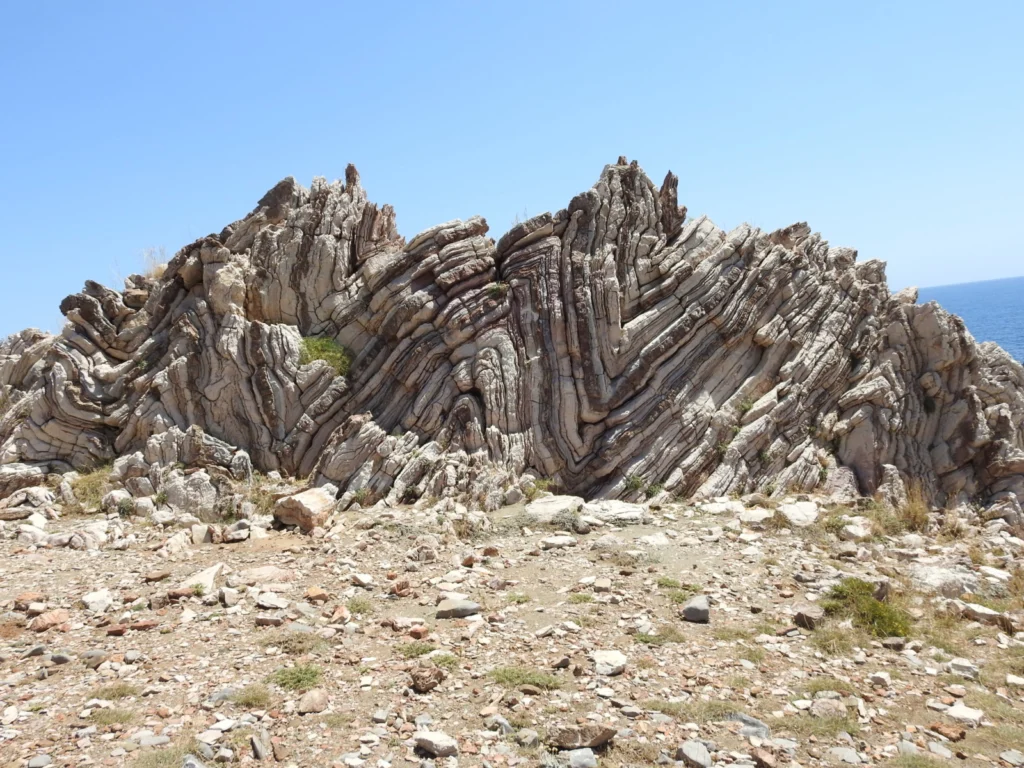
Diplono Petris near Agios Pavlos in the south of Crete island is one of Europe’s most impressive folded rock formations. The rock strata document an alternation of different limestone layers in the pindos top of the Cretan ceiling pile. These sediments, once deposited in a deeper ocean basin of the Pindos Ocean, were deformed in the course of Alpine fold tectonics, triggered by the Northern ...[Read More]

Geosciences Column: Spatial seismic hazard in western Indonesia – a new, adaptive, approach

Geosciences Column: Spatial seismic hazard in western Indonesia – a new, adaptive, approach

A Natural Hazards Earth System Sciences (NHESS) paper proposes a new sampling method for reducing uncertainty in geographical location in seismic hazard risk analysis, with implications for the insurance industry and risk communication in general.   Globally, rapid urbanisation is increasing the risk of exposure of human populations and infrastructure to natural hazards, including earthquakes ...[Read More]

GeoRoundup: the highlights of EGU Journals published during October!

GeoRoundup: the highlights of EGU Journals published during October!

Each month we feature specific Divisions of EGU and during the monthly GeoRoundup we will be putting the journals that publish science from those Divisions at the top of the Highlights roundup. For October, the Divisions we are featuring are: Natural Hazards (NH), Hydrological Sciences (HS) and Seismology (SM). They are served by the journals: Geoscientific Model Development (GMD), Hydrology and E ...[Read More]

Imaggeo On Monday: Reflections in floodwater

Imaggeo On Monday: Reflections in floodwater

This picture shows several trees and the sky reflecting in floodwater during an event that occured in February 2019 in front of the famous Postojna cave (Slovenia). In Slovenian karst areas, floods are considered as a very common natural phenomenon that can occur several times per year. While most of them are not harmful for local people, the most severe events cause considerable damages and might ...[Read More]

GeoPolicy: Proposed cuts to EU science funding could slow future research and innovation

GeoPolicy: Proposed cuts to EU science funding could slow future research and innovation

As a European scientific union with over 20,000 members, the EGU is well positioned to provide feedback on the current and future state of research and innovation funding in Europe. The recent cuts to the EU’s 2021-2027 research budget from European Parliament’s initial proposal of €120 billion to the current proposal of €81 billion (at 2018 prices), will not only affect researchers througho ...[Read More]

Imaggeo On Monday: Tragédia em Petropolis (Brazil)

Imaggeo On Monday: Tragédia em Petropolis (Brazil)

A series of deadly landslides and debris flows occurred in March 2013 in Petropolis, a municipality in the Brazilian state of Rio de Janeiro. This photo has been shot a little more than a month later. It highlights the important “supporting role” played by sewer pipes in this disaster. Description by Michele Calvello, after the description on imaggeo.egu.eu.   Imaggeo is the EGU’s ...[Read More]

GeoTalk: #BlackInTheMud panellists reflect on Black in Geoscience Week 2020

GeoTalk: #BlackInTheMud panellists reflect on Black in Geoscience Week 2020

After telling a personal and traumatizing field experience to my fellow colleagues of color, I found that we all had shared similar events! Shocked and outraged, I wanted to find a place to expose and highlight these events thus the #BlackInTheMud panel was created. This event was inspired by this picture. And it’s so funny because this photo has been used, until it’s almost like a stock photo on ...[Read More]

Imaggeo On Monday: The many sides of Australia’s bushfires

Imaggeo On Monday: The many sides of Australia’s bushfires

Bushfires in Australia are frequent in the hot and dry months characteristic of its climate. Their severity and seasonality is affected by climate change, and they impact extensive areas every year.   At first sight, they might look harmful and dangerous, since they can cause property damage and loss of human life. However, the natural ecosystem has developed different strategies to either re ...[Read More]

The Sendai Framework – a five year review

The Sendai Framework – a five year review

The Sendai Framework for Disaster Risk Reduction 2015-2030 is a set of agreed commitments for member states of the United Nations to act on the prevention of ‘new’ disasters and reduce existing disaster risk through the implementation of integrated and inclusive economic, structural, legal, social, health, cultural, educational, environmental, technological, political and institutional measures. T ...[Read More]

Imaggeo On Monday: Lahar in the jungle, Mexico

Imaggeo On Monday: Lahar in the jungle, Mexico

Volcán de Colima currently is the most active volcano in Mexico where many rain-induced lahars occur every year. La Lumbre ravine is the ephemeral channel that drains the west-southwestern slopes of the volcano. In 2016, while Volcán de Colima experienced a prolonged explosive phase, several lahars were documented in this channel. One of them is shown in his picture, taken on August 13, 2016, du ...[Read More]