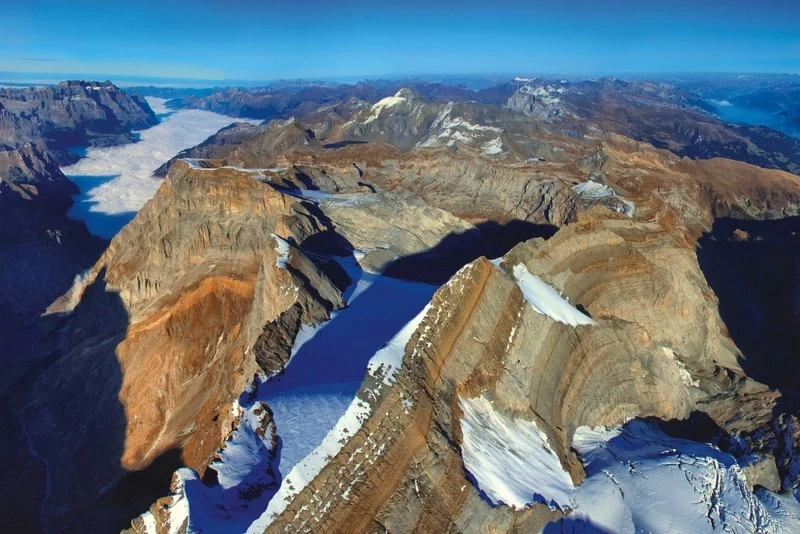
Undoubtedly, the Alps are one of the best studied mountain ranges in the world. Appreciating their immense beauty and geological wealth can be difficult from the ground, given their vast scale and the inaccessibility of some of their more challenging peaks. Kurt Stüwe, along with alpine photographer Ruedi Homberger, set about changing this by undertaking the ambitious task of photographing the len ...[Read More]
Geodynamics
The known unknowns: Climate, Life, and the Solid Earth (Part V)
After four fascinating instalments in the known unknowns series we have (sadly) come to the final post. Since the series began in September we have explored the top questions that still remain unanswered when it comes to understanding the inner workings of the planet as well as how the interplay of a number of systems that occur at the Earth’s surface give rise to its varied landscapes. The series ...[Read More]
The known unknowns – the outstanding 49 questions in Earth Sciences (Part IV)
We are coming to the end of the known unknowns series and so far we have explored issues which mainly affect the inner workings of our planet. Today we’ll take a look at the surface expression of the geological processes which shape the Earth. Topography significantly affects our daily life and is formed via an interplay between primarily tectonics and climate, but it also affected by biological, ...[Read More]
Imaggeo on Mondays: The perfect overnight stop.
Being an Earth scientist has its perks and camping overnight in a cave under an absolutely stunning unpolluted night sky has to be up there with one of the best! Our Imaggeo on Mondays image is brought to you by Simon Virgo who took the photograph in 2008 during an advanced mapping field course in structural geology in the Batain region of northeastern Oman. The Batain region extends over an area ...[Read More]
Imaggeo on Mondays: A mysterious shrinking lake
From this week’s Imaggeo on Mondays image it’s easy to see why Iceland is the setting of so many books, films and TV shows, inspiring and inciting writers and film crews alike. The picture was taken on the shores of Lake Kleifarvatn, in Reykjanes peninsula, approximately 30 km to the west of the country’s capital, Reykjavík. “The Reykjanes peninsula is unique because it marks theboundary between t ...[Read More]
The known unknowns – the outstanding 49 questions in Earth sciences (Part III)
We continue exploring the biggest conundrums in Earth sciences in this third post of the known unknowns. In the two previous instalments of the series we’ve discovered what the major questions still to be answered about the early days of planet Earth and its inner workings are. We now move onto the planet’s surface. The advent of plate tectonic theory, arguably one of the biggest advancements in t ...[Read More]
The known unknowns – the outstanding 49 questions in Earth Sciences (Part II)
Here is the second instalment in our series covering the biggest unknowns in the Geosciences. Last week we explored what it is about the Earth’s origin that still remains unclear and this week we probe the Earth’s deep interior. Unlike in Jules Verne’s Journey to the Centre of the Earth, there are no volcanic tubes we can climb down which will allow us to discover the inner workings of our Planet. ...[Read More]
GeoTalk: Steven Smith on fossil faults and fantastic faulting
This week in GeoTalk, we’re talking to Steven Smith, a Lecturer from the University of Otago. Steven takes us on an Earth-shaking journey, explaining how ancient faults reveal what’s happening under the Earth’s surface and delving into the future of fault zone research. First, could you introduce yourself and tell us a little about what you are currently working on? Last September I started as a L ...[Read More]
Imaggeo on Mondays: A rolling stone gathers no moss
Philippe Leloup brings us this week’s Imaggeo on Mondays, with tales from a mountain trail that show a geologist can never resist a good rock! This image is that of a polished slab of a rock composed of interlayered marbles and amphibolites. The sample was once part of a small dry-stone wall bordering an outdoor kitchen along a trail along the Ailao Mountain Range in China (or Ailao Shan in Chines ...[Read More]
Sniffing out signs of an earthquake
Last year Kate Ravilious was awarded an EGU Science Journalism Fellowship to follow scientists studying continental faults. Now she’s out in Nepal alongside researchers who are working out when the county’s next big quake will be… Sometimes the best rocks are found in the worst locations. Yesterday I was reminded of this as I watched Paul Tapponnier, from the Earth Observatory of Singapore, ...[Read More]