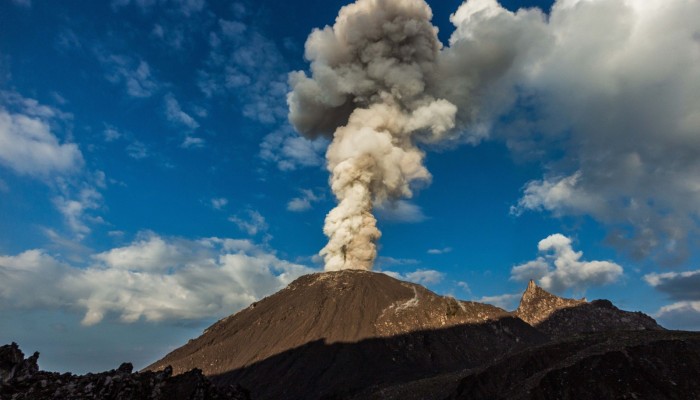
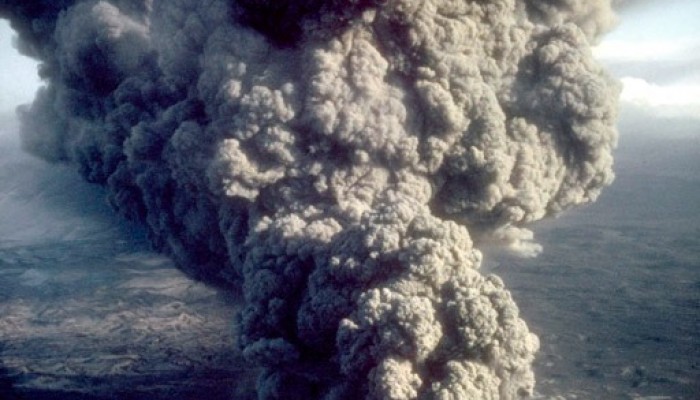
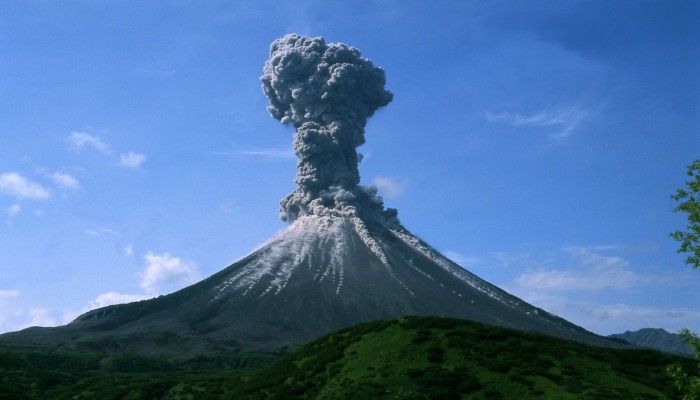
Santiaguito volcano in Guatemala is one of the most active volcanoes in Central America: currently erupting every 45-90 mintues, from its active lava dome Caliente, while at the same time sending a lava flow down its flanks. This makes it an ideal study object for volcanology. A group of volcanologists from the University of Liverpool, in the UK, installed a network of geophysical stations around ...[Read More]
Imaggeo on Mondays: A fold belt within a grain
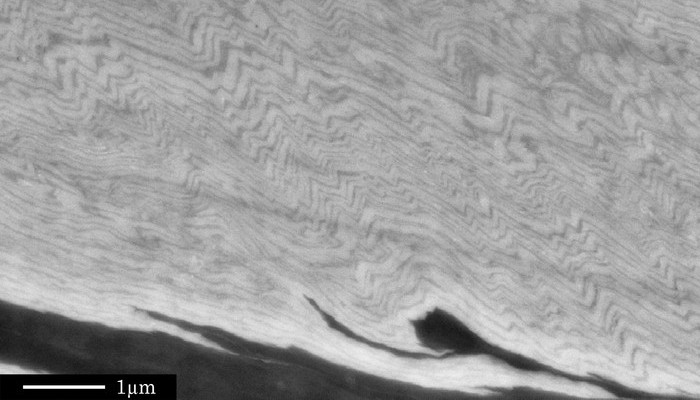
Tiny crinkly folds form the main basis of today’s Imaggeo on Mondays. Folding can occur on a number of scales; studying folds at all scales can reveal critical information about how rocks behave when they are squeeze and pinched, as described by Sina Marti, from the University of Basel. Although many geoscientists have seen such fold structures many times before, if you noticed the scale bar in th ...[Read More]
GeoTalk: How hydrothermal gases change soil biology
The biosphere is an incredible thing – whether you’re looking at it through the eye of a satellite and admiring the Amazon’s vast green landscape, or looking at Earth’s surface much more closely and watching the life that blossoms on scales the naked eye might never see, you are sure to be inspired. Geochemist, Antonina Lisa Gagliano has been working on the slopes of Pantelleria Island in an effor ...[Read More]
Iceland’s Bárðarbunga-Holuhraun: a remarkable volcanic eruption
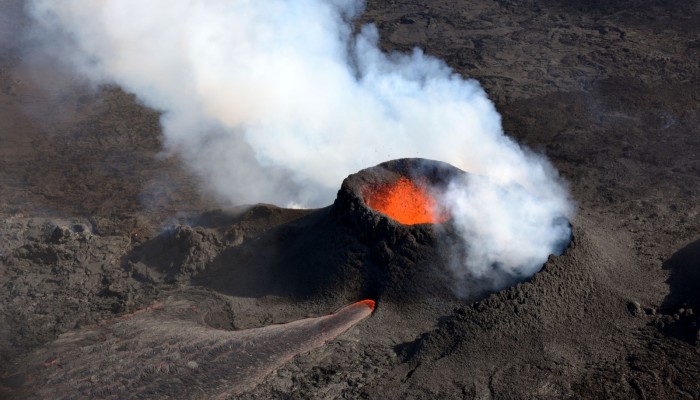
A six month long eruption accompanied by caldera subsidence and huge amounts of emitted gasses and extruded lavas; there is no doubt that the eruption of the Icelandic volcano in late 2014 and early 2015 was truly remarkable. In a press conference, (you can live stream it here), which took place during the recent EGU General Assembly, scientists reported on the latest from the volcano. Seismic act ...[Read More]
Imaggeo on Mondays: Finger Rock
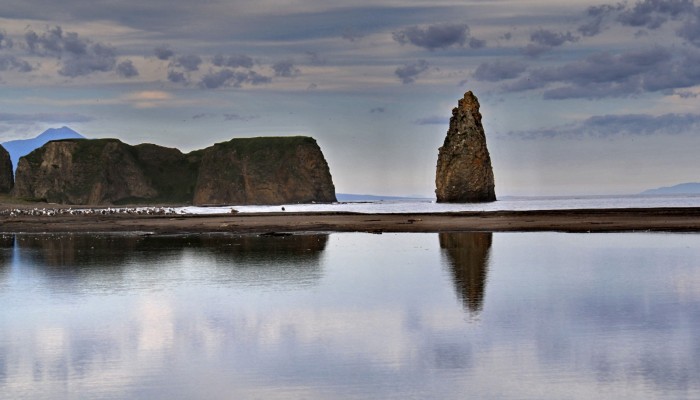
Standing proud amongst the calm waters of Golovnina Bay is ‘The Devil’s Finger’, a sea stack composed of volcanic sediments. Located on the Pacific coast of Kunashir Island -which is controlled by Russia but claimed by Japan – the stack is testament to the volcanic nature of the region. The island itself is formed of four active volcanoes which are joined together by low-lying geothermally active ...[Read More]
GeoTalk: Explosive testing with Greg Valentine
Following his session at the EGU General Assembly, Greg Valentine (Buffalo University) spoke to Sara Mynott about how he creates model volcanoes, specifically maar-diatremes, and blows them up to better understand what goes on in an eruption… So what is a maar-diatreme? A diatreme is a vent-like structure, mostly made up of broken up bedrock and magma. Initially, you have a dyke that channels magm ...[Read More]
Imaggeo on Mondays: Pyroclastic flow, Montserrat
Below the warm and tranquil waters of the Caribbean, some 480 km away from Puerto Rico, the North America Plate is being subducted under the Caribbean Plate. This has led to the formation of the Lesser Antilles volcanic arc; the result of the formation of reservoirs of magma as fluids from the down going North America Plate are mixed with the rocks of the overlying Caribbean Plate. The continued m ...[Read More]
Imaggeo on Mondays: An explosive cloud
One of the world’s most volcanically active regions is the Kamchatka Peninsula in eastern Russia. It is the subduction of the Pacific Plate under the Okhotsk microplate (belonging to the large North America Plate) which drives the volcanic and seismic hazard in this remote area. The surface expression of the subduction zone is the 2100 km long Kuril-Kamchatka volcanic arc: a chain of volcanic isla ...[Read More]
Imaggeo on Mondays: A Patagonia landscape dominated by volcanoes
Imagine a torrent of hot and cold water, laden with rock fragments, ash and other debris hurtling down a river valley: this is a lahar. A by-product of eruptions of tall, steep-sided stratovolcanoes, lahars, are often triggered by the quick melting of snow caps and glaciers atop high volcanic peaks. The history of the Ibañes River and its valley, in southern Chile, are dominated by their proximity ...[Read More]
The ethics of mining
This guest blog post is brought to you by Nick Arndt, Professor at ISTerre and convenor of the the Great Debate at last year’s General Assembly, Metals in our backyard: to mine or not to mine. During the Great Debate the issue of whether the environment impact of mining outweighs the benefits vs. domestic metal production was questioned. With Europe currently importing between 60-100% of the metal ...[Read More]