Jupiter’s moon Io is the most volcanically active world in our solar system, with hundreds of volcanoes that constantly erupt on its ever renewing surface. Although Io always points the same side toward Jupiter in its orbit around the gas giant, two other Galilean moons, Europa and Ganymede, pull Io’s orbit into an irregularly elliptical one. Thus, in its widely varying distances from ...[Read More]
Raising the (melt)stakes! How robotic innovation reveals new findings on melting glaciers
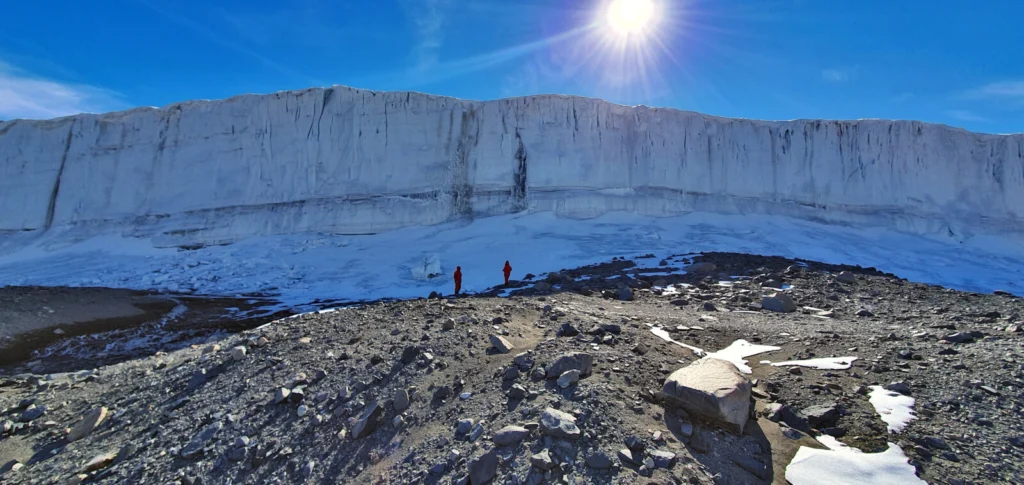
In the age of climate change, glaciers across the Arctic are melting, consequently reducing regional freshwater supplies and contributing to the ongoing rise in global sea levels. But how fast do they melt? And is it possible to predict that? A new study on the Xeitl Sit’ (LeConte) glacier in Alaska aims to answer these questions. The research group from Oregon State University, Harvard University ...[Read More]
Sarakiniko: A unique geoheritage site under threat
Sarakiniko, a stunning geological landmark on the aegean island of Milos, Greece, is under imminent threat. Known for its breath-taking white tuff formations built by the deposition of submarine volcanic eruptions and sculpted by wind and water over millions of years, this site serves as both a natural laboratory for geoscience and planetary research and a worldwide significant geoheritage site. H ...[Read More]
Geo-magicians: The mysterious work of understanding our magnetic Earth
There is a force all around us—unseen, unfelt, and yet profoundly influential. It guides the migration of birds across continents, whispers secrets to ancient rocks, and shields us from cosmic storms. This force is as mysterious as it is essential, shaping our world in ways that most of us never think about. Imagine a sailor centuries ago, staring at a compass that always points north. What guides ...[Read More]