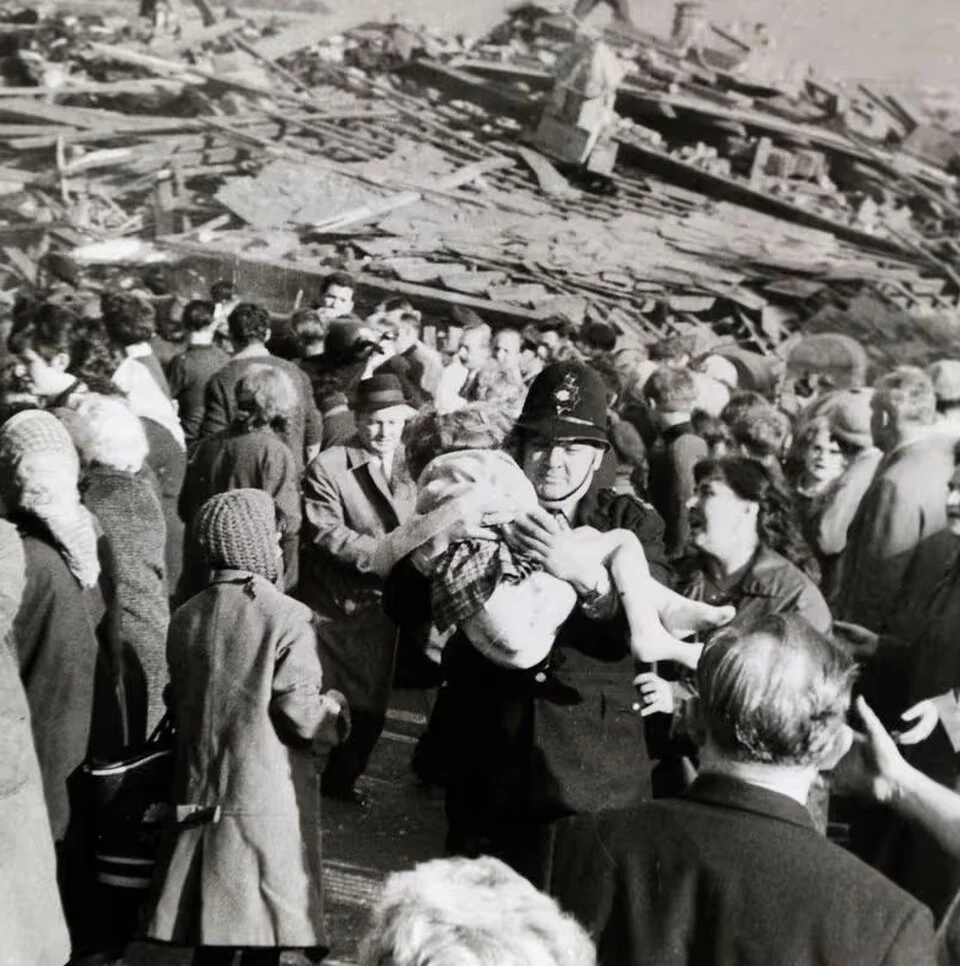
Aberfan is located in the South Wales Valleys and developed as a coal mining village during the industrial revolution in the mid-1800s. The village is much like any of the other villages scattered across the region – rows on rows of small terrace houses, nestled into the sides and bottom of steep, glacially eroded valleys. However, this quiet, beautiful village is also known across the world for its connection to one of the UK’s worst mining disasters.
On Friday, the 21st of October 1966, the children of Pantglas Primary School were settling down to their last day of lessons before the half-term holidays. At exactly thirteen minutes past nine, one of the colliery spoil tips, built high on the slopes above the school gave way, and more than 100,000 m3 of slurry, rushed downhill smashing into the primary school and the buildings beyond.
Rescue efforts began immediately, with villagers rushing to the site, followed by the emergency services and miners from the nearby colliery. No survivors were rescued after eleven o’clock in the morning. The slide caused the death of 144 people, including 116 children, with many more injured. More than 10,000 people attended a mass funeral for the victims which was held on the 27th of October.
To people who grew up in South Wales, the tragedy of 1966 is a huge part of our cultural history and identity. The tragedy shaped a generation and has had a lasting impact on the entire Welsh nation. While I am from South Wales, I am not from the village of Aberfan, but like many others, I know people who were impacted by the event, who lost family members, and who were involved with the rescue efforts.
I have always been drawn to Aberfan. I learnt about the disaster at school, researched the event for undergraduate coursework and now teach my own students about what happened. My recently graduated Ph.D. student researched coal tips and their legacies on the communities of the South Wales Valleys with Aberfan as a case study.
Despite my interest and connections, I had never visited Aberfan until recently. I wanted to, but it somehow felt inappropriate. I share in the collective memory and grief of what happened, but it is not my personal tragedy or story to tell. I worried that visiting would be intrusive and almost voyeuristic. As with other sites in the UK associated with tragic events, such as Hillsborough, Dunblane and Lockerbie, there is quite rightly no Dark Tourism industry drawing visitors to Aberfan. Instead, the events of 1966 are quietly commemorated with a garden of remembrance on the site of the original Pantglas School and an area in the local cemetery where those who were lost are buried.
In 2022, however, I was invited to visit Aberfan by a colleague who was researching aspects of Dark Heritage and wanted to understand the geographical and cultural context of the tragedy. This felt like an appropriate and respectable reason to visit. I drove from my home in Swansea, up the valley and across the mountain tops, passing through old mining towns, with evidence of our nation’s coal mining history visible across the landscape. I wasn’t sure what I’d expected the town to be like, but it was much like any other town in the South Wales valleys. There was a school, a shop and a play park. It was neither busy, nor quiet, just a normal post-industrial town.
The Cemetery
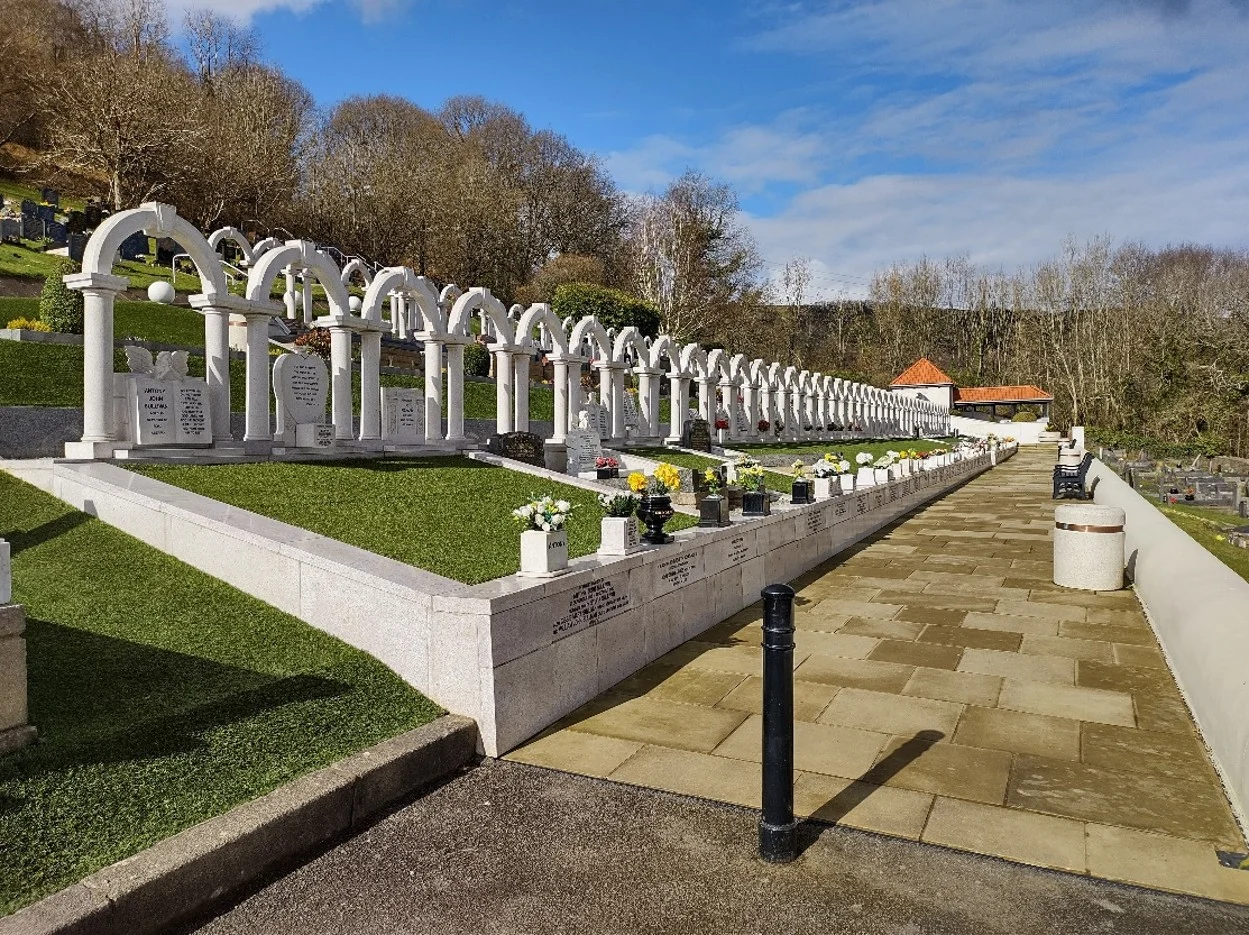
Graves of the children lost in 1966 at the cemetery in Aberfan. Photograph taken by the author.
I arrived before my colleagues and decided to walk through the cemetery to the graves of those lost in 1966. I wanted to experience the cemetery alone before they join me. I wanted the space and the solitude to experience and understand the magnitude of where I was and who I was visiting. I walked up to the graves, which are prominent within the cemetery. The graves are high up on the hillside, and form two rows of bright, white arches. Many of the headstones bore lines of poetry or scripture, mostly in English, though here and there verses appeared in Welsh.
I walked slowly and read every grave in turn. This was a deliberate act on my part. I can’t quite explain it, but I felt deep within myself that I needed to read each plaque, to know who each person was. Each grave contained the name of the child and their age, all aged 13 and under, and some graves included a photo of the child within. The photos caught me off guard. I had never seen images of those who were lost before, and it immediately humanised those children to me even more so than they had been already.
Many of the graves contained information about parents who had died more recently and had been buried with their children in the graves. In several instances, there were phrases such as “reunited at last”. It hadn’t occurred to me until this moment that so many of the parents would no longer be alive. The tragedy is still remembered so clearly across Wales, it’s somehow possible to forget that 60 years have passed. I noticed I’d been unconsciously whispering to myself as I passed the graves. I was whispering “nôs da blant bach” (“goodnight little children” in Welsh) as I walked, trying to provide some peace, although I wasn’t sure if it was for myself or for the children buried there.
I had to pause at this point as I was getting quite emotional. I have two small children at home myself, and in 2022 the oldest was four, and the youngest only 11 months. My eldest was the same age as the children who had been in Pantglas’ reception class. I had dropped her at school that morning and gone about my day, safe in the knowledge that she would be ok. Before dropping her at school, we’d had an argument about which shoes to wear, and why wouldn’t she leave the house faster as didn’t she know I had somewhere to be. Sitting here, in the cemetery, in the shadow of the graves, provided an uneasy perspective of how unimportant shoes are, compared to the loss of a child.
Compared to the loss of 116 children.
I sat on a bench away from the graves and considered the space around me. The cemetery was well cared for, with fresh flowers on most graves. It was sunny and warm. The cemetery itself was quiet, but there was plenty of sound from birds singing and from nearby traffic. Initially, the traffic noise felt intrusive, but it slowly started turning into white noise, similar to the app on my phone that helps soothe my baby when she can’t sleep. This noise reminded me of ongoing life nearby, and that those buried here were not alone.
After a while, my colleagues arrived at the cemetery, and we walked back up to look at the graves together. Our conversations were sombre and respectful, however it was a very different experience being there with the others. The conversation became more academic and less emotive. My colleagues were not from Wales, and they clearly did not feel the same connection to the disaster as I did, which made me realise I did the right thing but taking some alone time first.
The Garden of Remembrance
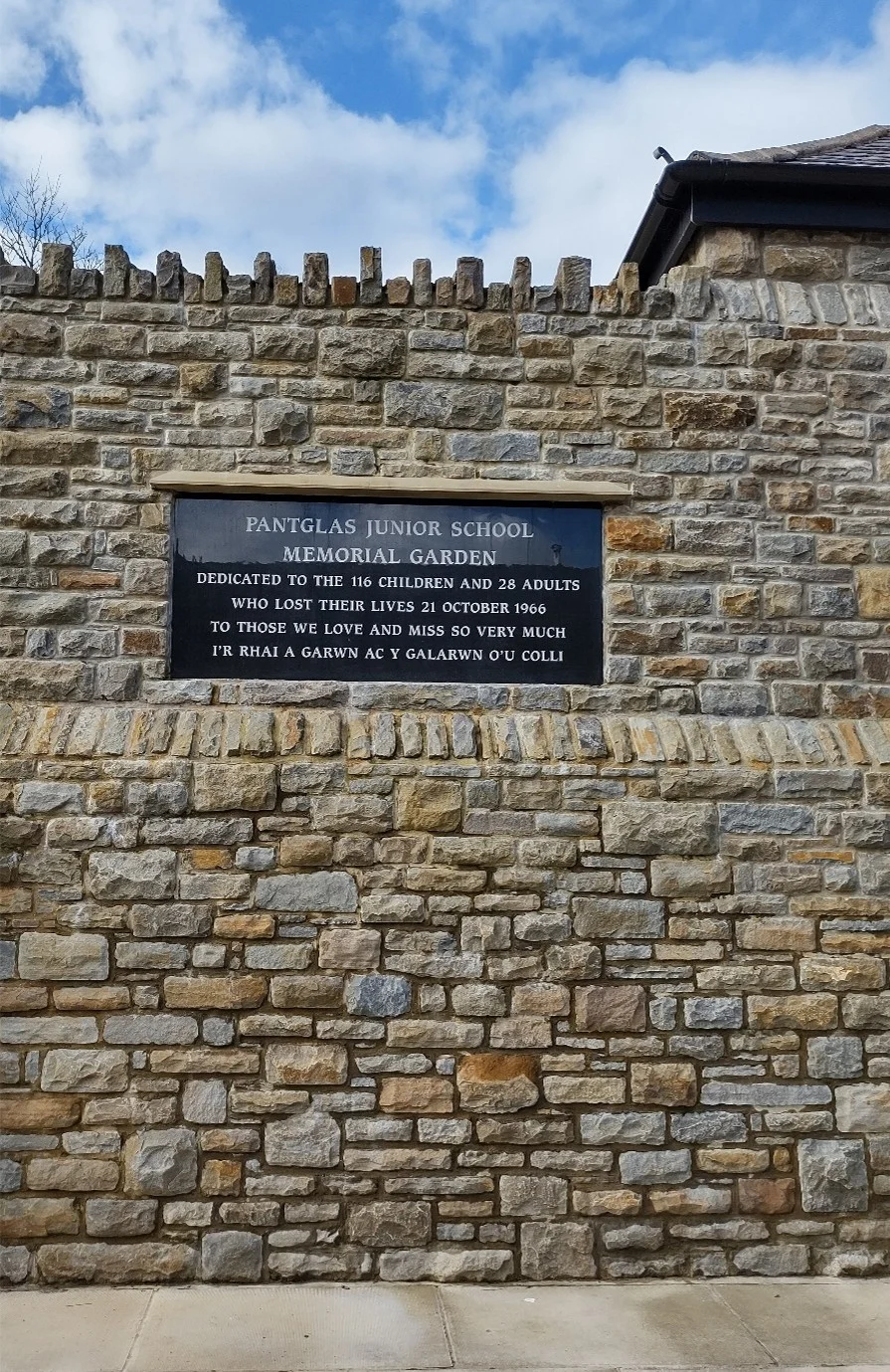
Memorial on the wall of the Garden of Remembrance to the children and adults who died in the tragedy of 1966. Photograph taken by the author.
While the cemetery is high up on the slopes of Merthyr Mountain, overlooking the town, the garden is situated lower down, at the site of the Pantglas Primary School. The garden maps out the layout of the school with pathways and grassed areas noting the location of the former classrooms. There are benches with memorials inscribed both to those lost in 1966 and to others lost more recently but still connected to the town. There is a specific memorial to the teachers and staff who worked at the school, many of whom died protecting their students.
I sat on a bench and looked up at the mountain behind the garden. The mountain where tip number 7 and its counterparts would have been located behind the school. From this perspective, it’s unimaginable that anyone would build tips in such a location.
An older lady was weeding the garden, and we stopped to talk about the weather and the different memorials. At our feet were some lavender bushes, and I commented that I was trying and failing to grow my own lavender at home in Swansea. She sighed and said these bushes always struggled to thrive as the ground below was too wet, due to the spring that ran down the hill and underneath the garden. The same spring that had saturated tip 7, causing the slide which destroyed the school. The same spring that the National Coal Board denied knowing anything about when they continued building tips on the valley sides, though tipping had originally begun under private owners in the 1910s. The same spring that had been clearly mapped on topographical and geological maps as early as 1874.
The memorial garden was peaceful, but not quiet. Next door there is a children’s playground with swings, slides and a roundabout. As I sat in the garden, I could hear children playing in the park. There was laughing, and screams of delight, sometimes tears after a fall and the occasional sound of a parent scolding some misbehaviour. At first, it felt odd to hear such sounds while sitting in a place designed to remember so many lost children. But the longer I stayed, the more comforting that sound became. There was so much damage, and so much loss here in this small village. Nothing will ever repair or replace that loss. But the laughter of those children as they played, reminded me that while Aberfan will always be connected to the tragedy of 1966; a community that’s still healing and looking to the future.
Between culpability and continuing threat
A formal tribunal was held following the disaster at Aberfan, to ascertain what had happened and if any group or individuals might be to blame. The tribunal unanimously found the National Coal Board (NCB) responsible, noting that the disaster could and should have been avoided, highlighting the ignorance, ineptitude and failures of communication of those involved. Despite the tribunal’s findings, the NCB was not fined for their involvement in the disaster, and no individuals were ever prosecuted.
As part of the tribunal, a coroner’s inquiry was held to record the causes of death of those lost in the tragedy. Most were categorised as multiple injuries, skull fractures, and asphyxiation. However, this medicalisation angered the locals in attendance. Many at the meeting verbalised that the NCB were responsible for their deaths, and as noted in the title of this piece, one man, who had lost both his children and his wife during the disaster shouted out in distress that the cause of death should be noted as “buried alive by the National Coal Board.”
The remaining tips at Aberfan were eventually removed after extensive campaigning by the village residents. The cost of removal was shared between the Government and the NCB, however a contribution of £150,000 was also demanded from the Aberfan Disaster Fund.
The disaster of 1966 was not the first time such events had happened in South Wales. There had already been similar slide events at the villages of Pentre in 1916 and Cilfynydd in 1939. There had even already been several slides on the tips in Aberfan in 1944 and 1963.
Even now, 60 years on, the legacy of the Coal Mining industry continues to haunt South Wales. Heavy rains in recent years have triggered similar spoil collapses from historical tips in Tylerstown (2020), Wattstown (2020) and Cwmtillery (2024). While not on the same scale as 1966, and thankfully without similar casualties, these incidents highlight the ongoing impact of spoil tips on local communities, particularly as our climate continues to change.
Here in Wales, the Disused Mine and Quarry Tips (Wales) Act came into force in September 2025. The Act has triggered work to identify, categorise and monitor historical coal tips across Wales with the longer-term intention to remove those tips deemed the highest risk. However, there are ongoing debates relating to where the financial burden of tip removal should fall. Most tips were created in Wales during the 1800 – 1900s, under the umbrella of the UK government. However, since Wales voted for devolution in 1997, and the formation of the Senedd (Welsh Parliament) in 1999, some suggest that we should be financially responsible for implementing our own repairs. Only time will tell what decisions are made, and in the meantime, we will continue to honour and remember those who were lost to us in 1966.
The author has translated the above to Welsh.
“Buried Alive by the National Coal Board” – Cofio trychineb Aberfan ar ôl 60 mlynedd
Mae Aberfan wedi ei leoli yng Nghymoedd De Cymru ac wedi datblygu fel pentref mwyngloddio yn ystod y Chwyldro Diwydiannol yn y ddeunawfed ganrif. Mae’r pentref yn debyg i unrhyw bentref arall yn yr ardal – rhesi ar ben rhesi o dai teras bach, wedi cwtsho mewn i waelod ac ochrau cymoedd serth. Ond, mae’r pentref yma hefyd yn enwog ar draws y byd am ei gysylltiad ag un o drychinebau mwyngloddio gwaethaf y Deyrnas Unedig.
Ar Ddydd Gwener, y 21ain o fis Hydref 1966, roedd plant Ysgol Gynradd Pantglas yn paratoi ar gyfer y diwrnod olaf o wersi cyn gwyliau’r hanner tymor. Am un deg tri munud wedi naw, fe fethodd un o’r tomeni glo, a godwyd yn uchel ar y llethr uwchben yr ysgol, ac fe lifodd dros 100,000 m3 o slyri a gwastraff glo lawr ochr y mynydd cyn chwalu drwy’r ysgol a’r adeiladau gyferbyn.
Dechreuodd y gwaith achub yn syth, gyda phentrefwyr yn brysio i’r safle, ynghyd â’r gwasanaethau brys a glowyr o’r pwll glo gerllaw. Achubwyd neb yn fyw ar ôl unarddeg o’r gloch y bore. Lladdwyd 144 o bobl yn ystod y drychineb, gan gynnwys 116 o blant, a llawer mwy wedi eu hanafu. Daeth dros 10,000 o bobl i angladd torfol a gynhaliwyd i’r rheini a fu farw ar y 27ain o fis Hydref.
I bobl a fagwyd yn Ne Cymru, mae trychineb Aberfan yn rhan fawr o’n diwylliant, ein hanes a’n hunaniaeth. Fe wnaeth y drychineb siapio cenhedlaeth, ac mae wedi cael effaith hir dymor ar y genedl gyfan. Tra fy mod i o Dde Cymru, dydw i ddim yn dod o bentref Aberfan, ond fel nifer o bobl eraill, dwi’n nabod pobl a effeithiwyd gan y drychineb, a gollodd aelodau o’i teulu, ac oedd yn rhan o’r gwaith achub.
Mae wastad wedi bod atyniad gyda fi i Aberfan. Nes i ddysgu am y drychuneb yn yr ysgol, ymchwilio’r digwyddiad ar gyfer gwaith cwrs is-radd, ac nawr dwi’n dysgu fy myfyrwyr i am beth ddigwyddodd yno. Mae fy myfyriwr doethuriaeth newydd raddio, ac fe wnaeth e ymchwilio effaith tipiau glo a’u hetifeddiaeth ar gymunedau cymoedd De Cymru, gan ddefnyddio Aberfan fel astudiaeth achos.
Ond, serch by niddordeb a nghysylltiadau, doedden i byth erioed wedi ymweld ag Aberfan tan yn ddiweddar. Roedden i’n moyn, ond rhywsut, doedd hi ddim yn teimlo’n addas. Dwi’n rhannu yn y cof a’r galar am yrr hyn ddigwyddodd, ond nid fy nhrychineb personol i yw hi, na fy stori i i’w rhannu. Roedden i’n poeni y byddai ymweld ag Aberfan yn ymwthiol neu’n foeyaristaidd rhywsut. Fel gyda lleoliadau eraill yn y Deyrnas Unedig, sy’n gysylltiedig â thrychinebau, fel Hillsborough, Dunblane a Lockerbie, does dim agweddau o dwristiaeth tywyll yn denu ymwelwyr i Aberfan. Yn lle hyn, mae’r drychineb yn cael ei choffáu gan ardd goffa ar leoliad gwreiddiol yr ysgol, ac chan ardal yn y fynwent leol ble claddwyd y rheini a fu farw.
Ond, yn 2022, ges i wahoddiad i ymweld ag Aberfan gan gyd-weithwyr oedd yn ymchwilio agweddau o Dreftadaeth Dywyll, ac oedd moyn deall mwy am gyd-destun daearyddol a diwylliannol y drychineb. Roedd hwn yn teimlo fel rheswm teilwng i ymweld â’r pentref. Fe yrrais i o fy nghartref yn Abertawe, lan y cwm ac ar draws y mynyddoedd, gan basio drwy hen bentrefi mwyngloddio. Roedd tystiolaeth o’n treftadaeth mwyngloddio i’w weld ar draws y tirlun. Doedden i ddim yn siŵr beth oedden i wedi disgwyl o’r pentref, ond roedd yn debyg iawn i unrhyw bentref arall yn y cymoedd. Roedd yna ysgol, siop, a pharc chwarae. Doedd hi ddim yn brysur, nac yn dawel, dim ond pentref ôl-ddiwylliannol arferol.
Y Fynwent
Cerrig feddi y plant a gollwyd yn y fynwent yn Aberfan. Llun: Rh. Meara.
Fe gyrhaeddais cyn fy nghyd-weithwyr, ac fe benderfynais i gerdded drwy’r fynwent at y cerrig beddi i’r rheini a gollwyd yn 1966. Roedden i am brofi’r fynwent ar fy mhen fy hyn yn gyntaf. Roedden i angen lle i brofi ac i ddeall y pwysigrwydd o ble oedden i, a phwy oedden i’n dod i weld. Fe gerddais i lan at y beddi, sydd wedi eu lleoli yn amlwg o fewn y fynwent. Mae’r beddi yn uchel ar ochr y mynydd, ac wedi eu creu mewn dwy res o fwaoedd gwyn. Mae gan sawl bedd gerddi neu pytiau o’r Beibl, fel arfer yn Saesneg, ond weithiau yn y Gymraeg hefyd.
Fe gerddais i’n araf gan ddarllen pob un bedd. Roedd hyn yn fwriadol ar fy rhan i. Alla i ddim cweit esbonio, ond roedden i’n teimlo’n gryf iawn bod angen i fi ddarllen bob plac, i adnabod pwy oedd pob un person. Roedd gan bob bedd enw y plentyn a’u hoedrannau, bob un yn 13 ac iau, ac roedd lluniau i’w gweld ar rhai o’r beddi yn dangos y plentyn a gollwyd. Roedd gweld y lluniau yn anodd. Doedden i byth wedi gweld lluniau o’r rheini a fu farw o’r blaen, ac roedden nhw nawr hyd yn oed yn fwy real i fi nag oedden nhw cyn hyn.
Roedd sawl bedd yn cynnwys gwybodaeth am y rhieni, oedd bellach wedi marw hefyd, ac wedi eu claddu gyda’u plant yn y beddi. Mewn sawl achos, roedd yna eiriau yn nodi pethau fel “reunited at last”. Doedden i heb ystyried nes y foment honno y byddai gymaint o’r rhieni bellach wedi marw. Mae’r drychineb dal wedi i’w chofio gymaint ar draws hyd a lled Cymru, mae rhywsut yn bosibl i anghofio bod 60 mlynedd wedi pasio. Nes i sylweddoli fy mod i’n siarad gyda fy hun wrth basio bob bedd. Roedden i’n sibrwd pethau fel “nos da blant bach”. Dwi’n meddwl fy mod i wedi bod yn ceisio creu bach o gysur a heddwch, ond i fi, neu i’r plant sydd wedi eu claddu yno, doedden i ddim yn siŵr.
Roedd rhaid i fi oedi yma, gan fy mod i’n mynd yn emosiynol. Mae gen i ddwy ferch fy hun, ac yn 2022 roedd yr hynaf yn bedair, a’r iengaf ond yn 11 mis. Roedd yr un hynaf tua’r un oedran â’r plant oedd wedi bod yn nosbarth derbyn Ysgol Pantglas. Roedden i wedi mynd â hi i’r ysgol bore ‘na, ac wedi gyrru yma, yn gwybod y bydde hi’n ddiogel ac hapus am weddill y dydd. Cyn cyraedd yr ysgol, roedden ni wedi cwympo mas am ba esgidiau roedd hi angen gwisgo, am ei bod hi mor araf a styfnig yn gadael y tŷ pan oedden ni mewn brys. Roedd eistedd yma, yn y fynwent, yng nghysgod y beddi, yn rhoi teimlad anesmwyth iawn am bwysigrwydd esgidiau, wrth gymharu â cholled plentyn. Am golled 116 o blant.
Eisteddais i ar fainc i ffwrdd o’r beddi ac ystyried y lle o nghwmpas i. Roedd y fynwent yn daclus, a blodau i’w gweld ar bron bob bedd. Roedd hi’n heulog ac yn dwym. Roedd y fynwent ei hun yn dawel, ond roedd digon o sŵn o’r adar yn canu, ac o draffig ar yr heol A470 gerllaw. I ddechrau, roedd sŵn yr heol yn tarfu arna i, ond ar ôl ychydig, naeth y sŵn droi mwy fel sŵn gwyn, yn debyg i’r ap ar fy ffôn oedd yn helpu fy mabi i gysgu. Doedd sŵn y ceir ddim yn tarfu, yn lle hyn, roedd hi’n atgof bod bywyd gerllaw. Yn atgoffa ni, bod y rheini sydd wedi claddu yma, ddim ar eu pen eu hyn. Roedd ystâd tai newydd i’w weld ar waelod y cwm, a thyrbin gwynt ar ben y mynydd gyferbyn. Roedd hi’n teimlo fel trawsdoriad o’r hen a’r newydd, y cofio, ond hefyd y symyd ymlaen.
Ar ôl sbel, fe gyrhaeddodd fy nghydweithwyr, ac fe gerddon ni lan at y beddi gyda’n gilydd. Roedd ein trafodaethau ni’n barchus, ond roedd hi’n brofiad gwahanol iawn bod yna gyda nhw. Roedd y sgyrsiau yn fwy academaidd, ac yn llai emosiynol. Doedd fy nghydweithwyr ddim yn dod o Gymru, ac yn amlwg heb yr un cysylltiad i’r hanes ag oedd gen i. Roedden i’n falch fy mod i wedi bod yno fy hun yn gyntaf.
Yr Ardd Goffa
Tra bod y fynwent yn uchel ar lethrau Mynydd Merthyr, mae’r ardd goffa yn bellach i lawr, ar safle gwreiddiol Ysgol Gynradd Pantglas. Mae’r ardd yn mapio safle’r ysgol, â llwybrau ac ardaloedd o laswellt yn dynodi lleoliad y dosbarthiadau. Mae yna feinciau yma, â chofebion i’r rheini a gollwyd yn 1966, ac i eraill a bu farw yn fwy diweddar, ond sydd dal yn gysylltiedig â’r pentref. Mae cofeb bendodol i’r athrawon a’r staff oedd yn gweithio yn yr ysgol, nifer a fu farw wrth geisio diogelu’r plant.
Fe eisteddais i ar fainc ac edrych lan at y mynydd tu ôl i’r ardd. Y mynydd ble byddai tip rhif 7 ynghyd â’r tipiau eraill wedi eu lleoli tu ôl yr ysgol. O’r ongl yma, mae’n angredadwy i feddwl y byddai unrhywun yn codi tipau yn y fath leoliad.
Roedd hen fenyw yn tynnu chwyn yn yr ardd, ac fe stopion ni i drafod y tywydd a’r cofebau gwahanol. Wrth ein traed, roedd sawl planhigyn lafant, ac fe wnes i sôn fy mod i’n ceisio tyfu planhigion tebyg nôl yn Abertawe. Fe edrychodd hi’n drist arna i, a nodi bod y planhigion yma o hyd yn gweld hi’n anodd i dyfu yma, gan bod y pridd yn rhy wlyb o ganlyniad i’r nant oedd llifo lawr y bryn ac o dan yr ardd. Yr un nant, a orlanwodd tip 7, gan achosi’r llithriad a chwalodd yr ysgol. Yr un nant, a wnaeth y Bwrdd Glo Cenedlaethol gwadu eu bod nhw’n gwybod amdano pan ddechreuon nhw godi’r tipiau yn yr 1910au. Yr un nant, oedd wedi ei hadnabod yn glir ar fapiau topograffeg a daearegol mor gynnar ag 1874.
Roedd yr ardd goffa yn heddychlon, ond ddim yn dawel. Wrth ymyl yr ardd mae yna barc chwarae i blant gyda siglenni a sleid. Wrth eistedd yn yr ardd, roedden i’n gallu clywed plant yn chwarae yn y parc. Roedd sŵn chwerthin a bloeddio hapus, weithau rhywun yn crio ar ôl cwympo, ac ambell i stŵr gan rieni wrth gamfihafio. I ddechrau, roedd hi’n teimlo’n wrthgyferbyniad od i glywed syniau fel hynny wrth eistedd mewn lle wedi ei ddylunio i gofio gymaint o blant colledig. Ond wrth aros yn hirach, mwyaf cysurus ddaeth y sŵn. Roedd gymaint o golled, a gymaint o ddinistr yn y pentref bach yma. Neiff ddim byd byth adfer neu amnewid hynny. Ond roedd clywed sŵn y plant bach yna wrth iddyn nhw chwarae, yn atgoffa fi i feddwl am Aberfan, nid yn unig am ei gysylltiad i’r drychineb o 1966, ond hefyd fel cymuned sy’n dal galar y gorffennol, tra hefyd yn edrych tuag at y dyfodol.
Rhwng euogrwydd a bygythiad parhaus
Cafwyd tribiwnlys ffurfiol ar ôl y drychineb yn Aberfan, i ddeall beth oedd wedi digwydd, ac i benderfynu a oedd unrhyw grŵp neu unigolyn yn gyfrifol. Fe gytunwyd heb os, mai’r Bwrdd Glo Cenedlaethol (BGC) oedd yn gyfrifol, ac fe nodwyd y gall y drychineb fod wedi ei hosgoi, gan nodi anwybodaeth, anallu a methiannau cyfathrebu y rhai dan sylw. Er gwaethaf darganfyddiadau y dribiwnlys, chafodd y BGC byth ei ddirwyio am ei rôl yn y drychineb, ac ni aeth unrhyw unigolyn i’r carchar.
Yn ystod tribiwnlys y drychineb, cafwyd ymchwiliad crwner i recordio achosion marwolaeth y rheini a gollwyd. Categoreiddiwyd y rhan helaeth fel “multiple injuries, skull fractures, and asphyxiation”. Ond roedd y meddygoli yma yn cynddeirio’r bobl leol oedd yno. Fe wnaeth nifer yn y gyfarfod, fynegi ar lafar mae’r BGC oedd yn gyfrifol am eu marwolaethau, ac fel y nodwyd yn nheitl y darn, fe waeddodd un dyn, oedd wedi colli ei wraig a’i ddau blentyn, y dylai achosiad marwolaeth gael ei nodi fel “buried alive by the National Coal Board.”
Fe gliriwyd gweddill y tomenni glo o Aberfan ar ôl ymgyrchu helaeth gan drigolion y pentref. Fe rannwyd cost y gwaith clirio rhwng y Llywodraeth a’r BGC, ond mynwyd bod cyfraniad o £150,000 i’w dalu o Gyllid Trychineb Aberfan.
Cofeb ar wal yr ardd goffa i’r plant a’r oedolion a bu farw yn y drychineb yn 1966. Llun: Rh. Meara.
Nid trychineb 1966 oedd y digwyddiad cyntaf fel hyn yn Ne Cymru. Roedd llithriadau tebyg wedi digwydd ym Mhentre yn 1916 ac yng Nghilfynydd yn 1939. Roedd hyd yn oed sawl llithriad wedi digwydd ar y tipiau yn Aberfan yn 1944 ac 1963.
Hyd yn oed nawr, 60 mlynedd yn ddiweddarach, mae etifeddiaeth y diwydiant glo yn parhau i daflu cysgod ar draws De Cymru. Mae glaw trwm dros y blynyddoedd diwethaf wedi achos llithriadau pellach mewn nifer o dipiau glo hanesyddol yn Tylerstown (2020), Wattstown (2020) a Chwmtileri (2024). Tra nid ar yr un graddfa ag 1966, a diolch byth heb anafiadau, mae’r digwyddiadau yma yn uwch oleuo’r effeithiau parhaus mae tipiau glo yn cael ar ein cymunedau, yn enwedig wrth i’r hinsawdd barhau i newid.
Yma yng Nghymru, mae’r Ddeddf Tomenni Mwyngloddiau a Chwareli Nas Defnyddir (Cymru) 2025 wedi dod ’r ffrwd ym mis Medi 2025. Mae’r Ddeddf wedi sbarduno gwaith i adnabod, categoreiddio a monitro tipiau glo hanesyddol ar draws Cymru, gyda’r bwriad hir dymor i gael gwared ar y rhai mwyaf peryglus. Serch hynny, mae trafodaethau yn parhau am pwy ddylai fod yn gyfrifiol am gost am y gwaith yma. Ffurfiwyd y rhan helaeth o’r tipiau yng Nghymru yn ystod yr 1800 – 1900au, o dan faner llywodraeth y Deyrnas Unedig. Ond, ers i Gymru bleidleisio dros ddatganoli yn 1997, a ffurfiad y Senedd yn 1999, mae rhai yn awgrymu y ddylen ni fod yn gyfrifol am ariannu y broses o glirio’r tipiau ein hun. Dim ond amser fydd yn dangos pa benerfyniadau fydd yn cael eu gwneud, ond yn y cyfamser, byddwn ni’n parhau i anrhydeddu a chofio y rheini a gollwyd i ni yn 1966.