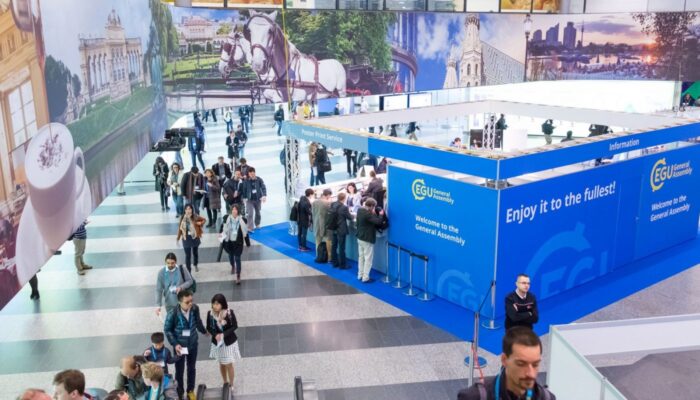
As we immerse ourselves in our 20th Viennese General Assembly EGU26, the volume of climate models and atmospheric projections can be quite overwhelming, to say the least. While our EGU geoscientific community is excellent at observing the planet, a persistent challenge remains in communicating that massive planetary data into tools that a local council, a commercial farmer, or an urban planner can actually use. This is where the Green Meridian Information Factory (GMif) steps in and provides a bridge between high-altitude satellite archives and, let’s call it ground-level decision-making.
The GMif project represents a significant ESA initiative designed to turn raw pixels into actionable knowledge. Focused on the land and air masses of the UK, Ireland, and France, it moves beyond traditional observation to create a web-based geospatial information system (webGIS). This week, the project team is inviting you to move from being mere observers to active participants in the Information Factory exchange, a spinter meeting titled: SPM53: Demonstration of the Green Transition Information Factory capabilities for UK, Ireland and France, organized by Jan-Peter Muller, Patrick Griffiths, and Rob O’Loughlin, taking place in Room 2.97 on Friday 08 May, 12:45–13:45 CEST.
This session is designed as an interactive workshop where scientists can explore how high-resolution Earth Observation data is being funneled into five transition domains. The project demonstrates mapping of urban heat anomalies at a resolution of 25 and 7.5 meters. This level of detail allows for a shift in focus from broad regional trends to specific public infrastructure. This enables the identification of which schools or hospitals are most vulnerable during extreme heat events. Similarly, the mobility and air quality component challenges the status quo of sensor placement.
Food security is addressed through a sophisticated fusion of Sentinel-2, Landsat-TM, and ERA5 data, which downscales drought forecasting to a 10 meter sub-field resolution. This allows for a granular understanding of crop resilience, and therefore helps farmers navigate the impacts of global heating on a field-by-field basis. For the energy transition, the team has developed a decision-support tool focused on the placement of raised bi-facial photovoltaic systems. This approach allows for the generation of solar power without encroaching on sensitive environments or despoiling the landscape: think of it as a way to offer a sustainable path for rural landowners who are facing economic pressures. Finally, the carbon accounting capability uses Sentinel-2 and the EarthDaily constellation to capture methane plume eruptions at resolutions as sharp as 60 meters, and provides a time-series tool for monitoring unplanned industrial emissions.
This Friday’s workshop is a request for feedback. The Factory concept relies on an exchange where your expertise helps refine these tools to better serve international research and local policy. You will have the chance to interact with the webGIS interface directly and discuss how these capabilities can be adapted to other geographical regions or specific research needs.
Curious to see how the European Space Agency is operating its data for the Green Transition? Then make sure not to miss this splinter meeting. Regardless of your field of expertise, this session will offer you a glimpse into the future of applied geosciences.
For those eager for a preview, a brief demonstration of the eodashboard will take place at the ESA stand on Thursday at 16:40. However, for a full exploration of the science and a chance to influence the project’s direction, the Friday splinter session is the place to be. More information and the client interface itself can be explored online at the project’s official website.