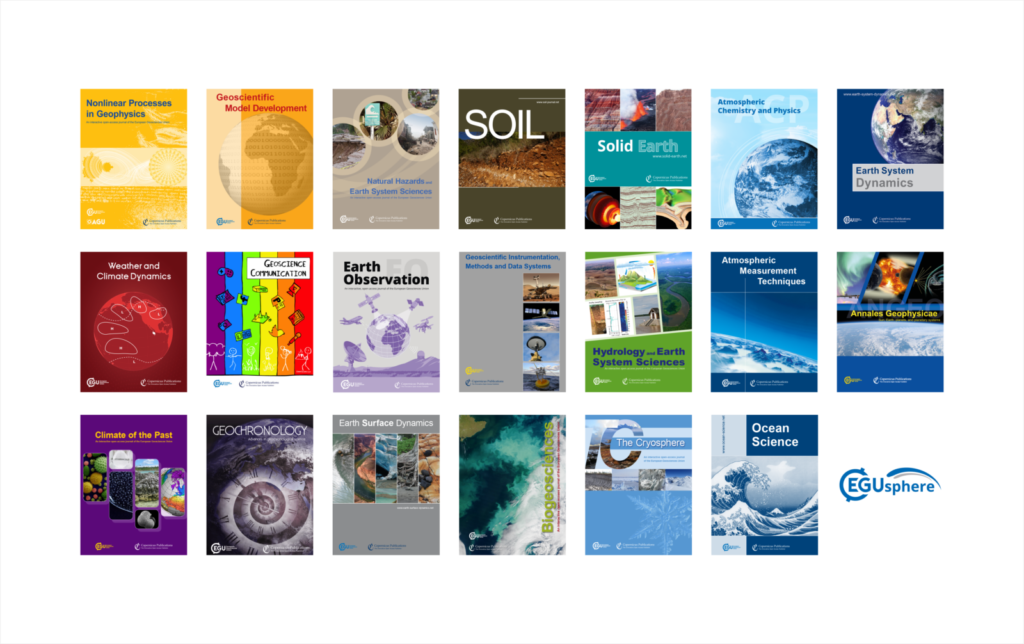
Each month we feature specific Divisions of EGU and during the monthly GeoRoundup we put the journals that publish science from those Divisions at the top of the Highlights section. During this month, we are featuring The Cryosphere (CR) and Solar-Terrestrial Sciences (ST). They are represented by the journals Geoscientific Model Development (GMD), Annales Geophysicae (ANGEO), and The Cryosphere.
A source or a sink? How the altitude of particle precipitation influence high-latitude electrodynamics – 26 February 2026
When energetic particles rain into Earth’s lower ionosphere, they ionize the gas, creating a highly conductive base layer. Using a large database of observations from four orbiting space weather satellites, we demonstrate that this plasma foundation acts as a giant electrical short-circuit: it actively neutralizes the electric fields that would otherwise power plasma turbulence higher up. Without this conductive base to drain the energy, topside turbulence freely grows and persists.
 Geoscientific Model Development
NorESM2–DIAM: a coupled model for investigating global and regional climate-economy interactions – 12 February 2026
We introduce NorESM2-DIAM (Norwegian Earth System Model version 2-Disaggregated Integrated Assessment Model), a first-of-its-kind tool linking a climate model with a high-resolution economic model to study how climate change, internal variability, and economic activity interact across the world. The model reveals strong regional differences and large annual swings in economic impacts, offers insights for climate policy discussions, and provides a strong foundation for future model development.
Water vapour isotope anomalies during an atmospheric river event at Dome C, East Antarctica – 09 February 2026
In December 2018, an atmospheric river event from the Atlantic reached Dome C, East Antarctica, causing a +18 °C warming, tripled water vapour, and a strong isotopic anomaly in water vapour (+ 17 ‰ for δ18O) at the surface. During the peak of the event, we found 70 % of the water vapour came from local snow sublimation, and 30 % from the atmospheric river itself, highlighting both long-range moisture advection and interactions between the boundary layer and the snowpack.
Atmospheric Measurement Techniques
Enhancing dust aerosols monitoring capabilities across North Africa and the Middle East using the A-Train satellite constellation – 18 February 2026
Machine-learning models of δ13C and δ15N isoscapes in Amazonian wood – 02 February 2026
Northward shift of boreal tree cover confirmed by satellite record – 05 February 2026
Nutrient flows and biogeomorphic feedbacks: linking seabird guano to plant traits and morphological change on sandy islands – 26 February 2026
The largest crop production shocks: magnitude, causes and frequency – 03 February 2026
Investigating controls on fluvial grain sizes in post-glacial landscapes using citizen science – 05 February 2026
Challenges and opportunities for understanding societal impacts of climate extremes – 27 February 2026
FAIR fission track analysis with geochron@home – 25 February 2026
Natural Hazards and Earth System Sciences
Towards an operational European Drought Impacts Database (EDID) – 20 February 2026
Lessons learned in institutional preparedness and response during the 2022 European drought – 27 February 2026
Phytoplankton blooms affect microscale differences of oxygen and temperature across the sea surface microlayer – 09 February 2026
Mesoscale variability and water mass transport of the Caribbean Current revealed by high-resolution glider observations – 23 February 2026
EGU in the news – February
- The Micropalaeontological Society draws attention to their EGU26 session Harnessing foraminifera and other microeukaryotes to understand Earth’s ecosystem changes: perspectives from past, present and future
- Mission Earth Ambassadors initiative at EGU26? Register for the workshop here
- AnaEE-ERIC to Present at EGU2026: Advancing Ecosystem Research in the Face of Global Change
- SCAR will be convening a session on Antarctic ice sheet past to future: bridging science to decision making at EGU26