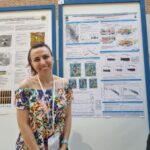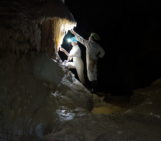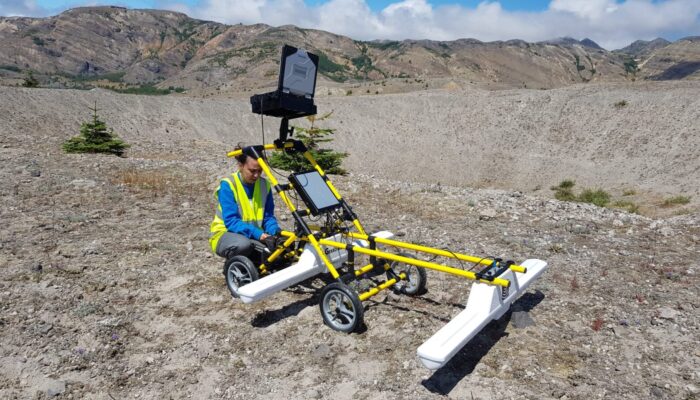
Hello you, and happy International Day of Women and Girls in Science! My name is Simona Gabrielli, and I am a researcher at the INGV (Istituto Nazionale di Geofisica e Vulcanologia, Italy), where I study seismic attenuation (in other words: how earthquakes lose energy while passing through rocks), to understand the presence of fractures and fluids.
My specialization in recent years has been in tectonic and volcanic seismology, and I focus on the central Apennines and Mt. St. Helens volcano.
Before coming back to my home country, Italy, in 2020 (and I’m still in a non-permanent position, but we will get back to that soon!) I had to travel extensively to find my proper path, to define what I could achieve and what I could become as a scientist, and, most of all, as a Female Scientist. What really changed my life was the opportunity to pursue a Ph.D. at the University of Aberdeen in Scotland, a place that opened my eyes even more than they already had been. The comparison between different universities and research environments showed the blatant gender gap in Italy. I can start by talking about one of the most classical questions during a Ph.D. interview in Italy: “How could you handle being distant from your partner?”, which insinuates that a woman wouldn’t/couldn’t move or give up her career for love.
I still remember vividly the shock of that moment; my mind kept repeating, “No one would ask me this if I were a man.” It was one of the first times that the gender bias hit me directly, right after I had just graduated! At that point, I started to picture myself climbing what I can describe as a really crowded mountain, women trying to find a spot in a world that doesn’t fit them.
My doctoral studies in the UK immersed me in a daily discourse regarding FLINTA* in STEM, an experience that was as inspiring as it was resourceful. However, it also highlighted the saddening reality: this level of engagement is far from the global standard and, in many spaces, continues to face significant institutional resistance.
As I wrote before, I don’t hold a permanent position, and this is one of the main struggles I face as a woman in STEM: the uncertainty of my work situation. Don’t get me wrong, research means changes, continuous motion, and cooperation around the world. This is a transversal problem that affects the entire early- and mid-career scientific community, regardless of gender. If your home country is unable to sustain this instability and uncertainty with proper wages and welfare structures, you are unable to plan your life (have your own family, buy a house, …), and you feel powerless.
Let’s talk statistics
The journey through Italian academia begins on relatively level ground, with women holding a hopeful 44.1% of early-career roles, but as the path climbs toward the peak of full professorship, a quiet exodus occurs. By the time the summit is reached, the landscape shifts dramatically, leaving women to occupy only 27% of those top-tier positions, quite the leaky pipeline also documented in the geological sciences by Radeff et al. (2025). This is the story of the 30s pivot, a crossroads where brilliant researchers are more likely to be forced to choose between the laboratory and the living room, especially in a culture where only 20–21% of fathers utilize optional parental leave. Yet, even these sobering numbers from the 2024 ANVUR report don’t tell the whole story; because the data remains strictly binary, gender-diverse and trans researchers are rendered effectively invisible, leaving us without a true map of the obstacles faced by those who don’t fit into a “standard” statistical column.
This leaves the entire burden of the family on women’s shoulders, automatically increasing the gender gap in STEM. This has an impact, for instance, on women with families or caregivers who should attend a conference, a fundamental part of our job. While some conferences now provide funds or support for such cases, others don’t, leaving women once again to choose between family and work. EGU has an EGU EDI Participation Support Scheme, which provides financial assistance to scientists who encounter significant EDI-related financial barriers that prevent them from attending the EGU General Assembly. The deadline for this year’s applications is 20 February. You can check the eligibility criteria and how to apply here: https://www.egu26.eu/authors/financial_support_and_waivers.html#edi-support .
This uncertainty is stressful for all of us and can affect our work. Our daily lunches at work in the past months have been mostly focused on these difficulties: several women in their thirties, with the same work instability, who confide in each other about possible solutions to the problem. And even if it sounds like a sad moment, it is also wonderful to hear the resilience of this group of girls and the different plan Bs they have (mine, personally, is to open a wine shop, but that’s a story for another day). But that is the point: we should not have a plan B! We are already working and fulfilling our plan A!
Moreover, as you all may know, geology and geophysics (as many other STEM disciplines) include fieldwork, which could become another “invisible” problem for women in STEM. Managing the menstrual cycle during geological surveys can be a very practical but often overlooked topic. When it comes to fieldwork, it is important to me to calculate my period before planning a campaign, due to my reduced mobility and extremely severe pain, but sometimes you cannot avoid it, and you still go on. The need to calculate such a more detailed plan can be an additional “mental burden” compared to other male colleagues. And sometimes, it is not taken into account at all.
I assume, I hope, that the logistical challenges of being in places without bathrooms or shelter are well known. For example, during my PhD fieldwork at Mount St Helens, there wasn’t even a tree to hide under, making managing personal hygiene a logistical nightmare that men don’t have to face.
This brings me to another point: what I highlighted so far is a binary vision of the problem of women in STEM. Science is not only male or female, and the diversity in the gender spectrum should be addressed equally. Fieldwork, for instance, can turn into an unpleasant situation for transgender* folks, as much as the difficulties of acceptance in a closed-minded work environment that does not allow you to exist or behave authentically.
I consider myself as someone who has been and is still fortunate, as I have the privilege to spend my career years surrounded by empowering women leaders and supportive supervisors. Their commitment to recognizing and addressing unconscious gender bias has been creating a better environment of continuous growth and meaningful change
And this is what I would like to see in the future: more awareness and more education. I am a firm believer that most people in a workplace don’t create problems out of malice. It can be difficult for some to intuitively understand logistical needs or fluctuations in capacity that they haven’t personally navigated. To bridge this gap, we must replace assumptions with open dialogue. Updated training courses. Self-paced unconscious bias training for any new employee or contractor. There are so many ways to improve any workplace by simply tackling the assumption that as long as people’s intentions are good, what is said and done should not matter much. It does. Harm can be done regardless of intention. Thus, speaking candidly about our socialisations, biological, and practical realities without shame, is the way to normalise these experiences within academia and the workforce. Only when we build an environment that accommodates all people can we stop wasting energy on ‘Plan B’ contingencies and focus entirely on our ‘Plan A’ ambitions.