The Think2030 Dialogue Denmark was held in crucial times, since once the uncontested frontrunner in global climate governance, Europe now faces the dual challenge of renewing its leadership and maintaining competitiveness amid a shifting geopolitical and technological landscape, alongside a constantly changing multilateral world order. At a time when global competition over clean technologies, resources, and policy influence is accelerating, the offers an opportunity to reassess Europe’s climate leadership.
The discussions amongst policy-related organisations, academia, the business sector and civil society at the Think2030 Denmark were focusing on the recently pressing debates around environmental policy, including agriculture, energy, competitiveness and financing. The Think2030 Dialogue Denmark, the event organised by CONCITO, Institute for European Environmental Policy (IEEP), and Think Tank EUROPA and in association with the Danish Presidency of the EU Council, welcomed us to represent our collaboration and joint IEEP-EGU Policy Mentoring scheme.
European decision-makers, businesses, policy experts and civil society leaders to discuss some of the most pressing sustainability challenges facing Europe. The event provided a dedicated space to share evidence, exchange perspectives, and co-develop actionable solutions for the decade ahead. The event programme delivered strategic insights and policy recommendations on the overall political approach of the EU and the required financial underpinning, featuring a combination of high-level keynotes, plenary sessions, as well as a series of breakout ‘science and policy sessions’ for more in-depth policy discussions with prominent experts.
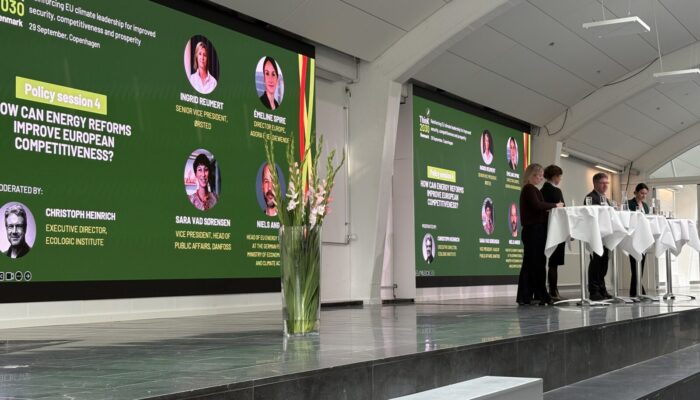
During the conference, discussions across panels and breakout sessions reflected both pride in Europe’s green achievements, but also a growing awareness that historic EU climate leadership alone will not suffice. Science, policy, and industry must evolve in tandem to deliver on the continent’s long-term ambitions of the European Union. The science and policy sessions focused on the role of agriculture in the post-2030 climate architecture, the EU’s Clean Industrial Deal, the challenge of financing the green transition, and the role of energy reform in improving EU competitiveness.
Too naive to think Europe is still a climate leader?
The European Union has built, over the past decades, and contributed to shaping a broad climate policy architecture, greenhouse-gas emissions, renewables, energy efficiency and a progressively integrated framework for the post-2020 period. In 2019, the most ambitious climate action set by the continent, the European Green Deal (presented in December 2019), anchored the goal of making Europe the world’s first climate-neutral continent by 2050, combining economic growth with clean-energy transition. With the Green Deal, the EU green agenda created a momentum: from the European Green Deal to leadership in global negotiations, the continent has consistently set high standards. As a key result of these developments, the EU and its global reputation as a pioneer in climate policy have been grounded in decades of science-informed policymaking, ambitious climate and green agenda targets, unilateral trade measures (over bilateral trade agreements) and overarching regulation, as well as international and multilateral diplomacy.
On the global stage, Europe has been considering itself as a central diplomatic player, as well as remaining the world’s largest public climate-finance donor, contributing around €28.6 billion in 2023 and mobilising another €7.2 billion in private investment. In parallel, the EU continues to step up its own climate-finance contributions: in 2024, the EU and its 27 Member States reportedly provided about €31.7 billion in public climate finance and mobilised an additional €11.0 billion in private finance.
Yet, due to the current geopolitical shifts, the conference speakers repeatedly emphasised that Europe’s climate leadership is now being tested. The current Danish Presidency, for instance, underscored the urgency of safeguarding Europe’s climate leadership by 2030 through continued innovation and investment in clean technology. As highlighted during the conference, we need to bring the climate targets closer to the business sector to build a prosperous Europe. Participants from think tanks and government institutions highlighted that the narrative around climate policy has shifted. In fact, science is no longer just a warning signal but a strategic resource. Meaning that climate ambition today must be driven by ‘greenovation’, measured not only in emission targets but in technological capacity and resilience.
The 3 equal pillars: climate ambition, economic competitiveness and energy security
Since 2022, with the war in Ukraine, a recurring theme throughout conferences, and thus the Think2030 as well, is the intricate balance between these 3 pillars. The current geopolitical tensions have accelerated the convergences and also set the scene for new types of security questions that the EU has to face currently, namely that the energy systems become geopolitical battlegrounds, and Europe’s ability to ensure secure and affordable energy access is now seen as a prerequisite for sustained climate action.
The speakers and participants identified that in this immensely changing reality of the 21st century, there is a need to create a new climate policy architecture. In order to build the new systemic structure for it, the conference aimed to collect the policy recommendations for creating one that integrates climate objectives with industrial, trade, and security strategies as well.
- The participants noted that Europe cannot afford to view climate policy in isolation; it must be framed within a broader economic and geopolitical strategy.
- Several contributors warned that Europe must become more strategic in aligning its policy tools, funding mechanisms, and international partnerships.
- The EU’s regulatory strength remains unmatched, but without greater coordination between innovation policy, industrial competitiveness, and climate goals, leadership risks becoming fragmented.
- To lead globally, Europe must also lead in innovation, implementation, and resilience. Whereas European economic productivity has shrunk over the past three years. The strategic foresight (understanding where technologies originate, how supply chains evolve, and where Europe adds value) will determine whether the EU remains a rule-setter or becomes a rule-taker in the green economy.
Key challenges include industrial competitiveness (especially in energy-intensive sectors), technological dependency, rigid regulations, and the slow pace of energy transition in key sectors like transport and manufacturing. Meanwhile, cheaper fuels and resilient infrastructure were highlighted as powerful lenses through which climate policies can engage broader concerns about energy and security.
Science is a cornerstone of a new climate policy architecture
Tension was apparent between the proponents of simplifying legislation and those emphasising the need for strong targets: the EU’s regulatory framework needed to be reduced to hasten adaptation and prevent businesses from waiting for regulation to catch up.
However, such measures may amount to dismantling the regulatory framework and undermining climate goals; legislation provides legal clarity, after all. Instead of weakening one of Europe’s assets, it was argued that there should be a greater focus on increasing national capacity to adapt by funding knowledge sharing and technical training to deliver targets.
Similar friction emerged over the carbon capture and storage capacities, calls for more funding and improved solutions for carbon removal systems were challenged, with carbon capture technologies highlighted as not being ready to be deployed or scaled up, especially regarding poorer cost efficiency. Carbon removal is not a silver bullet: negative emissions are required, not just net zero, a target which can only be achieved by cantering emission reduction targets.
Such tensions have developed along the assumption that regulation is bad for business; however, this opinion is far from monolithic: strong, science-based regulation establishes a scope within which businesses can act to minimise risk and provides direction in the face of uncertain futures. Unilever, for example, has called for stronger legislation to ensure climate-resilient supply chains and energy supply.

IEEP and some of the EGU representation at Think2030
Think2030 showcased the essential role of scientists and think tanks in bridging the gap between data and decision-making, a principle increasingly recognised across EU institutions. Science and research institutes are vital for providing the clarity and trust needed to shape future policy and business decisions. Scientific predictions form the foundation of stable policy frameworks, which are necessary for guiding industrial competitiveness and investment amid the green transition. Because science can also help mitigate unintended consequences (like social inequalities), participants emphasized that evidence-based policymaking must be central to Europe’s climate and industrial transformation.
Speakers urged a more coherent science-policy-industry interface to translate research into actionable policies and investments, requiring better coordination between EU targets (e.g. EU 2040 climate targets), national plans, and industrial strategies. While science provides a fair foundation for climate targets, achieving Europe’s long-term neutrality goals demands breakthroughs in clean energy, grid infrastructure, and carbon removal. To renew Europe’s climate leadership and drive growth, participants called for stronger coordination and simpler procedures for “Made in Europe” initiatives, ensuring science-informed policy and industrial innovation build a climate-resilient Europe that couples technological sovereignty with competitiveness and social trust.