The links between geomythology and science are considerable and officially began with the works of Vitaliano (EGU Blog – Geomythology. True science and/or strong communication medium ?!) and continues nowadays thanks to the Geoheritage Journal edited by Springer Nature, and evident in two proposed sessions to the EGU sessions, including one from the 2025 conference entitled “Geomythology: Bridging the Humanities and Geosciences” and a 2026 panel, “Mythogenic Landscapes”. In addition, the ScienceDirect database currently lists nearly 40 papers with “geomythology” in the title and many more related to the topic; a Google Scholar research shows about 1360 publications with “Geomythology” in the title and/or as a content.
Preceding Vitaliano
Yet Vitaliano had important predecessors, including Euhemerus, a 4th century BC philosopher, one of the first to analyse the Greek gods from a rationalistic perspective. He had an epiphany of sorts when he encountered a stele on what is now the island of Socotra (Yemen), listing the birth and death years of members of the Greek pantheon. Euhermerus came to regard those figures, not as supernatural, but as local, human leaders who had been promoted to divine status through legends. His approach, known as euhemerism, influenced Vitaliano’s definition of geomythology as “the geologic application of euhemerism”.
Other precursors include Palaephatus, Euehemerus’s protégé, who composed a work of paradoxography entitled On Incredible Things, in which he examines mythical persons from a naturalistic perspective. For instance, the Amazons, he contends, were not warrior women, but men who wore long skirts and ribbons in their hair, yet who were also able to fight (On Incredible Things, section 32). Palaephatus also dismissed the idea of men flying, suggesting instead that Daedalus and Icarus were imprisoned by King Minos, until Daedalus escaped and lowered Icarus through the prison window in a basket. They then sailed away, pursued by Minos’s men, and when a strong wind caught their boat, it was as if they were “flying” (Fig.1). However, the boat also capsized, and while Daedalus was able to swim to shore, Icarus drowned (On Incredible Things, section 12).
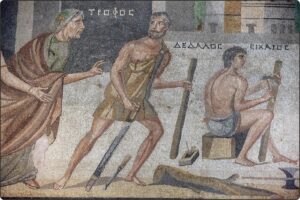
Fig.1. Daedalus and Icarus, mosaic from the ancient city of Zeugma in Türkiye. Public Domain
Palaephatus’s work can make for tedious reading, yet some of his explanations are plausible, such as his account of the founding of the Greek city of Thebes. According to this legend, on his way to rescue his sister Europa, who had been abducted by Zeus, the Phoenician prince Cadmus slew a dragon, then sowed the dragon’s teeth in the ground; the teeth yielded a crop of fierce warriors who helped him start the city (Fig. 2). Yet Palaephatus argues that the teeth were those of an elephant (Greek eléphās) and were initially owned by King Drakon of Thebes (On Incredible Things, section 3). Cadmus came to this region of Greece, after falling out with brother/rival Phoenix, then killed Drakon and seized the crown. At this point, Drakon’s friends fought back, and when Cadmus bested them, they fled, taking with them Drakon’s treasures, including the teeth. Eventually, men from other regions rose up against Cadmus, and the Theban citizens concluded that Cadmus’s king-slaying was an evil action, and that Drakon’s teeth had created this new crop of warriors.
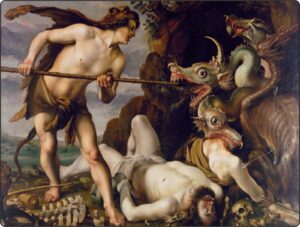
Fig. 2. Cadmus Fighting the Dragon. Hendrik Goltzius. Statens Museum for Kunst, 1500. Public Domain.
This “explanation” may be convoluted, true, yet it constitutes one of the first instances of an ancient thinker recognizing the truth informing a legendary claim, namely, that the so-called dragon teeth were in fact molars from an ancient species of pachyderm. Hence, we might put Palaephatus among the first geomythologists.
More recent figures who anticipated Vitaliano’s insights are Robert Hooke (1635–1703), the “English Leonardo” who grappled with the riddle of how fossilized marine organisms are found at the top of high mountains, far from the ocean. Hooke conjectured that some mountains were once lower lands that had been raised up by earthquakes. In his Lectures and Discourses of Earthquakes and Subterranean Eruptions (1667–68), he explains this claim mythologically, by alluding to the Gigantomachy, the legendary war of the Giants (including figures such as Enceladus, Mimus, and Polybotes) against the Olympians. Hooke argues that the poets Ovid and Virgil told this narrative as a way of explaining the actions of earthquakes and volcanoes. In Ovid’s account, for instance, the Giants pile up rocks and stones to bring themselves close to heaven. From there, they threaten the Olympians, but are overthrown by Zeus’s thunderbolts, then imprisoned under the earth (Metamorphosis, 1.183 et passim) (Fig. 3).
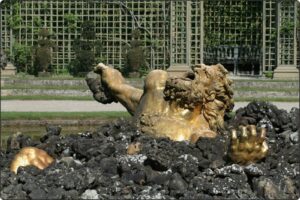
Fig. 3. Enceladus. Gaspar Mercy. Gilt-bronze. Versailles, France. Photo by Coyau. Uploaded 6 May 2011.
Ovid specifically names Mt. Olympus, Mt. Ossa, and Mt. Pelion as the locations of the battle; it is interesting to note how these locations all fall in the Thessaly region, which is characterized by active and seismogenic normal faults and was hit by a few earthquake induced tsunamis (Kassaras et al., 2020, Fig. 4).
Another scientist who anticipated Vitaliano is Georges Cuvier (1769-1832), the father of palaeontology. He kept careful records of all fossil and bone finds in America, as well as legends told about them. As a result, among other things, he was able to refute Thomas Jefferson’s hypothesis that the Incognitum, an allegedly carnivorous elephant, still roamed the western half of the United States. In fact, Cuvier posited that these animals were now extinct, and, further, that they were herbivorous; he turned out to be correct.
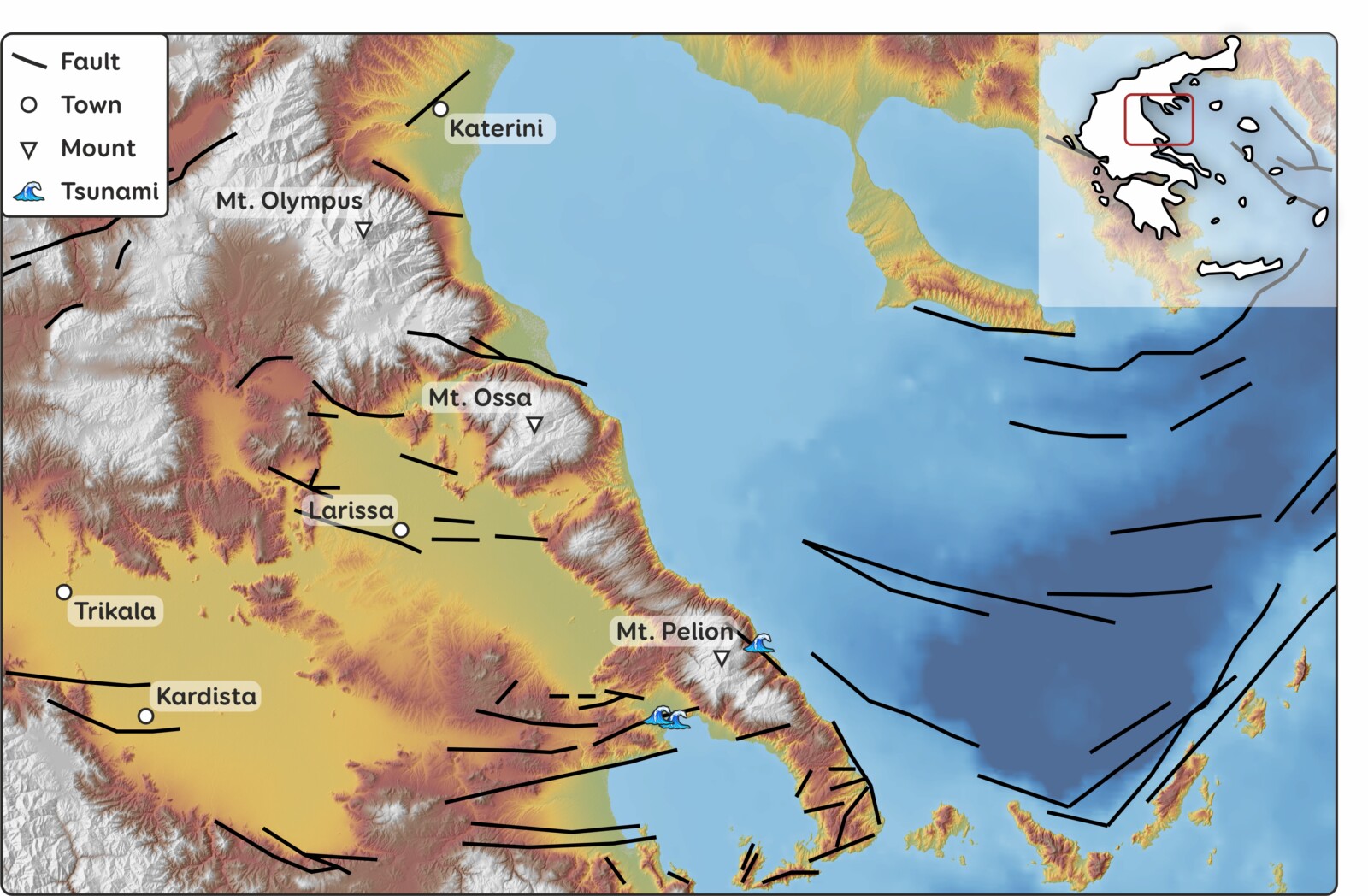
Fig. 4. Structural map showing the topography, bathymetry, seismogenic faults and earthquake related tsunamis of the Thessaly area and surroundings (Modified after Kassaras et al., 2020).
Cuvier, along with Virgil, Ovid, and Hooke, as well as figures like them, matter because they show that geomythology is not a recent fad, but rather, an idea with significant pre-modern roots.
References
Hooke, R., 1667–1668. Lectures and Discourses of Earthquakes and Subterranean Eruptions.
Kassaras, I., Kapetanidis, V., Ganas, A., Tzanis, A., Kosma, C., Karakonstantis, A., Valkaniotis, S., Chailas, S., Kouskouna, V., Papadimitriou, P., 2020. The New Seismotectonic Atlas of Greece (v1.0) and Its Implementation. Geosciences 10(11), 447. https://doi.org/10.3390/geosciences10110447.
Ovid, Metamorphoses. Translated By Samuel Garth, John Dryden, et al. The Internet Classics Archive, http://classics.mit.edu/Ovid/metam.html. Consulted on 09.03.2026.
Palaephatus, On Incredible Things. Translated by John Brady Kiesling. Consulted on 09.03.2026.