1. Introduction
Space weather is significantly affected by geomagnetic disturbances (GMDs) that occur during or after intense solar events such as coronal mass ejections (CMEs), which expel substantial amounts of electromagnetic particles into interplanetary space. Most of these particles collide with the magnetosphere (the outermost region of the atmosphere) where the solar wind (continuous flow of ionized particles) meets the Earth’s magnetic field and can cause compression of the magnetosphere [Gonzalez et al. 1998]. GMDs occur most frequently at the peak of the 11-year solar cycle, characterized by high sunspot activity. Evidence of past solar magnitude can be found in natural proxies, such as variations in tree rings [Rigozo et al. 2002].
The question of the correlation between space weather and biological indicators was addressed by Russian scientists such as Chizhevskii and Vernadsky, as early as the 1910s. Chizhevskii suggested a correlation between the periodic influence of the sun on the Earth’s biosphere, observing synchronous variations in the number of sunspots in relation to epidemics, epizootics, the reproduction of certain types of bacteria, and animal migration.
Regarding migration, it was added that migratory animals are guided by the geomagnetic field (GMF), and although it is not yet entirely clear how this occurs, an accepted proposal is that there is magnetoreception or magnetosensitivity in mammals and birds, and that the GMF transmits orientation and position information during migrations. Birds, for example, use two types of GMF information for their navigation: the direction of the field lines like a compass and, probably, the magnetic intensity, which seems to be perceived by magnetite-based receptors in the beak region [Wiltschko et al. 2019].
2. Key Points/Insights
● The Schumann resonance (SR) phenomenon was initially conceived and proposed by the German physicist W. O. Schumann. The existence of the signals was confirmed by measurements in the mid-1950s [Polk 1982]. The SR signal is a globally available Ultra Low Frequency Extremely or Low frequency (ULF/ELF) signal that has been generated since the ionosphere was formed, thus predating animal evolution on Earth.
● Following a solar flare, the magnetosphere is struck by particles that also impact the ionosphere (the layer of Earth’s atmosphere, located approximately between 60 km and 1000 km in altitude, characterized by the presence of free ions and electrons), resulting in increased ionization that is further intensified by the arrival of cosmic rays, known as Sudden Ionospheric Disturbances (SIDs). An SID increases the ion density of the D region (located between 50 and 80 km, and absorbing the greatest amount of electromagnetic energy from space) [Belrose et al. 1962].
● The diurnal electron density of region D is also modulated by the diurnal incidence of tropical storms [Polk 1982]. The close correlation between the tropical temperature anomaly and the SR signal intensity has already been demonstrated, and its data also reveal the strong influence of El Niño/La Niña events. El Niño produces warmer average conditions, which corresponds to an increase in the SR signal; and La Niña corresponds to a decrease in the SR signal intensity.
●It is observed that the SR signal has a great similarity to the spectrum of the human electroencephalogram (EEG). The first SR band (0–35 Hz) coincides with the first EEG band (0.5–30 Hz) [Malmivuo & Plonsey 1995] (Fig. 1). Humans, primates, birds, and fish have been shown to detect and react to ULF and ELF signals. It is also recognized that these low frequencies are used for biological telecommunication, vital in communication between brain cells and between cells, necessary for the maintenance of homeostasis [Cherry 2002].
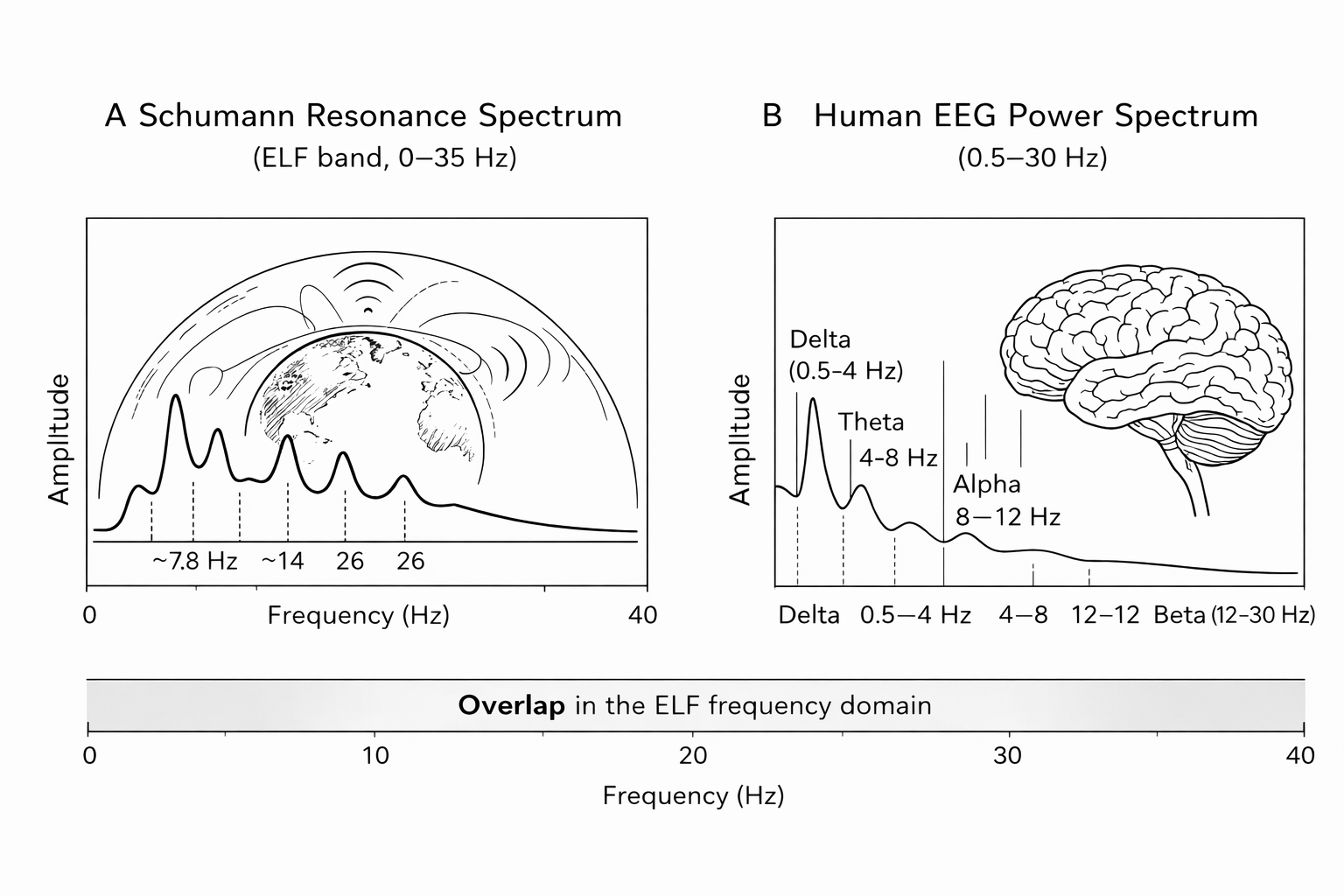
Figure. 1 Spectral comparison between the first SR band (ELF, 0–35 Hz) and the human electroencephalographic (EEG) frequency range (0.5–30 Hz). Panel A shows the Schumann resonance spectrum within the Earth–ionosphere cavity, including the fundamental mode (~7.8 Hz) and harmonics. Panel B shows the EEG power spectrum (delta, theta, alpha, and beta bands) with schematic scalp electrodes. The shaded interval indicates the shared Extremely Low Frequency domain (generated by Julius AI).
● Melatonin is a hormone synthesized from serotonin (a neurotransmitter) in the pineal gland of the brain, and its production is influenced by the perception of light by the retina, with light acting as an inhibitory factor. Melatonin’s function is related to the regulation of the circadian rhythm, a biological cycle that regulates the body’s daily activities, such as temperature, eating, motor activity, and sleep. In addition to this function, it is directly involved in cell protection and possesses antioxidant, anti-inflammatory, immunostimulating properties, and helps eliminate free radicals [Esposito et al. 2019].
● Environmental factors have the ability to influence the autonomic nervous system (ANS) and all the functions and organs that the melatonin/serotonin circadian cycle uses for thermal homeostasis. This includes blood pressure, respiration, changes in the immune system, cardiac, neurological and reproductive processes [Esposito et al. 2019].
● Several studies have demonstrated a connection between short-term GMDs and reduced heart rate variability (HRV). This reduction in HRV is an indicator of ANS dysfunction, being an established marker of high cardiovascular risk [Chai et al. 2023].
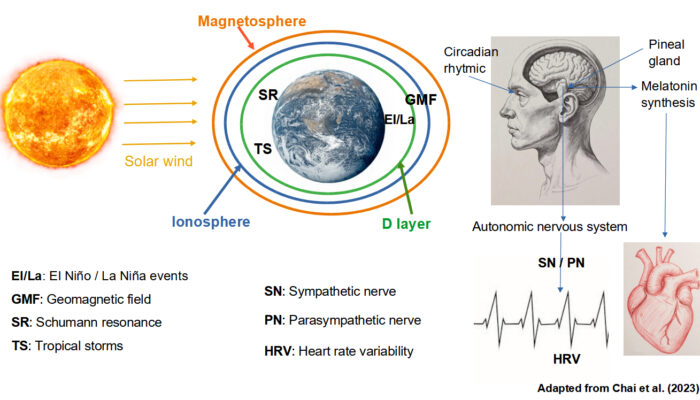
● The ferromagnetic receptor system in magnetite-containing cells is proposed as a mediator that allows organisms to detect variations in environmental GMF related to GMD. Overstimulation of this system disrupts the balance between sympathetic and parasympathetic activities in the ANS, which further affects HRV. In addition, this system mediates light-dependent stimulation of GMD and influences melatonin secretion in the pineal gland (Fig. 2).
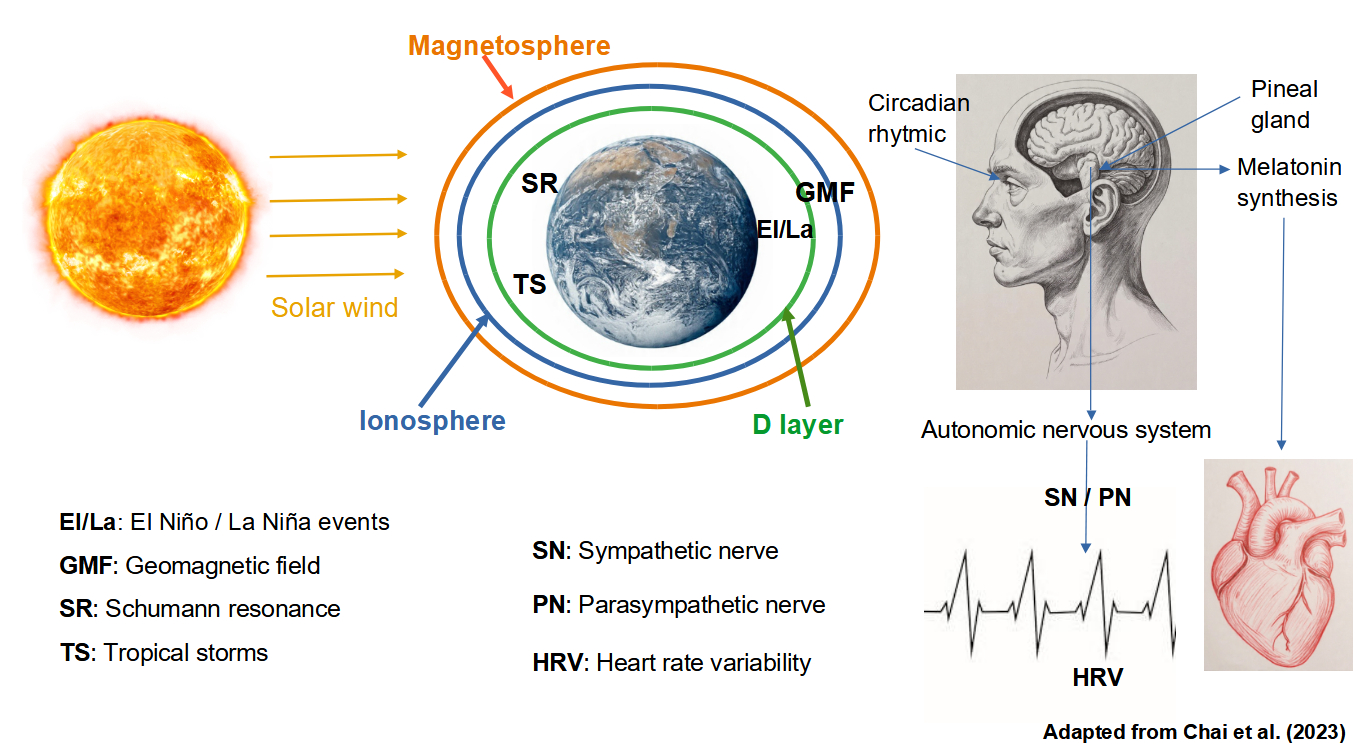
Figure2: Diagram of the effects of solar wind and its interaction with geophysical factors on the human body (Adapted from Chai et al. 2023)
3. Practical Implications
Regarding cardiovascular diseases (CVDs), Rezende et al., 2025 found evidence that women may be more susceptible to GMDs, and publications have shown that they are more sensitive to disruption in melatonin production. A deeper understanding of the relationships between GMDs and biological factors deserves and requires further study and in-depth analysis, which could contribute to public health issues in our terrestrial environment. Monitoring space weather can contribute to the prevention of CVDs and other problems related to the circulatory system.