
Algeria is often described as one of the great energy engines of Africa and the Mediterranean, and with good reason. Its proven oil and gas reserves are impressive, but what truly sets the country apart is the extraordinary complexity of its geological history. Over more than two billion years, tectonics, climate shifts and sedimentation created a series of basins that today host some of North Africa’s most prolific petroleum systems. These basins supply large volumes of natural gas to Europe, especially to Spain, Italy and France.
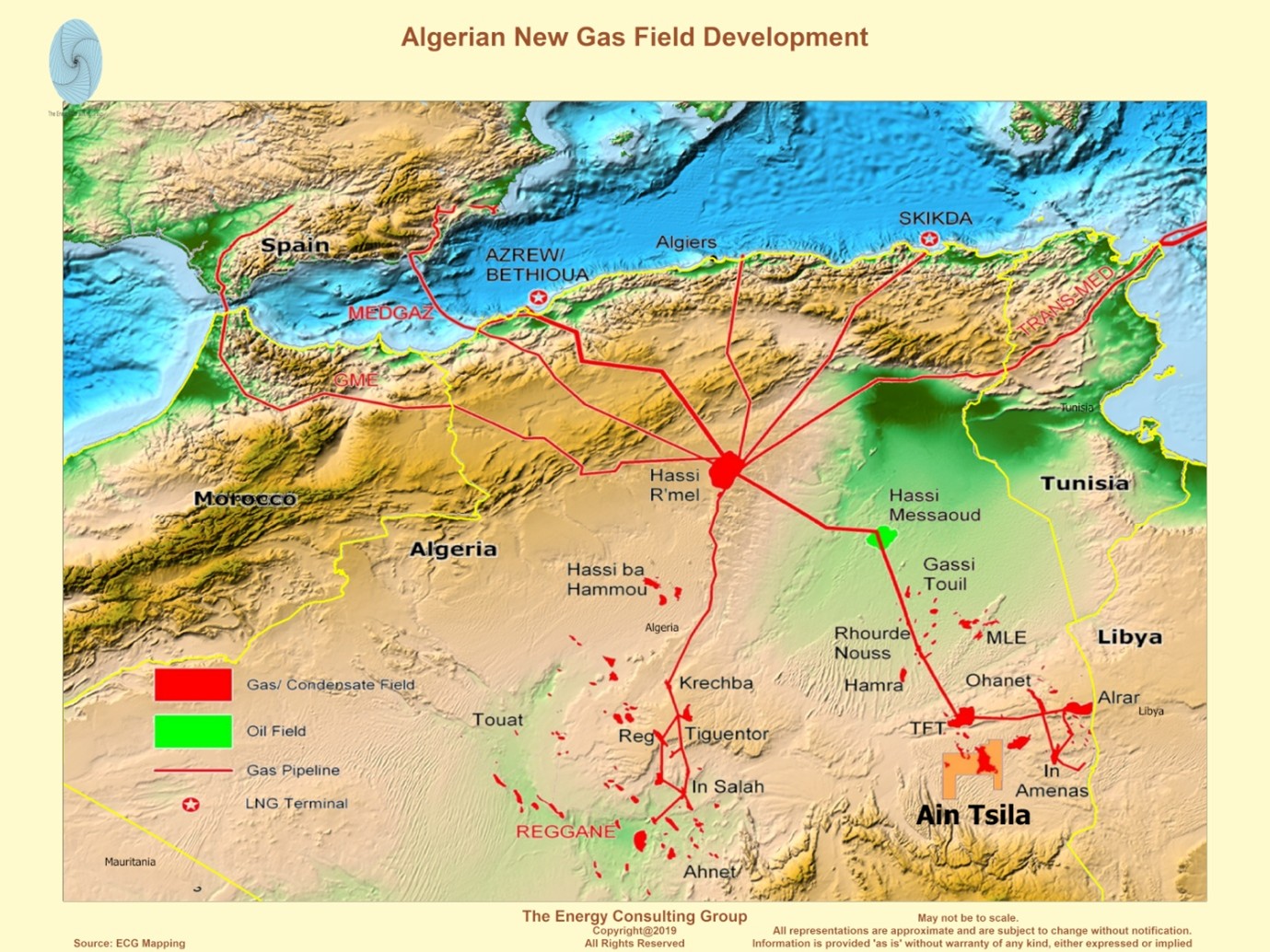
Figure 1 Main producing fields and export transportation pipelines of Algeria.
Having worked on exploration projects across the Saharan basins for years, I’ve seen how the stratigraphy behaves in practice, far beyond what maps alone can show. In every seismic review or reservoir discussion, the same idea reappears: the geology that explains Algeria’s hydrocarbon success is now becoming equally important for Europe’s energy transition, especially as natural gas and hydrogen begin to overlap. Understanding how these basins formed, and how tectonics and sedimentation shaped their evolution, is essential to understanding why Algeria remains so strategically important.
The Architecture of Algeria’s Sedimentary Basins
The Algerian Sahara is a patchwork of tectono-sedimentary domains. Their hydrocarbon potential comes from the combination of Paleozoic source rocks, excellent Cambrian, Ordovician and Triassic sandstone reservoirs, and thick Mesozoic evaporite seals. Cambrian and Ordovician sandstones often retain high porosity thanks to long burial and quartz overgrowths, while Triassic fluvial to aeolian systems maintain excellent reservoir quality even at significant depth. When you line up well logs, correlations and seismic sections, the efficiency of this petroleum system becomes obvious.
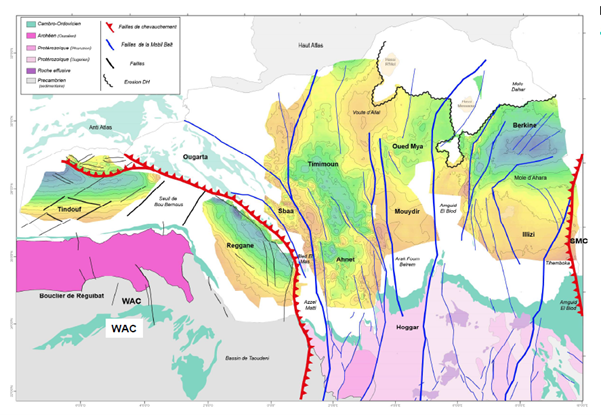
Figure 2 Map showing the main structural elements of the different Algerian Saharan basins, immediately south of the Atlas Mountains (Source: Alnaft website in collaboration with Beicip-Franlab).
Despite decades of exploration, many parts of Timimoun, Oued Mya, Berkine and Illizi remain sparsely drilled. Seismic coverage is variable, and stratigraphic intervals are sometimes poorly constrained. This underexploration is not a drawback, it is part of Algeria’s opportunity. New data constantly reveals traps, reservoir trends and structural patterns that previous campaigns overlooked.
These basins rest on a large Precambrian basement shaped by cycles of extension and compression. The main hydrocarbon provinces, Timimoun, Ahnet, Sbaa, Mouydir, Béchar-Abadla, Oued Mya, Illizi and Berkine, also contain thick Triassic and Liassic evaporites acting as regionally continuous seals, allowing large structural closures to form.
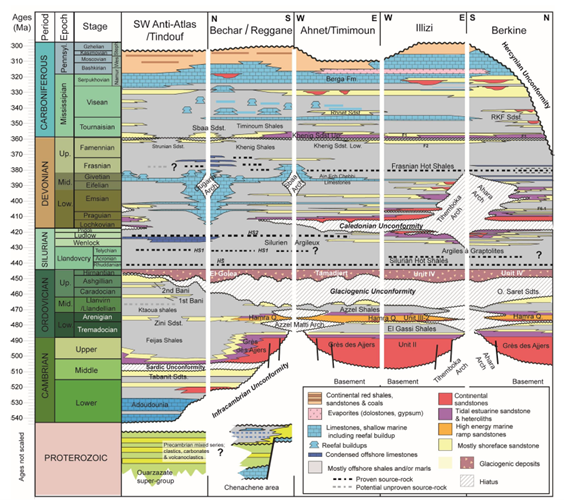
Figure 3 Chronostratigraphic chart of the Algerian Saharan basins (Source: Alnaft website).
Why Algeria Still Matters: Gas Systems Through Time
The discovery of Hassi R’Mel in the late 1950s marked a turning point. Even today, after more than six decades of production, the Triassic petroleum system remains remarkably robust. Updated reservoir models, compression projects and better field management have stabilized output. Combined with its proximity to Europe and an extensive pipeline network, Algerian gas continues to play a key role in European energy security, functioning as a stabilizing energy source while renewables expand.
Hydrogen from Algeria’s Gas Fields: The Opportunity Few People Talk About
When most people think about “hydrogen in Algeria,” they picture enormous solar farms in the Sahara generating green hydrogen. That vision is real, but it’s not the whole story. What many overlook, and what I find genuinely exciting, is that Algeria’s existing geology and infrastructure offer several hydrogen pathways that don’t rely solely on solar energy.
Thanks to its massive gas fields, deeply understood subsurface and one of the Mediterranean’s strongest export networks, Algeria is unusually well positioned to produce grey hydrogen, blue hydrogen and potentially even natural “gold hydrogen.” These are terms many people haven’t encountered, which is exactly why the topic deserves attention.
Grey Hydrogen: Fast and Scalable
Grey hydrogen comes from steam methane reforming of natural gas. It isn’t low-carbon, but it is cheap, reliable and widely used. Algeria could scale grey hydrogen quickly thanks to existing production at Hassi R’Mel and across the Paleozoic and Triassic reservoirs. The gas is already flowing, the processing plants are running, and pipelines to Europe are in place. Grey hydrogen won’t meet Europe’s long-term climate goals, but it could support Algerian industries or serve as a transitional step toward cleaner hydrogen.
Blue Hydrogen: Where Geology Becomes an Asset
Blue hydrogen uses the same process as grey hydrogen, but with CO₂ captured and stored underground. Here, Algeria’s geology becomes a real advantage. Decades of exploration have produced high-quality geological models of Triassic and Paleozoic reservoirs, many of which could be repurposed for CO₂ storage once depleted.
Three factors drive Algeria’s potential for blue hydrogen:
-
Well-studied reservoirs suitable for secure CO₂ storage
-
Existing gas facilities that can integrate capture technology
-
Alignment with future EU requirements for low-carbon hydrogen
Indeed, blue hydrogen won’t replace green hydrogen, but it can fill the gap while renewable-based hydrogen technologies mature.
Gold Hydrogen: The Geological Wild Card
Gold hydrogen, or natural hydrogen, forms underground through geological reactions such as oxidation of iron-rich rocks or “serpentinization”. Discoveries in Mali, the US and Australia have sparked new interest. Algeria has many of the geological ingredients associated with natural hydrogen: Precambrian basement exposures, iron-rich systems, deep fault networks and documented helium occurrences. No accumulation has yet been confirmed, but the scientific basis is strong enough that future exploration may start actively testing for it.
The Hidden Advantage: Infrastructure Already Built
Whether hydrogen comes from grey, blue or natural sources, Algeria has something no other North African country has at this scale: a fully developed export infrastructure already in place. This includes international pipelines connected to Europe, gas hubs, processing plants, compression stations and very short export distances. Studies suggest parts of this network could transport hydrogen blends with relatively minor modifications, and some segments could eventually be converted entirely to hydrogen. This means Algeria could deliver low-carbon hydrogen long before many countries that still need to build their networks from scratch.
Hydrogen discussions often focus on what might happen in 20 or 30 years. But Algeria has options that exist today, in its basins, in its geology, in its infrastructure and in its long tectonic history. That makes Algeria one of the most fascinating and underestimated hydrogen players in the Mediterranean, and a country worth watching very closely as Europe’s energy landscape evolves.
