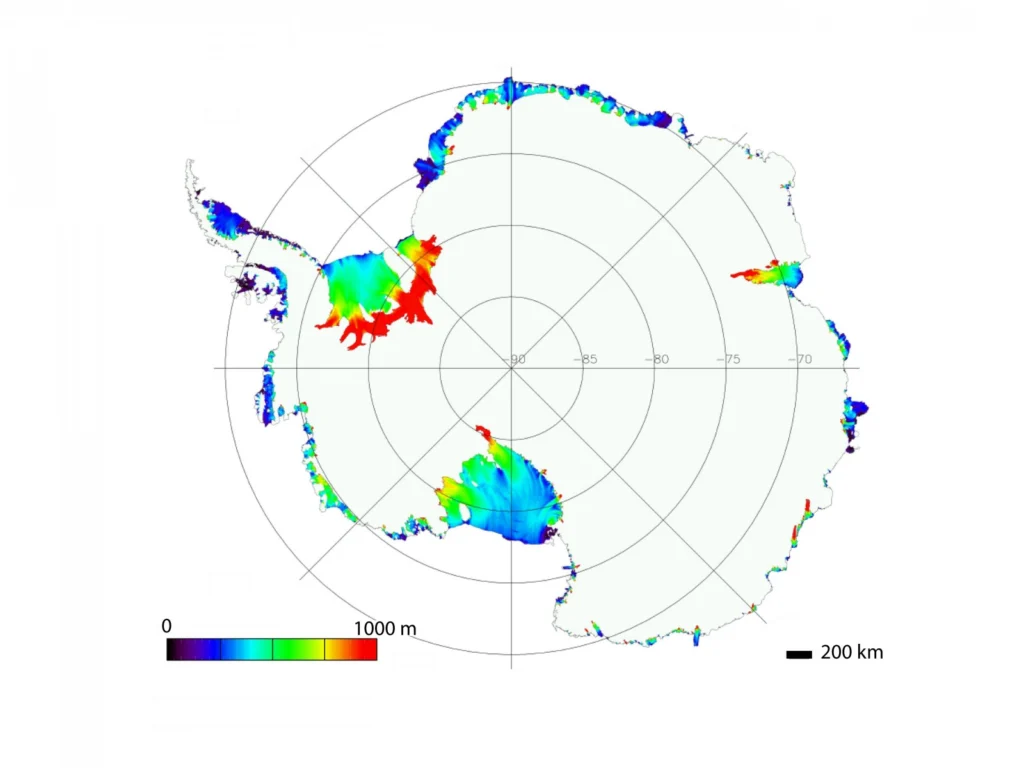
Thickness of floating ice shelves in Antarctica. Ice thickness is greatest close to the grounding line where it can reach 1000 meters or more (red). Away from the grounding line, the ice rapidly thins to reach a few hundreds of meters at the calving front. Ice thickness varies greatly from one ice shelf to another. …[Read More]
Division blogs
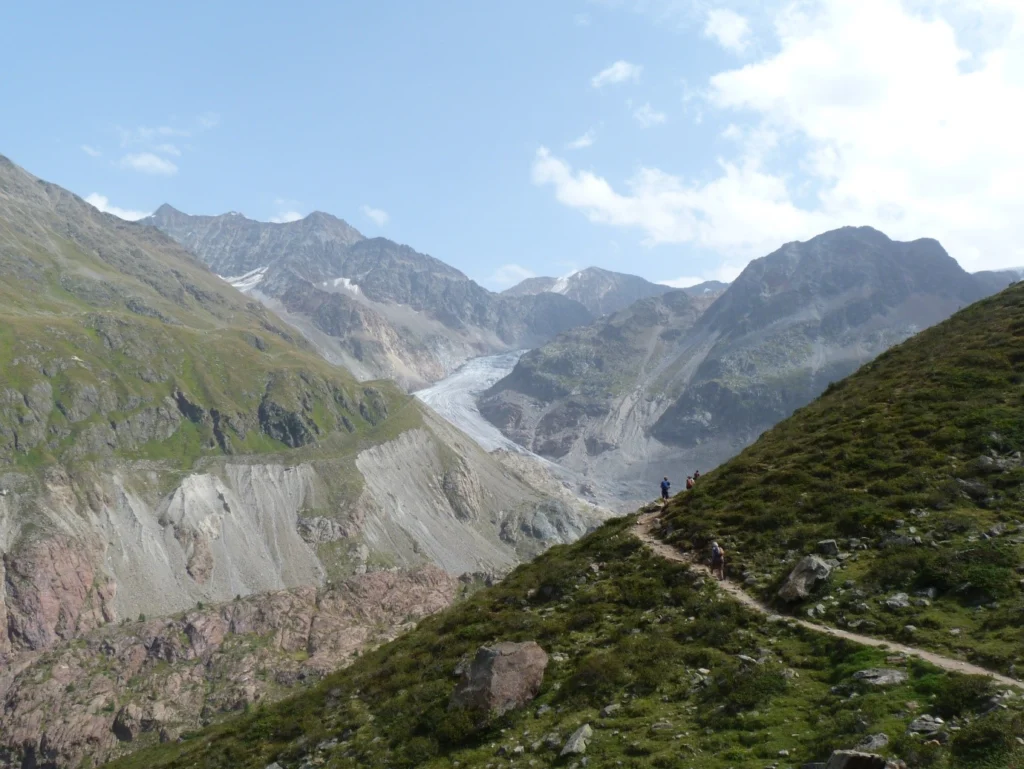
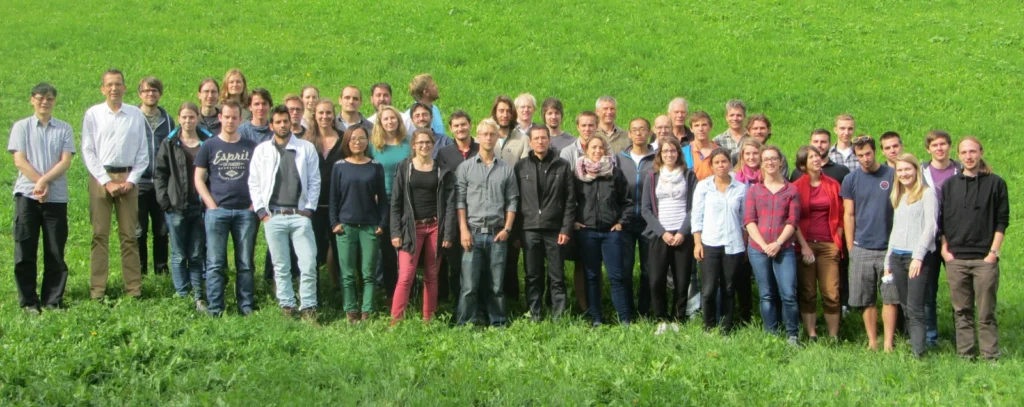
Report from the Summer School on Geomorphology in the Kaunertal Valley, Austria, 31st August – 6th September 2015
Written by Ciara Fleming ( University College Dublin) The focus of this Summer School was ‘Sediment dynamics in high mountain environments’ and as suggested by this title, the location did not disappoint. For the week-long school we were based in Feichten im Kaunertal (1273m a.s.l.), a perfectly-formed Alpine village in the Province of Tyrol, Austria. …[Read More]
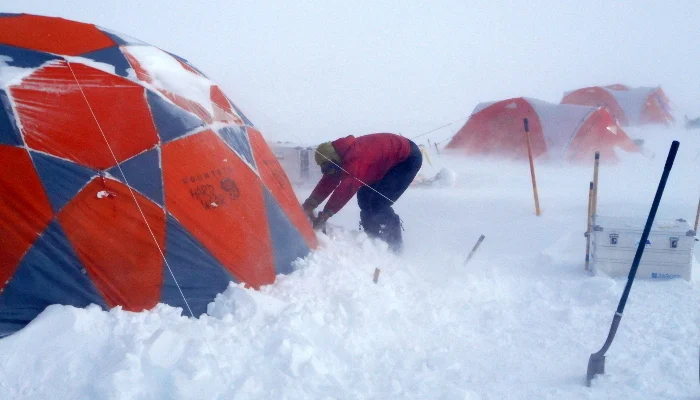
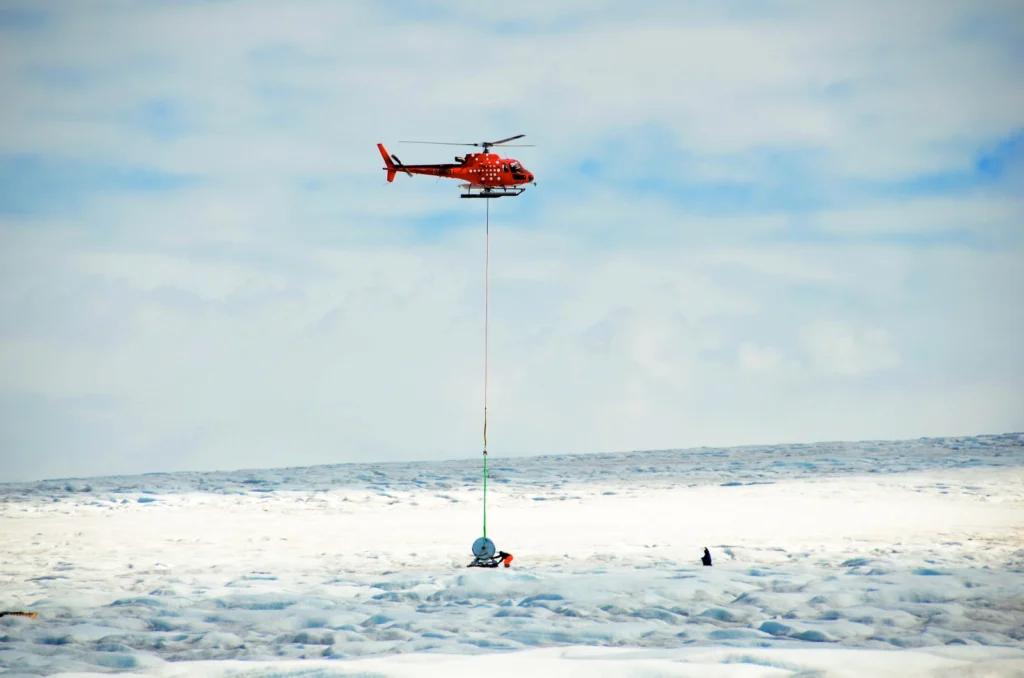
Riding the Storm: The Arctic Circle Traverse 2015
In the morning on the 19th of May, we – the Arctic Circle Traverse 2015 – found ourselves in a great dilemma; to stay or to go? On our check-in conversation with the KISS crew, we were informed that an east front from Kulusuk was expected to hit our location up on the ice sheet …[Read More]
Jobs on EGU website
If you are an Early Career Researcher or looking for a new research opportunity why not check out the EGU job site!? http://www.egu.eu/jobs/
Ingrid Kögel-Knabner, a multidisciplinary soil scientist
Ingrid Kögel-Knabner Chair of Soil Science Technical University of Munich The 2015 Philippe Duchaufour Medal is awarded to Ingrid Kögel-Knabner for her fundamental and ground-breaking work on the dynamics and stabilisation of soil organic matter in soils from a basic-chemistry and organo-mineral interactions perspective. I received my doctorate from the University of Bayreuth, Germany, in …[Read More]
Image of the Week : SAFIRE team getting ready to drill in Greenland
How do you get a hot water drill onto an ice sheet? The Subglacial Access and Fast Ice Research Experiment (SAFIRE) uses a hot water drill to directly access and observe the physical and geothermal properties where the ice meets rock or sediment at the glacier-bed interface. Here, SAFIRE principal investigator Bryn Hubbard and post-doc …[Read More]
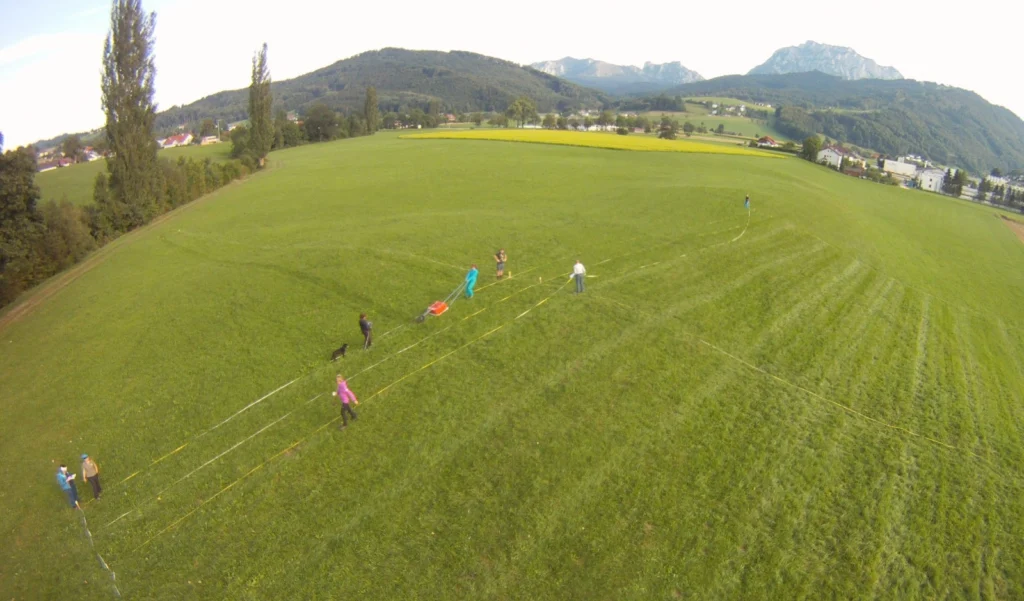
Joint MSc field course in geomorphology (Universities of Bonn and Salzburg)
From Wednesday to Saturday 9-12 September 2015, the geography departments of the Universities of Bonn/Germany and Salzburg/Austria, held a joint field course in geomorphology in the eastern European Alps. During these four days, 24 students master students, half from each participating university, gathered in Gmunden, Austria. Here, in the beautiful Salzkammergut, the course addressed topics …[Read More]
Drilling into magma: the future of electricity production from volcanic geothermal systems?
Words on Wednesday aims at promoting interesting/fun/exciting publications on topics related to Energy, Resources and the Environment. If you would like to be featured on WoW, please send us a link of the paper, or your own post, ERE.Matters@gmail.com *** Citation: Scott, S., Driesner, T. & Weis, P. Geologic controls on supercritical geothermal resources above magmatic intrusions. Nature Communications. …[Read More]
Karthaus Summer School 2015
After a train, the London Underground, another train, a flight, three more trains and a taxi (shared with people I had met on my way); I had arrived in a small Alpine village in the very north of Italy. The reason for this rather convoluted journey? To attend the Karthaus Summer School on ice sheets …[Read More]
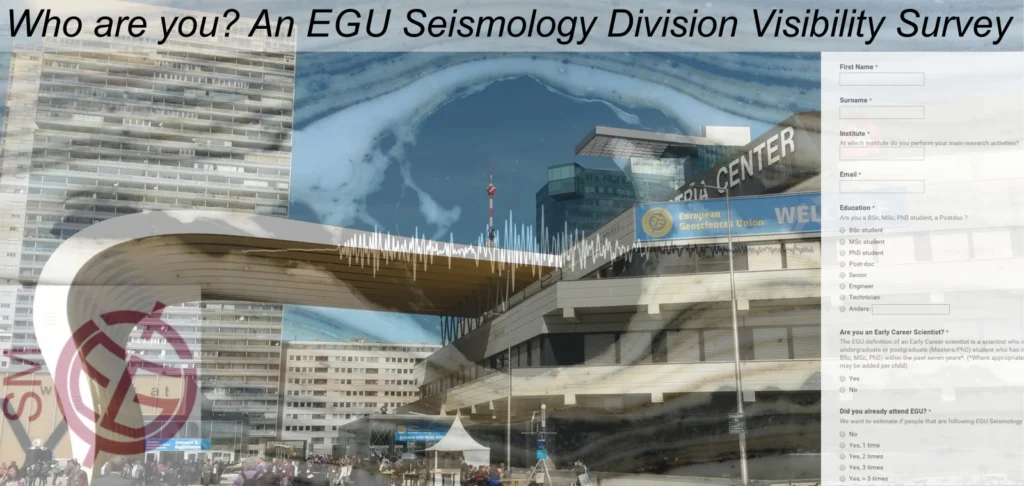
Who are you? An EGU Seismology Division Visibility Survey
When a PhD student publishes a new paper, of course he/she would like that other scientists will read the work. However, in a busy academic world with many institutional obligations, it might be hard to promote the work and the research you are performing. Social media and blogs, however, can play an important role in research visibility and …[Read More]