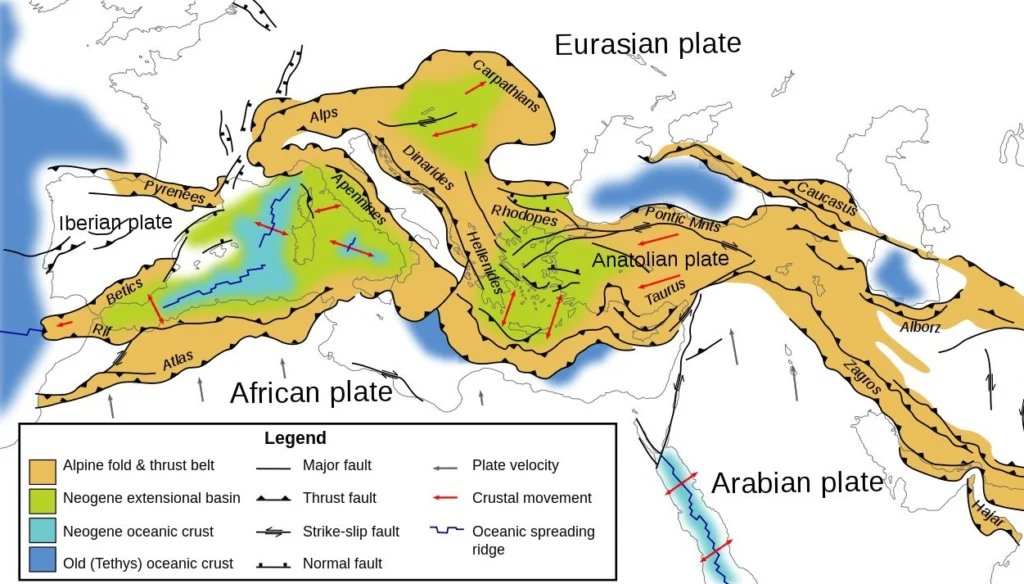
Folding is one of the most common geologic phenomena in the world. I should start with defining the term ‘deformation’ in order to understand the folding process better. In geology, deformation is an alteration of the size or shape of rocks. Deformation is caused by stress, the scientific term for force applied to a certain …[Read More]
Division blogs
Cryospheric Sciences
Image of the Week – When the dirty cryosphere destabilizes!
Ice is usually something you see covering large ocean areas, mountain tops and passes or as huge sheets in polar regions. This type of ice is clearly visible from space or with the naked eye. There is, however, a large volume of ice that is less visible. This ice is distributed over the polar and …[Read More]
Atmospheric Sciences
June 2017 Newsletter
The blog will now also host a newsletter specially dedicated to Early Career Scientists of the Atmospheric Sciences Divisions. ECS – AS News – Issue 1 – June 2017 FROM THE PRESIDENT Dear Early Career Atmospheric Scientists, I hope that you by now have digested all the excellent science and events that took place during …[Read More]
Atmospheric Sciences
The art of turning climate change science to a crochet blanket
We welcome a new guest post from Prof. Ellie Highwood on why she made a global warming blanket and how you could the same! What do you get when you cross crochet and climate science? A lot of attention on Twitter. At the weekend I like to crochet. Last weekend I finished my latest project …[Read More]
Cryospheric Sciences
Image of the Week – Far-reaching implications of Everest’s thinning glaciers
From 1984 to 2015, approximately 71,000 Olympic size swimming pools worth of water were released from the melting Khumbu Glacier in Nepal, which is home to Everest Basecamp. Find out how Himalayan glaciers are changing and the implications for downstream communities in this Image of the Week. Himalayan glaciers supply freshwater Himalayan glaciers supply meltwater …[Read More]
Atmospheric Sciences
Do you want to establish a career in the atmospheric sciences? Interview with the Presidents of the AMS and the EGU-AS Division.
Establishing a career in the atmospheric sciences can be challenging. There are many paths to take and open questions. Fortunately, those paths and questions have been thoroughly explored by members of our community and their experiences can provide guidance. In light of this, in September 2016 Ali Hoshyaripour [Early Career Scientists (ECS) representative of the …[Read More]
Cryospheric Sciences
Image of the Week – Ice lollies falling from the sky
You have more than probably eaten many lollipops as a kid (and you might still enjoy them). The good thing is that you do not necessarily need to go to the candy shop to get them but you can simply wait for them to fall from the sky and eat them for free. Disclaimer: this …[Read More]
Atmospheric Sciences
What? Ice lollies falling from the sky?
You have more than probably eaten many lollipops as a kid (and you might still enjoy them. The good thing is that you do not necessarily need to go to the candy shop to get them but you can simply wait for them to fall from the sky and eat them for free. Disclaimer: this …[Read More]
Tectonics and Structural Geology
Teaching in the 21st century – a PICO session
With the progress in the digital world there are more and more e-tools available for research and teaching. What are smart ways to make use of new techniques in teaching? For inspiration and learning, Hans de Bresser, Janos Urai and Neil Mancktelow convened a PICO session at the EGU 2017 General Assembly to showcase present-day …[Read More]
Cryospheric Sciences
Image of the Week – How geometry limits thinning in the interior of the Greenland Ice Sheet
The Greenland ice sheet flows from the interior out to the margins, forming fast flowing, channelized rivers of ice that end in fjords along the coast. Glaciologists call these “outlet glaciers” and a large portion of the mass loss from the Greenland ice sheet is occurring because of changes to these glaciers. The end of …[Read More]