
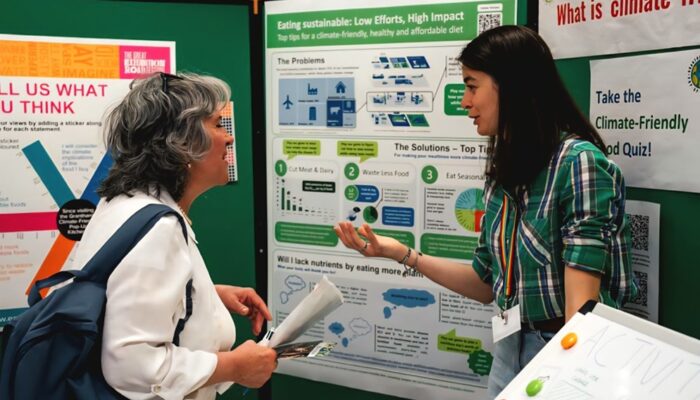
Meet the new Early Career Scientist (ECS) Representative for the Ocean Sciences (OS) division: Arianna Olivelli! In this role, she is dedicated to connecting, supporting, and advocating for early career ocean researchers across Europe and beyond. We sat down with Arianna to hear about her journey, her vision for the OS ECS community, and how she is empowering the next generation of ocean scientists.
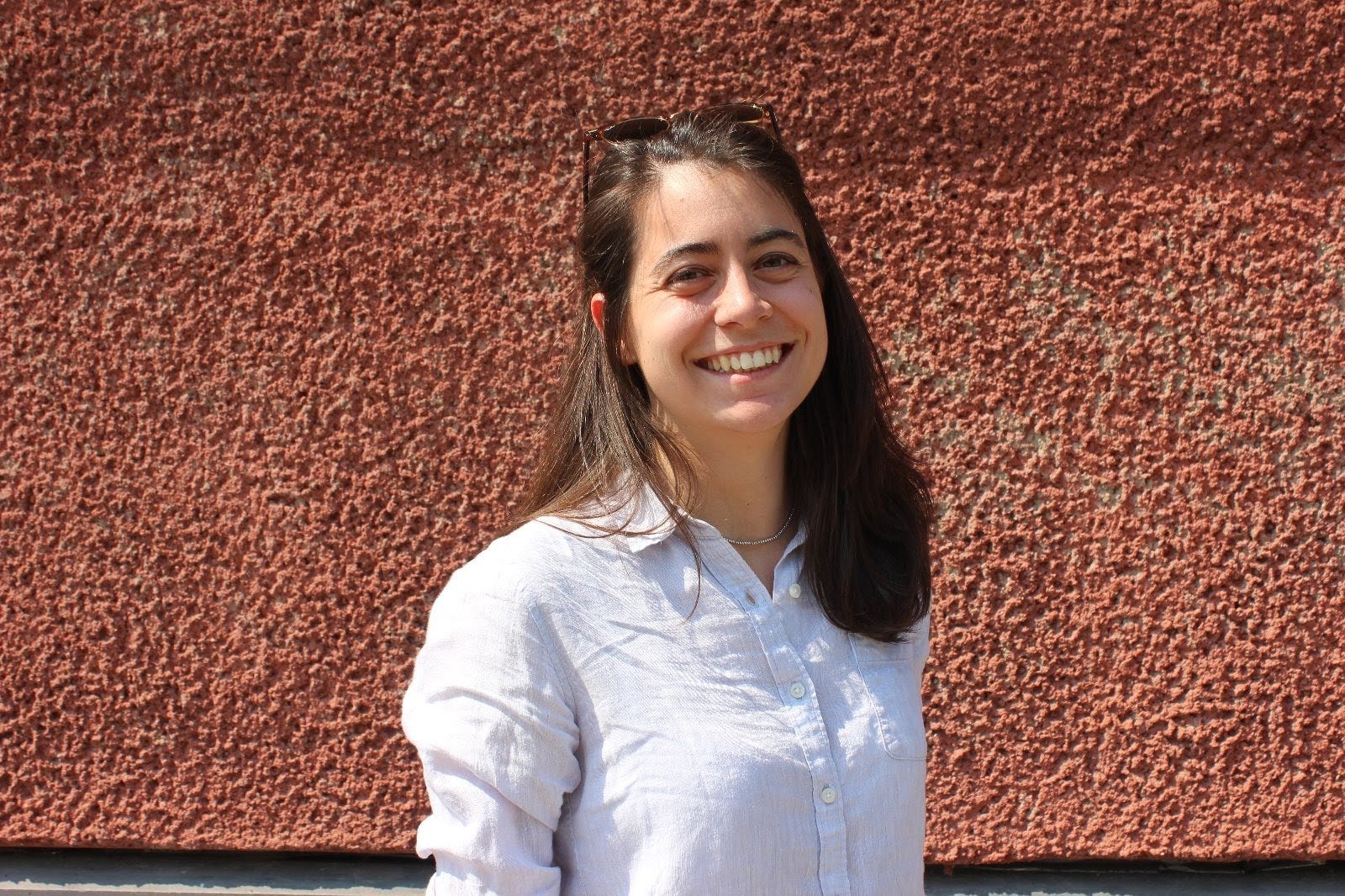
Image: Arianna Olivelli, the new OS ECS representative.
🌊 Could you briefly introduce yourself and your research background?
I am a chemical oceanographer and postdoctoral researcher at the Flanders Marine Institute (VLIZ) in Belgium. Broadly speaking, my research focuses on understanding the impacts of human activities on marine climate change and tracing environmental pollution from sources to sinks. I do so with a wide range of methodologies, spanning from analysing the composition of seawater in the laboratory to leveraging data science and modelling techniques to investigate the distribution of chemicals at regional and global scales.
In my postdoc, I am developing machine learning algorithms to fill the gaps between very sparse observations of oceanic oxygen concentrations collected over the past 30 years. This work aims to quantify rates of deoxygenation and oxygen minimum zone expansion at an unprecedented spatial resolution. My PhD focused on the use of lead (Pb) isotopes to trace pollution from human activities on land, combining laboratory analyses of seawater in clean rooms and mass spectroscopy with machine learning mapping of Pb distribution in the ocean over the past 15 years. Prior to my PhD, my research focused on plastic pollution in the marine environment and at the land-ocean interface.
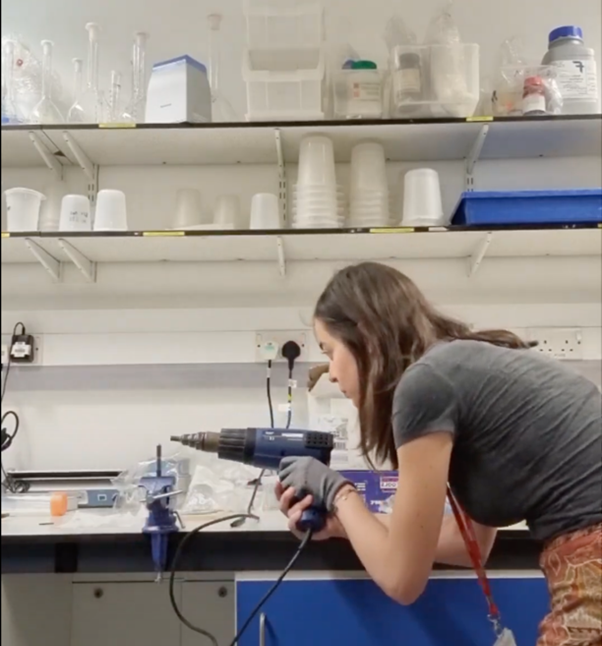
Image: Arianna making columns to be used to separate lead (Pb) from other elements in seawater using ion exchange chromatography.
As you can see, many different topics, all connected by an underlying interest in understanding human impacts on the ocean and providing the best evidence on which to develop new policies for the protection of the marine environment.
🌊What motivated you to become the Early Career Scientist representative for the Ocean Sciences division?
I have always drawn a lot of energy and inspiration from interacting with peers and developing a network with the wider ocean sciences community. In fact, I believe these interactions have fueled some of my most exciting research and helped me restore motivation during challenging times. During my PhD, I sat on various committees and managed outreach initiatives at both the university and regional levels, so when the opportunity arose it was a no-brainer to become the new ECS Representative for the Ocean Sciences division. My main motivation is to be able to give back to the community and contribute to the development of the new generation of ocean scientists.
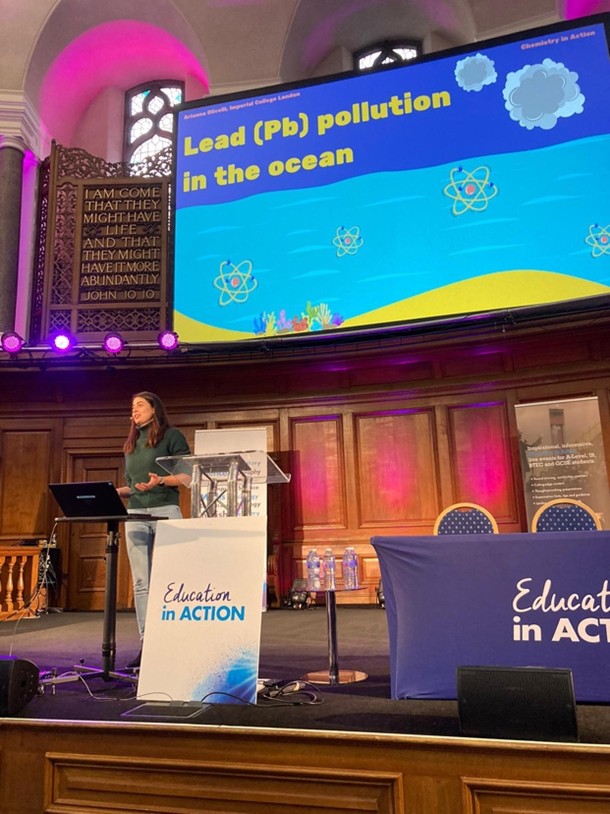
Image: Arianna giving an outreach talk to secondary school students as part of the Education in Action programme of 2024.
🌊What does the ECS representative role involve in practice?
In my role, I represent the OS ECS community both at the division level, i.e., in meetings with the OS Division President, Vice President, and Section Leaders, and at the Union level, i.e., in meetings with the ECS Representative for the EGU as a whole. In practice, in addition to actively participating in these institutional meetings, I oversee the activities organised by the core team of OS ECS volunteers and facilitate the development of new initiatives within the community.
🌊 What do you see as the biggest challenges facing early career ocean scientists today, and how can the ECS network help them navigate these challenges?
Based on many chats with colleagues and friends, I believe that several of the biggest challenges faced by OS ECS today are very similar to those of ECS in other areas of research, although I cannot speak from direct experience. Job insecurity and the competitiveness of the academic job market, poor work-life balance and mental health issues, and high pressure to publish, all seem to be shared across scientific domains. In addition to these, early career ocean scientists also face challenges related to the nature of their research: organising and carrying out fieldwork at sea, having access to expensive equipment and laboratory facilities, and often being exposed to scientific results that make us feel helpless in the face of the climate and biodiversity crises unfolding around us.
All these are extremely difficult challenges to navigate, especially when one lacks a strong support network. This is why the OS ECS network aims to have a beneficial impact on early career ocean scientists in Europe and beyond. Within the OS division, we will focus on developing activities and connections that are inherent to our specific macro-area of research, the ocean. By doing so, we hope to effectively complement the many resources and initiatives developed by the EGU that are aimed at the larger geosciences ECS community.
🌊 Can you give us a teaser on what the OS ECS community is planning for the upcoming year? Are there OS division projects or outreach activities you’re particularly excited about?
In the first quarter of 2026, we are planning to launch an OS ECS newsletter and an OS ECS campfire series. Campfires are online seminars or panel discussions spanning a wide variety of topics, from purely scientific presentations to fieldwork spotlights, career advancement talks, and so on. I am very excited for the launch of both initiatives, as all members of the OS ECS team have been very enthusiastic and are dedicating a lot of effort to their development. I hope that both the newsletter and campfires will allow us to reach a wide audience of OS early career scientists and prove to be beneficial to the whole community.
🌊 Are there opportunities for ECSs to get involved in organising sessions, volunteering, or contributing to the EGU ECS network? How can ECSs reach out if they want to get involved or share ideas?
Absolutely, there are opportunities for everyone who would like to be involved and can commit some time to volunteering for the OS ECS community!
From day one, my mission as OS ECS Representative has been to encourage the development of bottom-up-led initiatives that benefit the community in the most effective way possible. I would therefore be extremely happy to receive new expressions of interest from people who would like to get involved in the organisation of existing or new activities, or simply share ideas. Please feel free to email me at: ecs-os@egu.eu.
🌊 Looking back, what advice would you give your “early PhD” self?
I would tell myself to try to be more present in the moment rather than worry about what will come after (which is something I am still learning to do). I really enjoyed my PhD and all the doors it opened, despite the inevitable ups and downs and challenges I faced along the way. However, I only realised towards the very end how incredible an opportunity it is to be free to pursue research in my chosen field, while having time to actively engage in learning, outreach, teaching, and anything else one might find interesting. I would also tell myself that it is okay to say ‘no’ to additional workloads and requests when one does not have the capacity to take them on. Even if it feels difficult, this is a really important step in protecting one’s work–life balance and, consequently, mental health.
🌊 Any final message you’d like to share with the OS early career community?
I am very honoured to represent the whole OS ECS community at the EGU level, and this is a role I take with a lot of responsibility. I would like to encourage everyone again to get in touch if you have ideas, suggestions, or any feedback to share. This community is here for you to make the most out of it, so do not be shy and contact me if there is anything you would like to let me know or see implemented.
We would like to thank Arianna for taking the time to share her experiences, insights, and plans for the OS ECS community. We wish her every success in her role as OS ECS Representative and look forward to seeing the exciting initiatives she will bring to the early career ocean science community!
