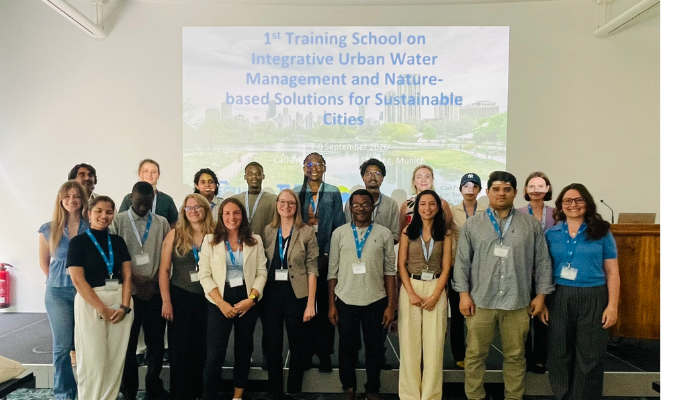
From 7-8 September 2026, the 1st International Training School on Urban Water Management and Nature-based Solutions for Sustainable Cities was held in Munich, Germany. Organised by researchers from the Technical University of Munich, the Leibniz Institute of Freshwater Ecology and Inland Fisheries (IGB), Berlin, and the University of Cagliari in collaboration with the International Association of Hydrological Sciences (IAHS), the event was supported through the European Geosciences Union (EGU) Training School Programme. For two days, Munich became a classroom for the next generation of researchers working on how to design sustainable and climate-resilient cities.
The training school brought together 16 PhD candidates and Master’s students from 13 countries for two days of deep dives into the key challenges and emerging approaches in sustainable urban water management. Through lectures, practical exercises, and interactive discussions, participants explored how hydrological, ecological, technical, and social perspectives must be considered to support more sustainable water-sensitive cities. Particular emphasis was placed on climate-resilient urban planning, innovative monitoring approaches in urban ecosystems, and the fate and treatment of micropollutants in urban water cycles.
In addition to providing advanced scientific training, the school offered a valuable interdisciplinary platform for networking and knowledge exchange among early career researchers from diverse academic backgrounds. Conversations were lively and curious, and new friendships and connections were made across oceans and disciplines.
Thanks to the support of the Carl Friedrich von Siemens Foundation, the event could be hosted under excellent conditions in Munich, surrounded by the green spaces and waterways of the Schlossgarten Nymphenburg. Participants benefited from the outstanding facilities of the venue as well as opportunities to gain practical insights into urban water management and climate adaptation strategies implemented within the city.
Studying cities from above and below
The first day focused on three thematic blocks addressing current challenges in sustainable urban development. Sessions covered nature-based solutions for disaster risk reduction and urban climate resilience by Dr. Elena Cristiano and Dr. Andrea Reimuth, green infrastructure planning for climate adaptation by Prof. Stephan Pauleit, and the occurrence and fate of micropollutants in urban water systems by Dr. Felicia Linke.
The second day emphasised hands-on learning and field-based experiences to get a sense of design, monitoring, and engineering challenges. During a guided visit to Munich’s sewer network and wastewater infrastructure, organised in cooperation with Munich’s municipal wastewater utility, participants gained first-hand insights into urban drainage systems and modern stormwater management practices. This was a highlight for many students, some of whom had never seen such infrastructure up close. Realizing the hidden flows of water and effluents underneath the city and the technical and engineering challenges related to maintaining such a system gave the students a new perspective on how the water management of a large city depends on invisible infrastructure. At the same time, the visit also highlighted where the city’s capacity to absorb extreme rainfall is challenged, sparking a hot debate on the role of blue-green infrastructure and nature-based solutions in closing that gap.
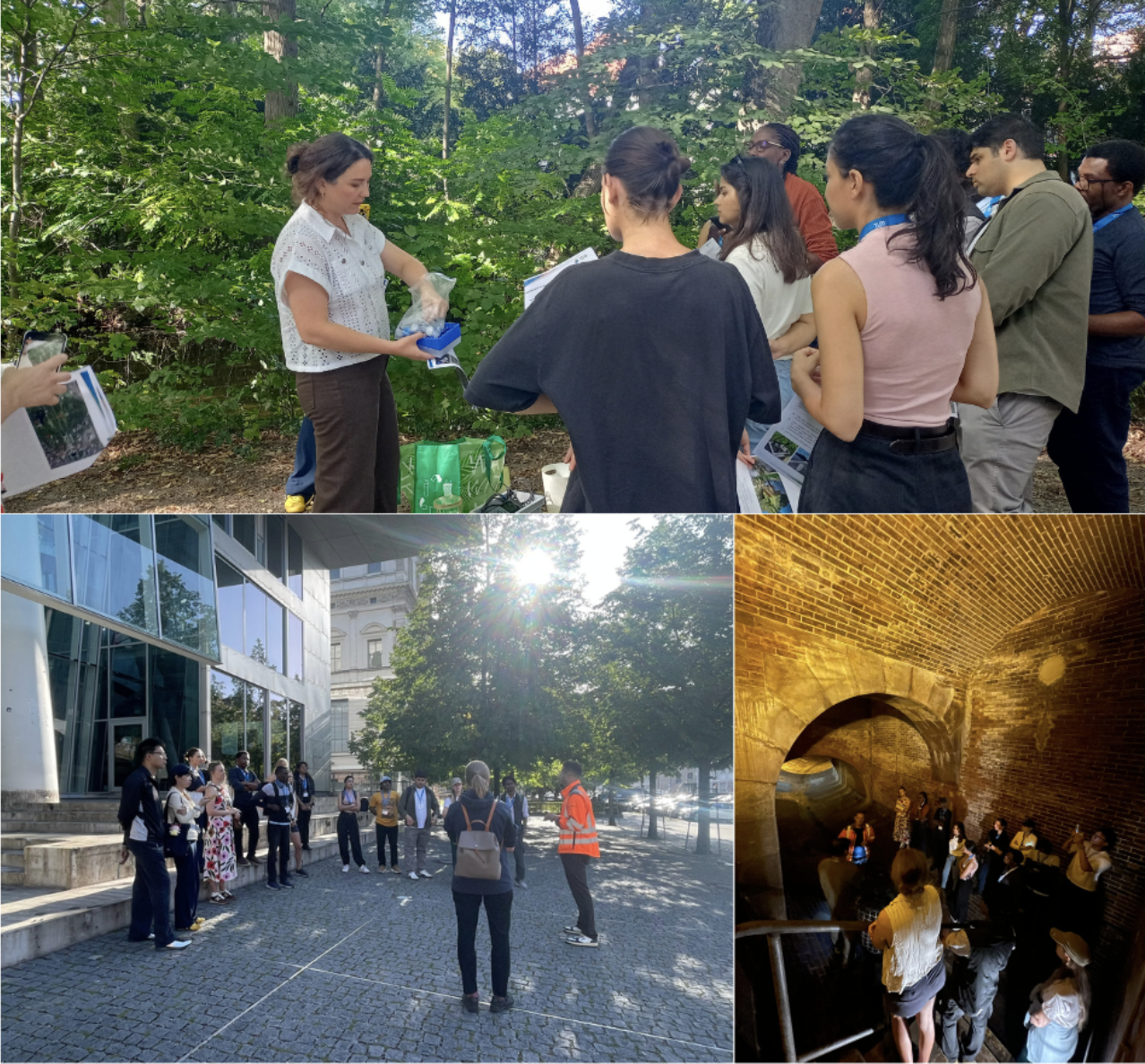
Combined lectures, field activities, and hands-on exercises enabled participants to translate scientific concepts into practical skills relevant to their own research. © Andrea Reimuth und Maria Magdalena Warter
Keeping with the practical theme, a half-day field workshop in Nymphenburg Park was led by Dr. Maria Magdalena Warter, introducing participants to monitoring and sampling techniques for urban ecosystems. Different analytical methods were presented and applied under real field conditions, enabling participants to connect theoretical concepts with practical applications relevant to their own research projects. Drinking water quality was tested directly in the park and found to be of great quality – a testament to Munich’s water supply.
Scientific exchange and networking across scientific and geographic borders
One of the most highly valued aspects of the training school was the opportunity for interdisciplinary exchange among participants from fields including engineering, hydrology, ecology, and urban planning. The international and interactive character of the event fostered lively discussions between participants and invited experts, leading to new scientific perspectives and professional networks that will hopefully inspire participants to keep connecting with peers across disciplines.
The combination of scientific lectures, group activities, practical exercises, and field excursions stimulated discussions on emerging research questions and potential future collaborations. By bringing together early career scientists and leading experts in a focused learning environment, the training school successfully fulfilled the core objectives of the EGU Training School Programme while strengthening the international community working on urban water management and nature-based solutions. It is events like these that are valuable opportunities for early career researchers and we are grateful for the support of our partners and colleagues.