

Like many glaciologists (in the broad sense – as in, cryospheric researchers, not just those who study glaciers!), my professional “home” has been the International Glaciological Society (IGS) ever since grad school; My first conference was an IGS branch meeting, I found my postdoc by networking at an IGS symposium, I have published work in IGS journals, and IGS has supported many community activities I have been a part of. But, I know there are a lot of cryospheric scientists who might not have such a close relationship with IGS or may not know about its many roles in the cryospheric research community and how the IGS complements the work done by other organizations like the EGU. If that’s you, then read ahead!
_____________________________________________________________________________________________________________________________________
The IGS is a dedicated international member-driven society for cryospheric researchers. We welcome scientists from all fields under the umbrella of cryospheric research, no matter if you you study ice sheets, glaciers, snow, sea ice, freshwater ice, permafrost, or cryospheric habitats on other planets!. The IGS was founded in 1936 to provide a community for individuals interested in practical and scientific aspects of snow and ice, including the broader cryosphere. As stated in the IGS Constitution, the objectives of IGS are to:
- Stimulate interest in, and encourage research into the scientific and technical problems of snow and ice in all countries;
- Facilitate and increase the flow of glaciological ideas and information between glaciologists and
- Promote & mentor the next generation of scientists.
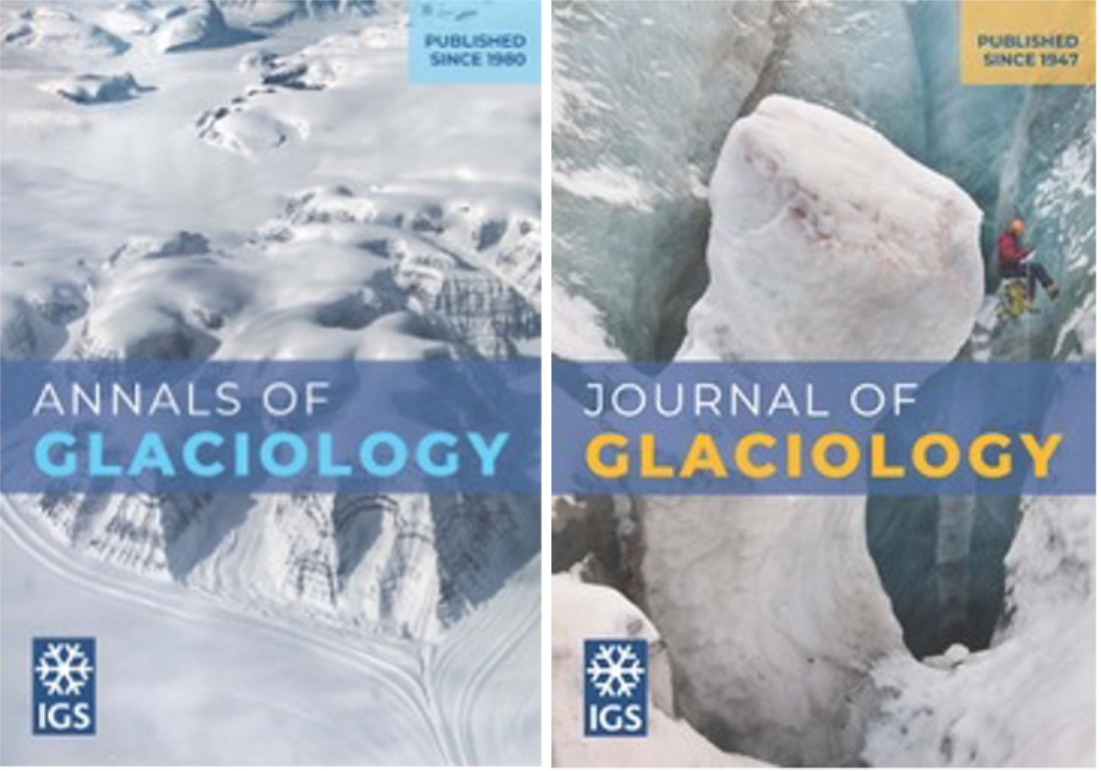
You can publish your research in the IGS open-source journals ‘Journal of Glaciology’ and ‘Annals of Glaciology’. [Credit: IGS]
Professional societies play an important role in the research landscape, providing a mix of highly-visible activities, which are made possible by the (often invisible) community infrastructure. Cryospheric researchers – like academics in all fields of research – often are members of several professional societies at a time to stay up to date with the state of their research. Some of the key contributions of IGS to the cryo-community include:
- Publishing leading peer-reviewed journals: IGS disseminates authoritative research through publishing the Gold Open Access Journal of Glaciology and Annals of Glaciology, ensuring that the latest discoveries reach the global scientific community. While the Journal receives papers on all cryospheric research topics on a continual basis, Annals is structured around topical collections.
- Organizing & co-sponsoring international symposia, seminars and workshops: These events, both virtual and in-person, provide vital platforms for disciplinary and interdisciplinary exchange, fostering collaboration, advancing knowledge, and setting future research agendas. The unique and specialized IGS Symposia provide critical opportunities for researchers at all career stages to present findings, network, and establish collaborations, while the annual regional branch meetings are more intimate and informal. The IGS Global Seminar Series is a free weekly series, held on Zoom, where an expert, or group of experts, present their cryospheric work – check out the archive of previous seminars on theIGS YouTube channel, and feel free to reach out to the organizers if you’d like to present in the future!
- Connections and capacity building: IGS serves as a crucial network, connecting scientists worldwide and promoting public awareness of the cryosphere. A range of IGS awards recognize excellence in and service to the glaciological research community. IGS has an annual call to support summer schools and workshops. The IGS Early-career Glaciology Group (IGS-EGG) also offers travel grants, career development & mentorship, and networking & training opportunities. Finally, IGS also publishes books about glaciology.
The IGS actively supports Early Career Scientists through its Early-Career Glaciologists Group (EGG). [Credit: IGS]
So, how does IGS fit into the landscape with EGU? They are great complementary partners! For example…
- Journals: Both societies have open access journals — while IGS journals serve a broad community need and allow for specific topical focus, the EGU’s The Cryosphere offers a different model of open peer review.
- Meetings: While the EGU General Assembly is a broad meeting perfect for seeing 16,000+ other geoscientists, IGS symposia offer a familiar format and more focused opportunities to nerd out on more focused topics with a few dozen to a few hundred colleagues/friends. EGU reliably returns to Vienna every spring, while IGS symposia are proposed by local hosts and so take place around the year and all around the world.
- Small Grants: Both IGS and EGU support workshops and field schools, providing complementary support for the important grassroots work of the cryospheric research community.
- Awards: Both IGS and EGU depend on the research community to nominate and evaluate excellence with our own ranks. EGU confers both Union & Division Medals and Early Career Scientist Awards. IGS members can nominate both individuals and teams, and the awards both explicitly target a broader range of career stages and recognize excellence in science and community support, as well.
- Membership: The membership of IGS and the EGU Cryosphere Division forms a pretty significant Venn diagram, too! EGU’s membership is global with an emphasis in Europe, while IGS has a global membership that also convenes through annual regional branch
Like EGU, IGS depends on its members. We invite all those interested in the cryosphere to engage with IGS activities and join as active members for £50 or less each year. By joining IGS, you can promote your career while building community and advance your own research and collective global progress in scientific understanding of the fascinating frozen world (You get some pretty great discounts on publications and meetings, too!).
The vision of IGS is to be the primary professional home for all cryospheric scientists – so we look forward to seeing you, a cryospheric community member, networking at a meeting, publishing in a journal, and submitting small grants – both through EGU or IGS!