CL
Climate: Past, Present & Future

Climate of the Future

Challenges in accessibility and code quality of the climate models that underpin our understanding of climate change

Challenges in accessibility and code quality of the climate models that underpin our understanding of climate change

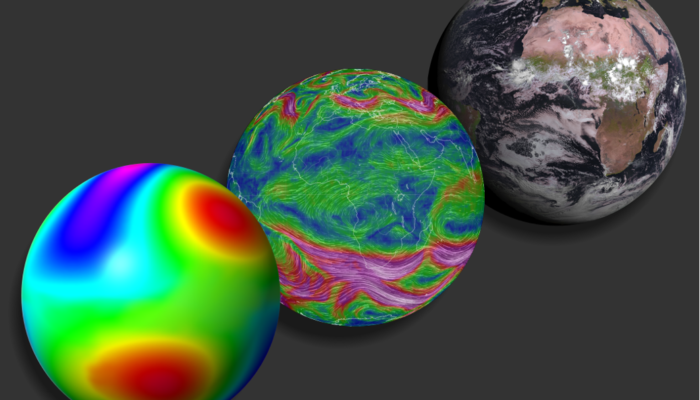
Climate models help us understand how the climate system works, project future climate change, and provide evidence that supports international assessments such as exposed on the IPCC. At this point, there is a fundamental question that is rarely discussed and solved: Can we access and reproduce the climate models used throughout the history of the Coupled Model Intercomparision Project (CMIP)? In ...[Read More]

Sudden Temperature Change in a Warming World: Why Future Temperature Swings Are a Global Tug-of-War?

Sudden Temperature Change in a Warming World: Why Future Temperature Swings Are a Global Tug-of-War?

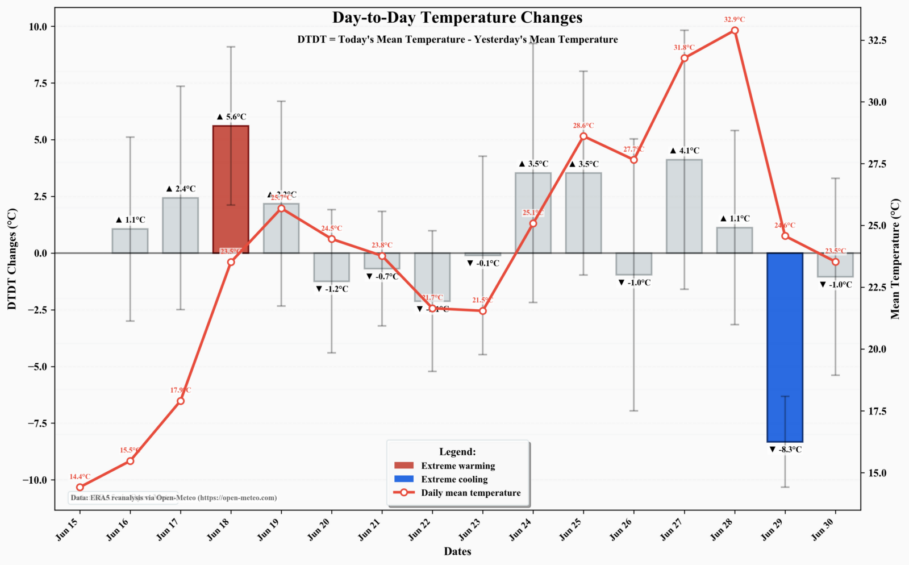
Berlin just went through a brutal heatwave, and then out of nowhere, the temperature crashed between June 28 and 29. The daily mean temperature dropped from nearly 33°C to 25°C—a dramatic drop of about 8°C in just 24 hours (based on ERA5 reanalysis data structure accessed via Open-Meteo). Scientists call these abrupt shifts temperature volatility: rapid transitions from unusually cold to warm cond ...[Read More]

Türkiye’s Climate at a Crossroads

Türkiye’s Climate at a Crossroads

Climate change is often described as a challenge of the future. Yet through our latest work, we’ve realized the future is already unfolding across Türkiye’s landscapes and climates. The signs are visible in the shifting seasons, intensifying heatwaves, and changes in rainfall… As one of the authors of the study “High-Resolution Projections of Bioclimatic Variables in Türkiye: Emerging Patter ...[Read More]

Can we improve our understanding of extreme precipitation events in the Sichuan Basin by using high-resolution regional climate models?

Can we improve our understanding of extreme precipitation events in the Sichuan Basin by using high-resolution regional climate models?

Invited guest from the EGU 2024 Outstanding Student and PhD candidate Presentation (OSPP) Award Context The Sichuan Basin, located at the eastern slope of the Tibetan Plateau in China, is a lowland region that regularly experiences heavy rainfall during the summer months. This is due to its complex topographical features (Fig. 1) and the influence of the East Asian monsoon. The heavy rainfall can ...[Read More]

Spotlighting the Climate Division’s sessions for EGU24

Spotlighting the Climate Division’s sessions for EGU24

Dear community of climate enthusiasts and EGU lovers, We know that being part of the EGU is not just about staying in the loop with the latest geoscience works – especially when it comes to our all-time favorite realm of sciences: climate sciences 🤩. It is also an amazing opportunity to spark exciting collaborations and expand your network with scientists from all over Europe and the world. EGU is ...[Read More]

Put a Climate lab in school and make it better!

Put a Climate lab in school and make it better!

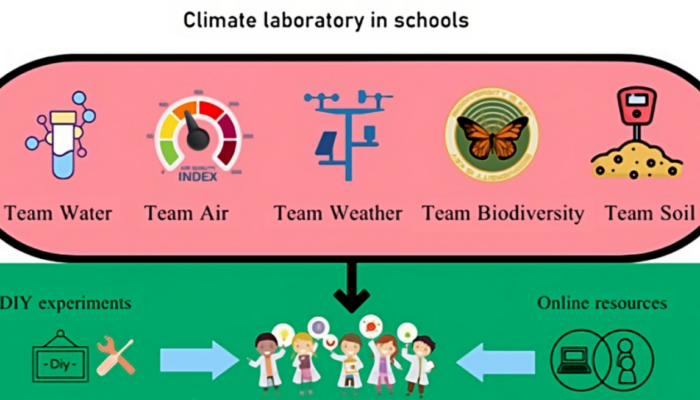
Put a Climate lab in school and make it better “The car will not go through this road”, the driver replied. Well, the path, which he was mentioning was a mudslide made up of clay soil, completely wet from the rain the previous day. We were traveling to a small village in Sundarban to establish a climate laboratory. The concrete road ends 2 kilometers before the schools, and then it was a mud bath! ...[Read More]

A glimpse into the INTIMATE’s summer school of 2022

A glimpse into the INTIMATE’s summer school of 2022

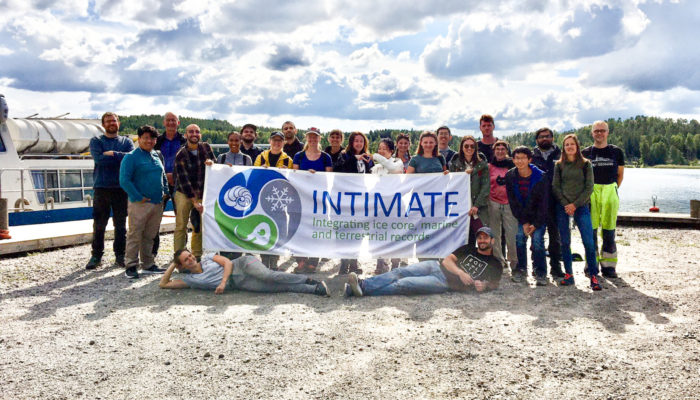
The Earth’s climate has been rapidly changing in the last decades. That’s a fact! Virtually, every one of us has been experiencing those changes in person, but how do we know that Earth’s climate has changed in the past beyond the instrumental data of the last ~200 years? From ancient manuscripts to geologic records, there are many “archives” one might consider “reading” to infer or reconstruct pa ...[Read More]

Simple is good: How we understand climate using idealised models

Simple is good: How we understand climate using idealised models

Do you gravitate to science because of the subject’s ability to explain complicated behaviour in nature through experimentation? When we see things or get our hands dirty by conducting experiments, it helps us comprehend scientific theories which are harder to explain. Introducing a complicated scientific theory is often carried out initially by presenting a simplified version.  For example, stude ...[Read More]

Don’t miss out on these awesome #EGU22 activities!

Don’t miss out on these awesome #EGU22 activities!

Dear climate enthusiasts, EGU lovers, and early/senior climate scientists, With #EGU22 approaching, we wanted to give you a quick overview of the great short courses and great debates that are planned for this years’ General Assembly! If you want to learn more about the scientific sessions offered, please have a look at our Seasonal love letter from December. Short Courses If you are about to fini ...[Read More]

High school-University Connection: Teaching experiences in rural communities regarding climate change

High school-University Connection: Teaching experiences in rural communities regarding climate change

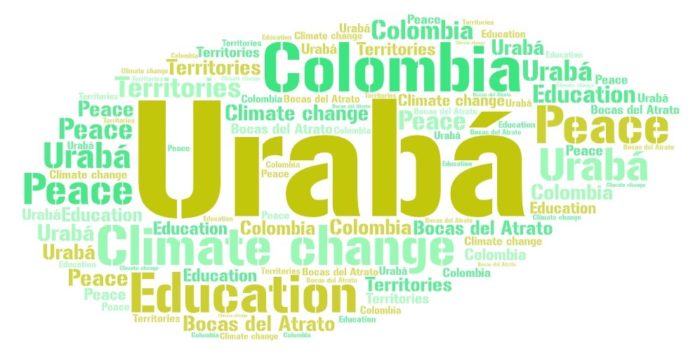
Understanding how our environment is changing under a warmer climate will be one of the new challenges our children will face. Meanwhile, teachers are challenged to seek new pedagogical strategies for teaching climate change in the youngest, especially in rural communities, which are one of the most vulnerable to climate change impacts, as they lack resilience towards surviving extreme events. Alt ...[Read More]