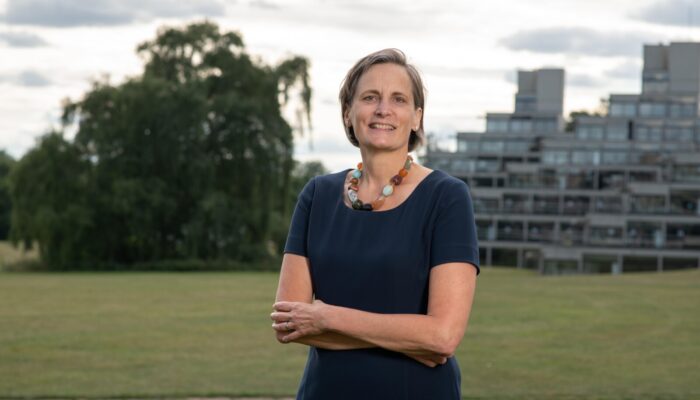
We spoke to Corinne Le Quéré, a Royal Society Research Professor of Climate Change Science at the University of East Anglia (UK). She is the recipient of the 2025 Vladimir Ivanovich Vernadsky medal of the EGU, awarded annually by the Biogeosciences division to those who make an exceptional contribution to biogeosciences.
Can you tell us a bit about your background and how your career progressed to your position today?
It took me a little while to find my way but eventually, after a year of studying anthropology, I did my undergraduate in physics at the University of Montreal and my master’s in atmospheric and oceanic sciences at McGill University. I then worked for four years as a professional technician at Princeton University, where I learned to model the ocean carbon cycle, before completing a PhD at the Sorbonne University in Paris, also on carbon cycle modelling. From there, I moved to the Max Planck Institute for Biogeochemistry in Jena, Germany, and eventually obtained a faculty position at the University of East Anglia in the UK. I also worked in parallel at the British Antarctic Survey for five years before becoming Director of the Tyndall Centre for Climate Change Research. It was around that time that I started the Global Carbon Budget within the Global Carbon Project, which I directed for thirteen years.
More recently, I became increasingly interested in informing policy. I became a member of the UK Climate Change Committee and eventually was invited to found and direct the French equivalent, the Haut conseil pour le climat until 2024. I remain at the University of East Anglia today, as a Royal Society Research Professor in the School of Environmental Sciences.
You have initiated and co-led the Global Carbon Budget within the Global Carbon Project, with the goal of providing an annual synthesis of global emissions and sinks of carbon. What do you think has been the most important insight for science and for society from this effort?
For science, the Global Carbon Budget has been fantastic because it provides a pathway by which the community comes together every year, synthesises the latest information, and confronts evidence from different sources – observations, models, and increasingly machine learning approaches alongside process-based models. This synthesis and the challenging of information from diverse sources have allowed us to identify the frontier of understanding in the global carbon cycle, both on land and in the ocean.
For society, the annual release of information timed with the UN Climate Change Conferences (Conference of the Parties – COP) has maintained crucial momentum and visibility for climate action. It brings the latest trends at the forefront of the policy conversation when it matters most.
Coming from a climate and carbon cycle modeling background, what has been your biggest eye-opener when moving into the climate policy space?
My biggest eye-opener has been realising that most policymakers working in this field genuinely want to act on climate change, and they are well equipped to take decisions under uncertainty, it’s their job. This has encouraged me to be more present in the policy space, even though that has meant I spend a lot of time outside my comfort zone, and to ensure that the information I produce is understandable, accessible, and actionable. I don’t always agree with the actions that are ultimately taken, of course, but I’ve come to respect that the obstacles are real and many decision makers are trying hard to make climate responses work, at least in the countries where I’ve operated (mainly the UK and continental Europe).
Where do you see your field of research progressing in the future, and what are the knowledge gaps to be filled?
Key gaps to be filled include understanding how the land and ocean carbon reservoirs respond to a changing climate. For the land, it’s particularly important because we observe variability in atmospheric carbon dioxide on timescales of three to ten years, which we suspect is attributable to the terrestrial biosphere’s response to climate change, yet we cannot fully explain it today. Understanding this response is crucial because it will influence how the biosphere responds to future climate change and potentially increase projected warming.
For the ocean, the situation is somewhat different. We have a much better quantitative understanding of the ocean carbon sink and its variability. The real issue is how marine ecosystems will evolve in a changing climate under multiple stressors – ocean acidification, deoxygenation, fisheries pressure, microplastics, and more. If ocean productivity declines, it could have significant consequences not only for the availability of marine resources, but also for the long-term storage of carbon in the deep ocean and, consequently, for the zero emissions commitment.
If you were able to travel back in time and give your younger self one piece of advice, what would it be?
I would tell my younger self not to worry so much, and to pursue the research I truly value and believe is important. I’d also encourage myself to engage with society outside of science, to step out of academic circles and understand how the issues that I research matter beyond the research community. Beyond that, I’d emphasise valuing progress over the end goal. When you have ideas and move them forward, you often generate new ideas in the process. You see the research, the problem, and even the world from a different perspective. That shift in perspective is incredibly valuable in itself.
Finally, what does it mean to you personally to have been awarded the Vladimir Ivanovich Vernadsky medal?
This medal means a great deal to me. It recognizes not only my own work, but also the immense support from my research group and the precious and productive collaborations from which I have benefited over the years. I feel very lucky to work in this stimulating field, to interact with people from around the world, and to have the opportunity to make a difference.