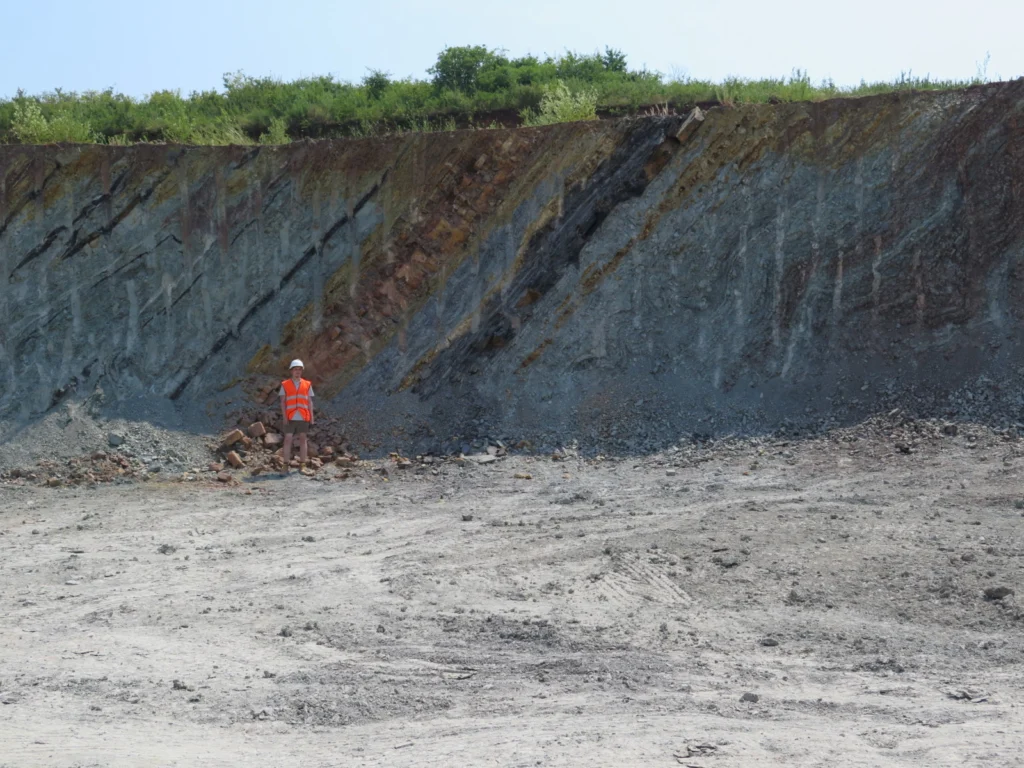
In one of the former episodes of the ‘Features from the field’ series we have talked about foliations, and how they develop when rocks are pushed together by the movement of tectonic plates. It is quite uncommon, however, that tectonic forces are active in the same direction for an unlimited period of time. The rule, …[Read More]
Latest posts
GeoLog
EGU’s 2020 Photo Competition finalists – who will you vote for?
This year’s Photo Competition judging panel did a fantastic job of narrowing down the outstanding photo submissions to the EGU’s Photo Competition to just 10 finalists! The finalist photos are listed below and on the Imaggeos website where you can vote for them from today (27 April) until 7 May 2020. Then three photos with …[Read More]
WaterUnderground
Groundwater and climate change revisited: informing adaptation in a warming world
Recent research has identified the natural resilience of groundwater to climate change and our tendency to deplete this invaluable resource. It’s time we understood, valued, and governed groundwater as the vital adaptation to climate change that it is. roundwater flowing within the geology beneath our feet is the world’s largest liquid store of freshwater. Its volume …[Read More]
GeoLog
#shareEGU20: top 10 tips for participants to get the most out of Sharing Geoscience Online
So, you’ve taken the plunge – you have decided to upload your materials as an author, or committed to hosting your session with your fellow conveners, or perhaps started to add sessions to your personal programme as a participant. What comes next? Interacting with other researchers using one of our new platforms! During these final …[Read More]
Cryospheric Sciences
Icequakes, the little brothers of earthquakes, what do they tell us about ice flow?
Each day, several tens of tiny earthquakes happen beneath Rutford Ice Stream in Antarctica. These events are so small that no human would be able to feel them – yet, scientists can use recordings of these so-called “icequakes” to obtain valuable information on the way ice flows in Antarctica. Read on to find out how… …[Read More]
Seismology
Back to normality (?)
I imagine that in a couple of months European countries will give the green light: the restrictions and social-distancing will be relaxed and people will step out of their houses. Blinking into the bright summer sunlight in the Northern Hemisphere, they will lift a hand towards the sun to shield their sensitive eyes unaccustomed, …[Read More]
Geodynamics
The Sassy Scientist – Mic Muting
After asking many times whether or not I can hear him and just generally struggling to communicate, Noel finally manages to ask: On average, how many times is ‘Can you hear me now?’ uttered during a conference call? Dear Noel, Unlike the ritual of – the almost spiritual – sharing of screens, the accidental muting …[Read More]
Nonlinear Processes in Geosciences
NPG Paper of the Month: “Application of a local attractor dimension to reduced space strongly coupled data assimilation for chaotic multiscale systems”
This month the NPG Paper of the Month award is achieved by Courtney Quinn for her paper “Application of a local attractor dimension to reduced space strongly coupled data assimilation for chaotic multiscale systems” (https://www.nonlin-processes-geophys.net/27/51/2020/). Dr. Courtney obtained her PhD in Mathematics at the University of Exeter (UK) researching critical transitions in dynamical systems. She …[Read More]
GeoLog
#shareEGU20: how to participate in the live-streamed sessions
The foundation of Sharing Geoscience Online, as the name of course suggests, is interacting with other scientists, whether via the presentation materials you upload, comments you exchange with colleagues, and/or the live text chats scheduled for each session. In addition to the text-based interactions, all week you’ll also be able to participate in a series …[Read More]
GeoLog
#shareEGU20: comments on your display presentation
Now that you have uploaded your presentation materials, you might start to get some comments! This is great news and is exactly how we hope people will use our format to share ideas about their research. If you are wondering about how you will be informed that your display presentation has comments, how to reply …[Read More]