
Over the summer we published a very popular series of posts outlining some Top Travel Tips to help those undertaking mapping projects, fieldwork or research visits overseas. Good preparation is essential to get the most out of overseas work. It helps our work be more effective, more efficient and ultimately more sustainable. Today, Susanne Sargeant shares her insights from time …[Read More]
Latest posts
Become a book reviewer for the EGU newsletter!
Interested in free books and getting published? The European Geosciences Union has an opportunity for you… The Union’s newsletter, GeoQ, is a magazine distributed for free to all Union members – that’s around 12,000 scientists – and we’re looking for reviewers wiling to write short book reviews for it! Whether you are a young scientists …[Read More]
Geology Photo of the Week # 20 – Feb 3-9
This week we have a photo of the something that has been on my mind a lot for the last little while and will continue to be on my mind in the comings years months weeks. Of course I am speaking of lab work and particularly the new iodine extraction line that I have been developing. Over …[Read More]
Save the Date – GfGD National Conference 23rd October 2013
On Wednesday 23rd October 2013, GfGD will be hosting their first National Conference in London. Aimed at students and recent graduates, this one day event will be a great opportunity to learn more about GfGD and their work, explore the role of geoscience in development, and meet people across the country with the same interest in applying their work to fight …[Read More]
Imaggeo on Mondays: Kalalau Valley
At over 5 million years old, the island of Kauai is the oldest island in the Hawaiian Achipelago. Hawaii, Maui and Oahu are all younger and lie further to the southeast. This island chronology is no coincidence – the Archipelago formed as a result of intra-plate volcanic activity. Intra-plate volcanism occurs where an upwelling magma …[Read More]
Guest Blog: Managed aquifer recharge in coastal Bangladesh
Donald John MacAllister has a BSc in Geophysics from the University of Edinburgh and an MSc in Water Management from Cranfield University. He has spent three years working as a hydrologist and water engineer, both in the UK and in the international development sector. He is currently pursuing a PhD at Imperial College London researching the …[Read More]
Gender confusion in Confuciusornis? Not any more!
Among the many issues with the fossil record is the case of gender identification. In modern organisms, it is usually pretty easy to tell which members of a particular species are the males and which are the females. This can either be through consistently perving on them to figure it out during copulation, or some …[Read More]
Sea-floor spreading, on land
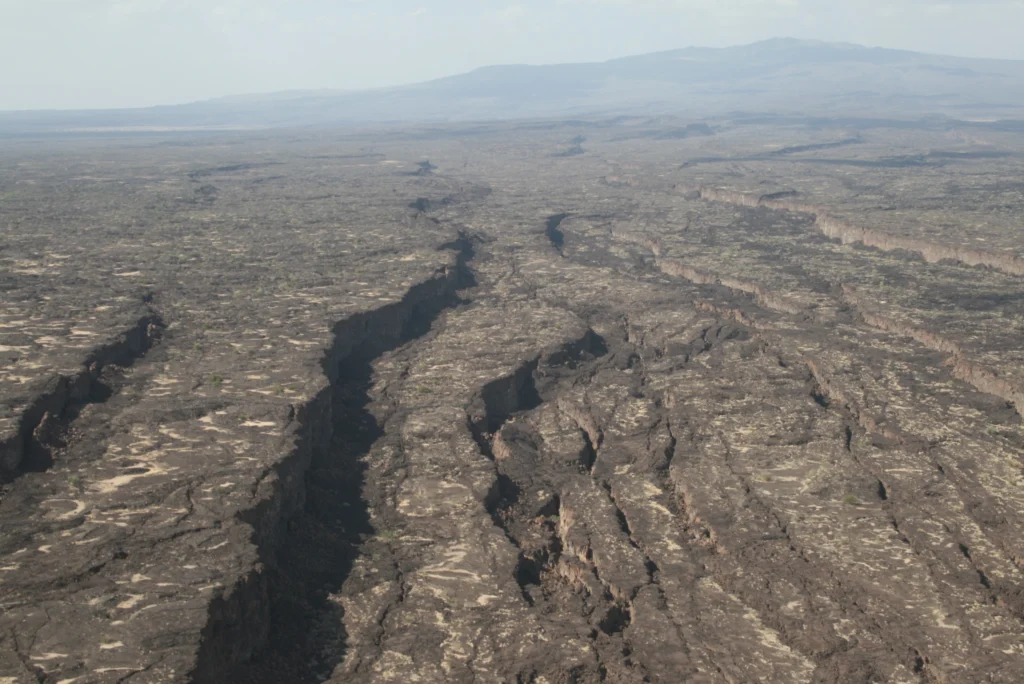
One piece of evidence that helped to establish the theory of Plate Tectonics in the early-1960’s was the recognition of patterns of magnetisation in the basalts of the seafloor that were symmetrical about the global oceanic ridge system. Fred Vine and Drummond Matthews recognised that this pattern had to be fixed in place as the …[Read More]
Friday Photo (65): Geologists in the field – escaping the sun
In contrast to last week’s snowy photo, geologists trying to squeeze into a patch of shade during field work in the betics, Spain, April 2011. Get involved with our Friday Photo series – send us your favourite photos of geologists in the field! (c) Geology for Global Development 2013
Geosciences Column: The contribution of climate change to water scarcity in the MENA region
In this month’s Geoscience’s column, Alex Stubbings discusses the water scarcity problems in the Middle East and North Africa region and the recent developments in modelling water resources here. The Middle East and North Africa (MENA) region is considered the most water-scarce region in the world. As such, the region faces a multitude of challenges …[Read More]