
Next week we’ll be announcing two new ways you can get involved with our hazards education programme in Ladakh (taking place in June 2014). Here is another of Rosalie Tostevin’s fantastic images from the region. Credit: Rosalie Tostevin
Latest posts
Sniffing out signs of an earthquake
Last year Kate Ravilious was awarded an EGU Science Journalism Fellowship to follow scientists studying continental faults. Now she’s out in Nepal alongside researchers who are working out when the county’s next big quake will be… Sometimes the best rocks are found in the worst locations. Yesterday I was reminded of this as I watched …[Read More]
Science Snap (#22) Landslide in Washinton state
This week, the world has been shocked by images of devastation after a huge landslide buried the town of Oso, north of Seattle, in Washington state, USA. At 11:00 PDT on Saturday 22nd March 2014, a 500m-wide section of mud and rock became detached from a hillside above the 180 population town, and hurtled down …[Read More]
Presenting at the Assembly: A quick ‘how to’ from the EGU
The schedule is out, presentation slots have been assigned and it’s time to start thinking about putting yours together. Whether you have an oral, poster or PICO slot, we have a suite of simple guidelines to get you ready for the conference! Orals The guidelines for oral presentations are online. All oral presentations should have the …[Read More]
GeoTalk: The mantle and models and measurements, oh my! Talking geophysics with Juan Carlos Afonso
This week in GeoTalk, we’re talking to Juan Carlos Afonso, a geophysicist from Macquarie University, Sydney. He explains how a holistic approach is crucial to understanding tectonic processes and how a little “LitMod philosophy” can go a long way to achieving this… First, could you introduce yourself and tell us a little about what you …[Read More]
New GfGD University Groups
Over the past month we’ve been working with students at the University of Durham and Camborne School of Mines (University of Exeter) to establish and launch new GfGD University Groups. These groups will join our existing network of groups, based in Cambridge, Imperial College, Leeds, Leicester, Oxford, Plymouth, Southampton, UCL and Trinity College Dublin. University …[Read More]
Active learning in large classes: a gallery ‘walk’ with a 100 students
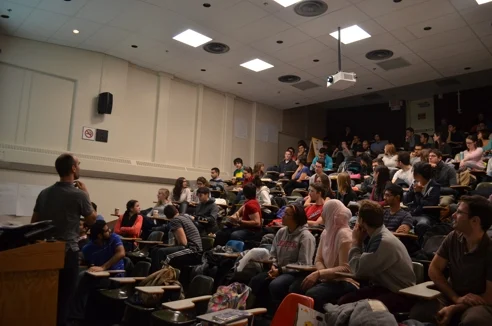
Active learning in large classrooms is difficult but not impossible – here is one example of an active learning technique developed for small classrooms, the gallery walk, which I have successfully re-purposed for a class of 100 (but I see no real upper limit on class size with the modified version of this activity). “In …[Read More]
The coolest groundwater paper of 2013!
What paper inspired you the most in 2013? The Early Career Hydrogeologists’ Network (ECHN) of the International Association of Hydrogeologists (IAH) has announced a new contest: ‘2013 Coolest Paper of the Year’ award (described in this Hydrogeology Journal editorial). I nominated Fan et al (Science, 2013) who completed a Herculean effort to map the depth …[Read More]
Co-teaching a blended class across universities: why? and why not?
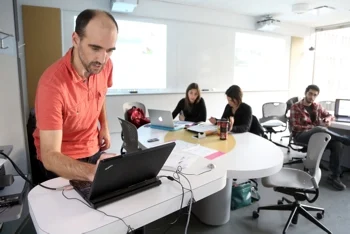
This term I am co-teaching a graduate class in advanced groundwater hydrology with Grant Ferguson (University of Saskatchewan) and Steve Loheide (University of Wisconsin – Madison). In co-developing and co-delivering this course we have learned a lot – I’ll start here with our initial motivations and write later about our pedagogic decisions, software tools and …[Read More]
Why read “Water Underground” blog? And for me, why write a blog?

My reason to blog is really quite simple: to share what doesn’t currently fit into peer-reviewed articles. I will write about groundwater as well as how I research, teach, supervise and collaborate. In short I hope to cover the whole kit and caboodle of academia, from the underground perspective of groundwater. Why read this blog? …[Read More]