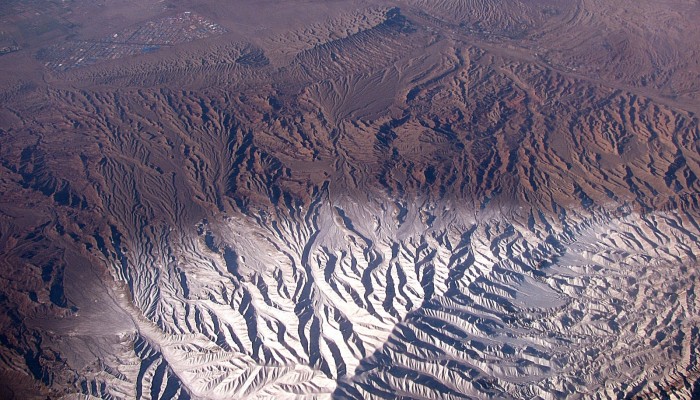
High peaks, winding river channels and a barren landscape all feature in today’s Imaggeo on Mondays image, brought to you by Katja Laute, a geomorphologist from Norway. This photo was taken from an airplane flying over the Zagros Mountains in Iran. The Zagros Mountain range stretches south and west from the borders of Turkey and Russia to the Persian Gulf, and is Iran’s largest mountain ran ...[Read More]
Imaggeo on Mondays: Foehn clouds
This week’s post is brought to you by Stefan Winkler, a Senior Lecturer in Quaternary Geology & Palaeoclimatology, who explains how the mountain tops of the Southern Alps become decorated by beautiful blanket-like cloud formations. The Sothern Alps of New Zealand are a geoscientifically dynamic environment in all aspects. They are arguably one of the youngest high mountain ranges in the ...[Read More]
Imaggeo on Mondays: Earthquake Lake
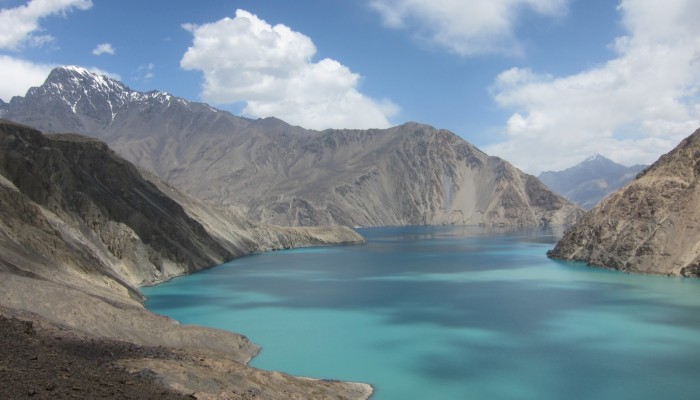
Despite its alluring turquoise waters and rugged mountain backdrop the story behind this beautiful lake is rather more troubling. In today’s Imaggeo on Mondays, the first post since our short break from the traditional format during the General Assembly, Alexander Osadchiev writes about the shaky origins of Sarez Lake. Lake Sarez is situated in Tajikistan, deep in the Pamir Mountains. In 1911 a lo ...[Read More]
Imaggeo on Mondays: The largest fresh water lake in world
Most lakes in the Northern hemisphere are formed through the erosive power of glaciers during the last Ice Age; but not all. Lake Baikal is pretty unique. For starters, it is the deepest fresh water lake in the world. This means it is the largest by volume too, holding a whopping 23,615.39 cubic kilometres of water. Its surface area isn’t quite so impressive, as it ranks as the 7th largest in the ...[Read More]
Imaggeo on Mondays: An explosive cloud
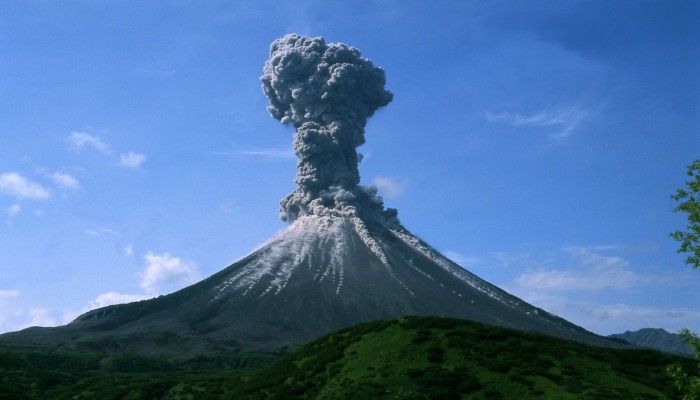
One of the world’s most volcanically active regions is the Kamchatka Peninsula in eastern Russia. It is the subduction of the Pacific Plate under the Okhotsk microplate (belonging to the large North America Plate) which drives the volcanic and seismic hazard in this remote area. The surface expression of the subduction zone is the 2100 km long Kuril-Kamchatka volcanic arc: a chain of volcanic isla ...[Read More]
Imaggeo on Mondays: Landslide on the Cantabrian coastline
Shimmering blue seas, rocky outcrops and lush green hills sides; this idyllic landscape is punctuated by a stark reminder that geohazards are all around us. Irene Pérez Cáceres, a PhD student at the University of Granada (Spain) explains the geomorphology behind this small scale landslide on the Asturian coastline. This picture was taken in May 2011 in the coast of Llanes (Asturias, Spain). I was ...[Read More]
Imaggeo on Mondays: Artists’ Paint Pots
Many artists draw inspiration from nature and it’s not surprising when faced with landscapes which are as beautiful as the one featured in this week’s Imaggeo on Mondays post. Josep Miquel Ubalde Bauló writes about the origin of the colourful mud pots and bobby-socks trees! This picture corresponds to The Artist Paint Pots, found in in Yellowstone, the first National Park of the world. Yellowstone ...[Read More]
GeoEd: A risky business
In this month’s GeoEd post, Sam Illingworth explores the pitfalls of being a scientist in the public eye. Following the recent acquittal of 6 geoscientists on manslaughter charges after ‘failing’ to predict the 2009 L’Aquila earthquake, is it time we thought about improving how risk is communicated to the wider public? At the beginning of November of this year, six Italian scientists were acquitte ...[Read More]
GeoTalk: Stacia Gordon
Geotalk is a regular feature highlighting early career researchers and their work. Following the EGU General Assembly, we spoke to Stacia Gordon, the winner of the Tectonics and Structural Geology Division Outstanding Young Scientist Award, 2014. First, could you introduce yourself and tell us a little more about your career path so far? My name is Stacia Gordon. I am an Assistant Professor at the ...[Read More]
Imaggeo on Mondays: Stone Flower
In a true feat of endurance, self-discovery and resilience, Solmaz Mohadjer and Josy Strunden, geology students at the University of Tübingen (Germany), cycled 800 km in the Pamir Mountains as part of a trip to raise awareness about autism in Tajikistan. ““We cycled through one of the most tectonically active regions on the planet, passing by mountain communities that welcomed us warmly as well as ...[Read More]