2019 was a brilliant year for our blogging network here at EGU. Across the EGU’s official blog, GeoLog, as well as the network and division blogs there were so many interesting, educational and just downright entertaining posts this year it was hard to get the blog editors to choose their favourites! Nevertheless in December, to celebrate the excellent display of science writing across the network ...[Read More]
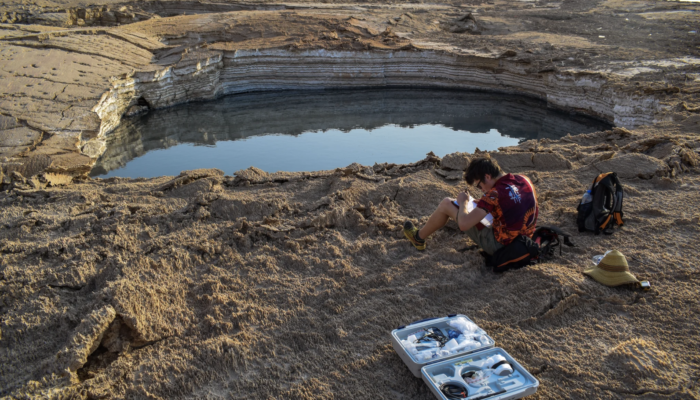
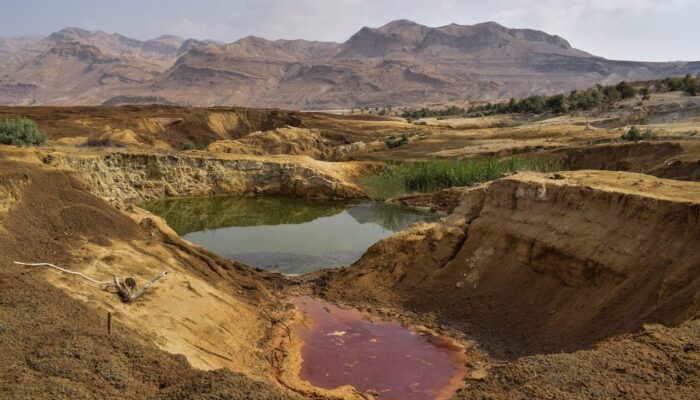
Imaggeo on Mondays: Sampling sulfurous sinkhole water
Sampling of water present in sinkhole formed in superficial salt-rich lacustrine deposits at Ghor Al-Haditha, Dead Sea eastern shore, Jordan, during a field campaign in October 2018. The water in this sinkhole flows into the Dead Sea in a surface stream channel formed in 2012. The water was highly acidic and extremely conductive, with a strong sulfurous odour. Understanding the chemistry of the wa ...[Read More]
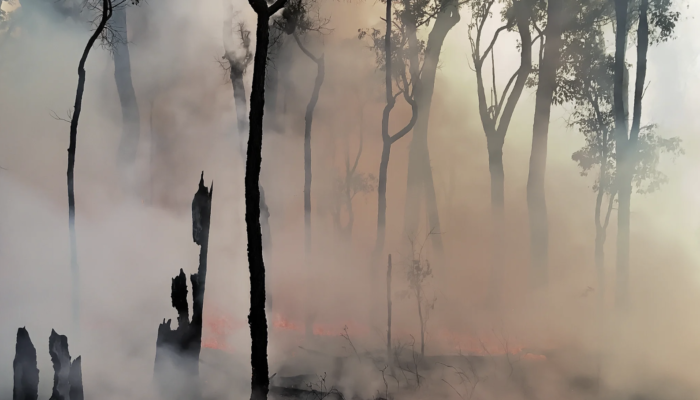
Imaggeo on Mondays: Setting trees aflame to understand the carbon balance of fires
Smoke clears after an experimental wildfire in Australian eucalyptus forest carried out for carbon balance estimations of wildfires. We meticulously measured the carbon in all leaves, twigs, logs and bark in a forest block about 35km east of Manjimup and then they set it on fire with help from the Dept. of Parks and Wildlife, [Western Australia]. We the counted the carbon all over again including ...[Read More]
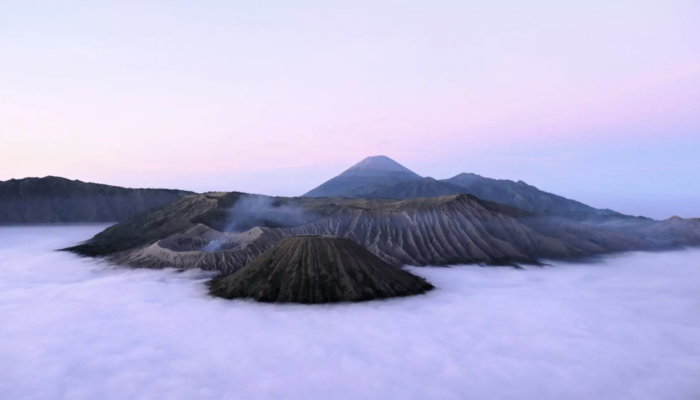
Imaggeo on Mondays: Mount Bromo – volcanic deity
Featured in this photo, rising out from a sea of violet fog at dawn, is one of Indonesia’s most iconic volcanoes, Mount Bromo. The mountain is a large volcanic crater, also known as a caldera, which formed when an ancient cone volcano collapsed in the late Pleistocene and early Holocene epochs, between 126,000 and 8,300 years ago. The current structure stands at 2,392 metres in the eastern region ...[Read More]
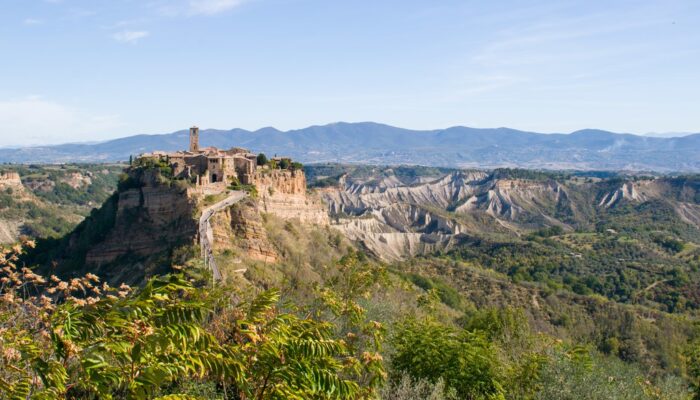
Imaggeo on Mondays: Civita di Bagnoregio – the dying town
On top of a steep cliff standing out from the surrounding countryside, lies the small town of Civita di Bagnoregio, one of the most famous villages of Italy. It is often called the dying town, although more recently people have started to refer to it as fighting to live. What this little town is fighting against is the threat of erosion, as its walls are slowly crumbling down. Located in central I ...[Read More]
Imaggeo on Mondays: The colourful sinkhole clusters at Ghor Al-Haditha
Sinkholes that form on the Dead Sea shore at Ghor Al-Haditha, Jordan, often occur in clusters, with many holes packed into a small area. However the visual appearance of neighbouring sinkholes can vary significantly. Mineral precipitation in the foremost sinkhole in this picture, which has no fresh water supply, gives it a garish pink-orange colouration. The larger hole behind has a groundwater-de ...[Read More]
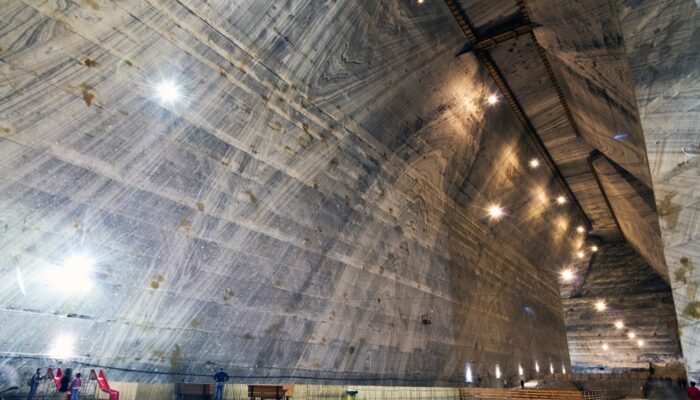
Imaggeo on Mondays: The salt mine carving into the Carpathians
The image gives us a glimpse into the Slănic Salt Mine in central Romania, about 100 kilometres north of the capital city Bucharest. The region was actively mined for almost 30 years, from 1943 to 1970. The Slănic Salt Mine is the largest salt mine in Europe, and the facility consists of 14 large chambers, each more than 50 metres high. The cavities of the mine, more than 200 metres deep, carve in ...[Read More]
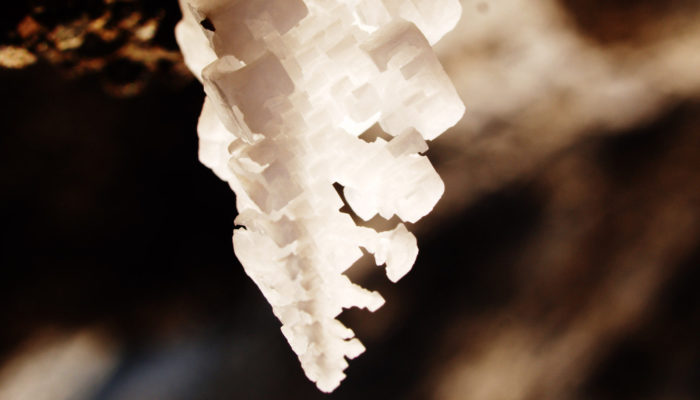
Imaggeo on Mondays: The ephemeral salt crystals
Rock salt stalactites (Speleothems) are the indicators of entrance in a salt cave. These crystal stalactites precipitate from brine only at the entrance in the salt caves, as that is the only place where the physical and chemical properties of the air and the brine dripping from the ceiling allow these crystals to grow and be preserved. And they are extremely fragile – if there is just a sma ...[Read More]
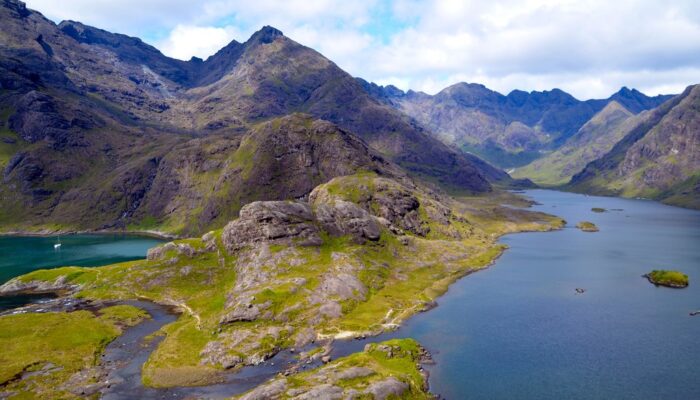
Imaggeo on Mondays: Loch Coruisk – home of the wild Kelpie
On the south-western coast of the Isle of Skye, Scotland, lies Loch Coruisk, supposedly home of a water horse. At the southern end of this freshwater Loch, the Scavaig River discharges into a sea Loch, Loch na Cuilce. Loch Coruisk snuggles close to the center of the Cuillin Hills complex, younger than both the northern and southern formations of the Isle. At present, the neighbouring hills are dom ...[Read More]
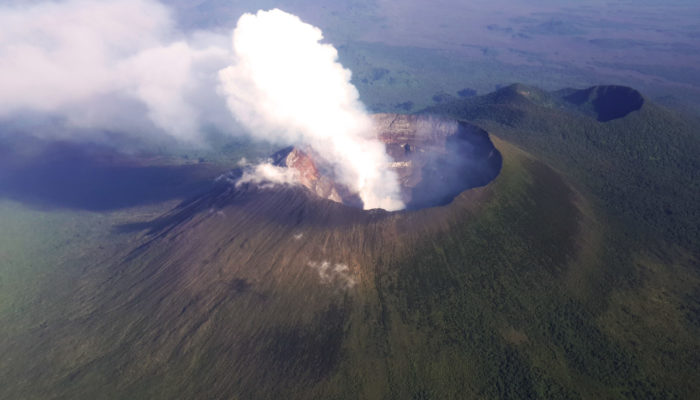
Geosciences Column: How erupting African volcanoes impact the Amazon’s atmosphere
When volcanoes erupt, they can release into the atmosphere a number of different gases initially stored in their magma, such as carbon dioxide, hydrogen sulfide, and sulfur dioxide. These kinds of gases can have a big influence on Earth’s atmosphere, even at distances hundreds to thousands of kilometres away. A team of researchers have found evidence that sulfur emissions from volcanic eruptions i ...[Read More]