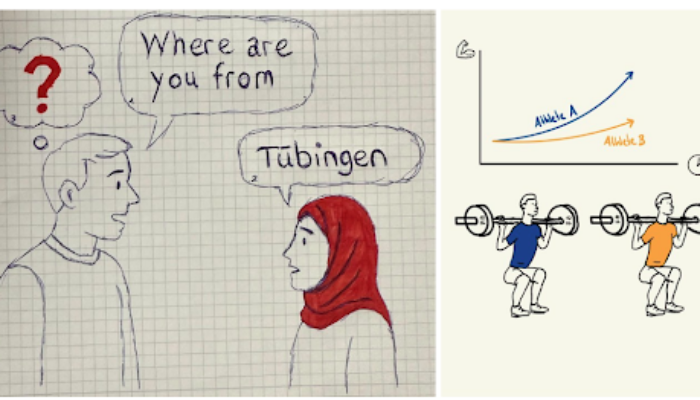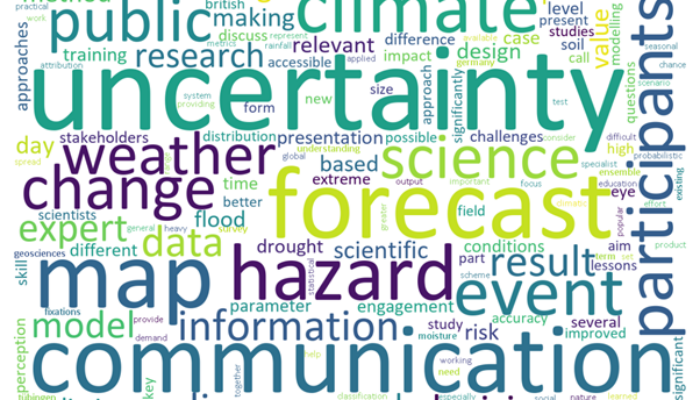
Welcome to a new series on GeoLog dedicated to one of the most critical yet frequently misunderstood aspects of research: Communicating uncertainty in science. Over the coming months, we will feature six guest posts written by students from a summer course at the University of Tübingen. Bringing together 13 students across diverse disciplines, the course challenged them to reframe uncertainty as a ...[Read More]
Communicating uncertainty to non-experts: A good problem to tackle
Uncertainty in geosciences is an inherent part of scientific processes and assessments, propagating throughout the entire workflow (Pérez-Díaz et al., 2020). As scientists, we are used to seeing error bars, confidence intervals, or statistical indicators that tell us how robust our models or measurements are (Padilla et al., 2021). The challenge arises when we need to communicate these scientific ...[Read More]
How to make your geoscience communication publishable: Find out at EGU25
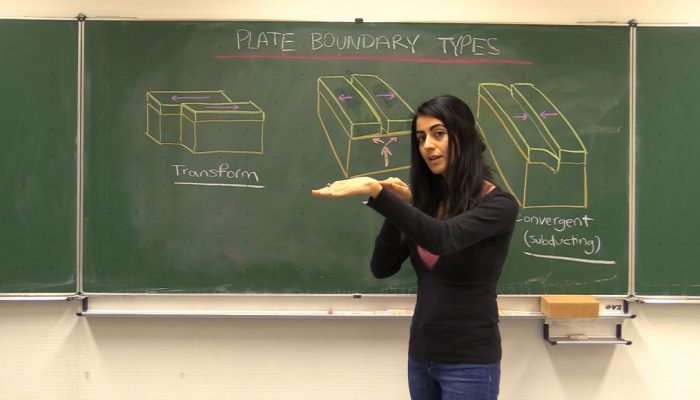
A long time ago, when I walked into the Ministry of Education building in Dushanbe (Tajikistan) to inquire about offering an earthquake education workshop in a public school, I had no research agenda, let alone thinking about publishing it one day. All I wanted was to do something useful: sharing earthquake science with school children. Recognizing the value of geoscience communication, my graduat ...[Read More]
How to make your geoscience communication publishable: Find out at EGU23
A long time ago, when I walked into the Ministry of Education building in Dushanbe (Tajikistan) to inquire about offering an earthquake education workshop in a public school, I had no research agenda, let alone thinking about publishing it one day. All I wanted was to do something useful: sharing earthquake science with school children. Recognizing the value of geoscience communication, my graduat ...[Read More]
Sign up for EGU’s Mentoring Program: here’s why!
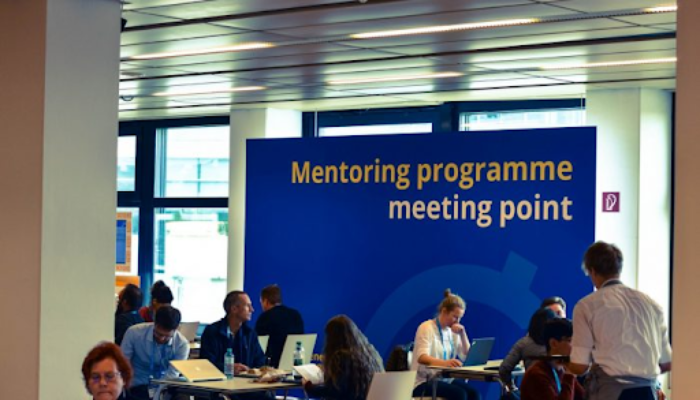
You have been matched! I take a deep breath and click to open the message. Two women from Iran, a Master and a PhD student. Their research interests match mine: geohazards, geomorphology and modeling. I’m filled with pure joy. Being an Iranian woman myself, doing science outside of Iran for over two decades, I feel I am finally returning home. Carrying a backpack filled with knowledge and experien ...[Read More]
A Pedagogical Dance: EGU’s Teacher-Scientist Pairing Scheme
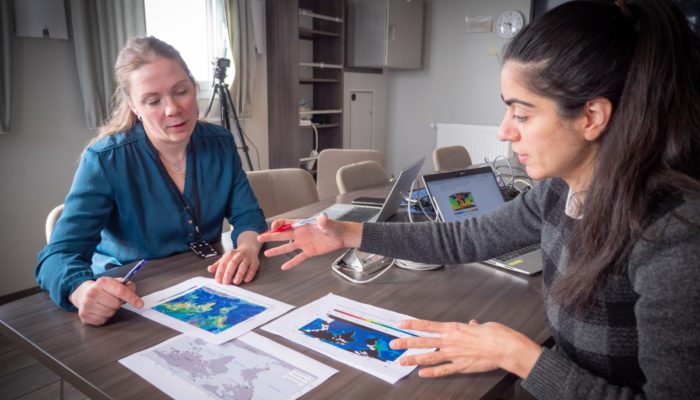
An email from Giuliana Panieri, a geology professor at the Arctic University of Norway (UiT) in Tromsø, cracked my pandemic bubble late last year. She invited me to join an unconventional expedition (AKMA OceanSenses) to the Arctic Ocean, where scientists worked hand-in-hand with other societal actors, to integrate different kinds of knowledge and create tools that help open up people’s minds to a ...[Read More]
The EGU22 Mentoring Program could be just what your career needs
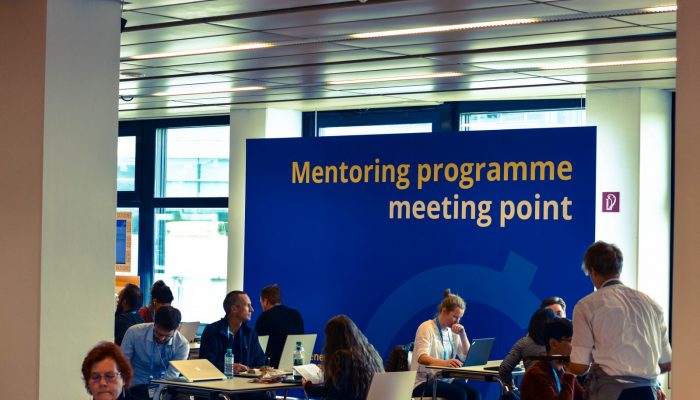
The countdown to EGU22 has officially begun! If you are participating in the General Assembly this year and want to support and connect with other researchers in or outside of your field, we encourage you to sign up for the EGU22 Mentoring Program. The program matches experienced conference participants (mentors) with those who have not previously participated in a large geoscience conference (men ...[Read More]
Introducing INTEGRATE: a complete higher-education teaching package for climate science
If you are a higher-education instructor and want to teach climate science and a suite of relevant technical skills to those with no (or minimal) prior knowledge of climatology, you may want to begin with INTEGRATE (Integrated Teaching of Atmospheric Science, Technical Skills and Empirical Methods). This teaching package is self-contained, open-access, and available online. Topics covered include ...[Read More]
EGU Teacher-Scientist Pairing Scheme: supporting geoscience education in schools
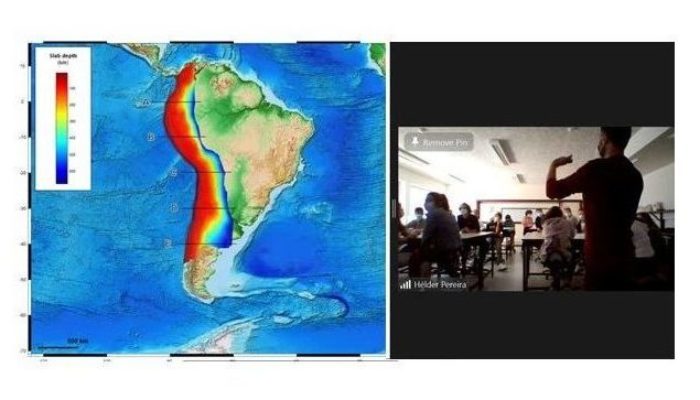
For the vEGU21 General Assembly, the EGU Education & Outreach Committees tried something new. They connected school teacher, Hélder Pereira, with seismologist, Susana Custódio, to create and teach a lesson plan on a topic relevant to Hélder’s classroom curriculum: the origin of the South American volcanic gaps. The lesson was live streamed online from Hélder’s class in Algarve, Por ...[Read More]