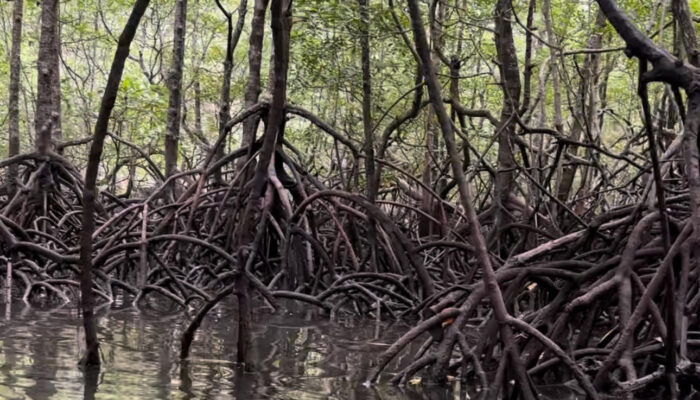
This Sunday, July 26, marks the International Day for the Conservation of the Mangrove Ecosystem. We are currently experiecing critical crossroads globally, where groundbreaking data on global forest recovery collides with the immediate threats of an escalating climate crisis.El Niño is pushing Pacific sea surface temperatures toward levels that rank among the highest on record, and climate specialists expect damaging marine heat reaching almost half of the globe till the end of 2026. In the past, this kind of climatic settings have tipped mangroves’ resilience almost to a collapse point. So continue reading to learn about how these significant coastal buffers are faring on the front lines, and why our approach to protecting them must urgently evolve.
A strengthening El Niño is pushing Pacific sea surface temperatures toward levels that rank among the highest on record, and climate specialist expect damaging marine heat reaching almost half of the globe till the end of 2026. In the past, this kind of climatic settings have tipped mangroves’ resilience almost to a collapse point.
Mangrove trees are the key element of these ecosystems. They are extremely good at tolerating stress, unless this stress is delivered too fast, or stacked. A great example is the 2015–16 El Niño, when more than 7,000 hectares of mangrove forest died within months along the Gulf of Carpentaria, in Australia. The El Niño suppressed rainfall and dropped regional sea level just as temperatures spiked, and the combination of reduced tidal flushing, high evaporation and hypersaline sediment triggered hydraulic failure. This means that the mangrove trees died of thirst while standing in salt water (Gauthey et al. 2022). Another example is a case in the Maldives in 2020, where record sea levels driven by an extreme Indian Ocean Dipole event outpaced sediment accretion almost five times, killing almost a quarter of the archipelago’s mangroves (Carruthers et al. 2024).
It is important to understand such mechanism because they can be extrapolated and used for didactic measures. Natural climatic oscillations currently operate on top of a warmer, higher baseline. Every swing toward hypersalinity, heat stress or anomalous sea level starts from a more precarious position than it did fifty years ago. With El Niño again strengthening through 2026, coastal scientists are watching for stress indicators in vulnerable estuaries, such as northern Australia and East Africa. Such indicators or early warning signals can vary from sudden canopy browning to rhizosphere salinity spikes, or dieback at the driest, most tidally restricted edges of mangrove stands.
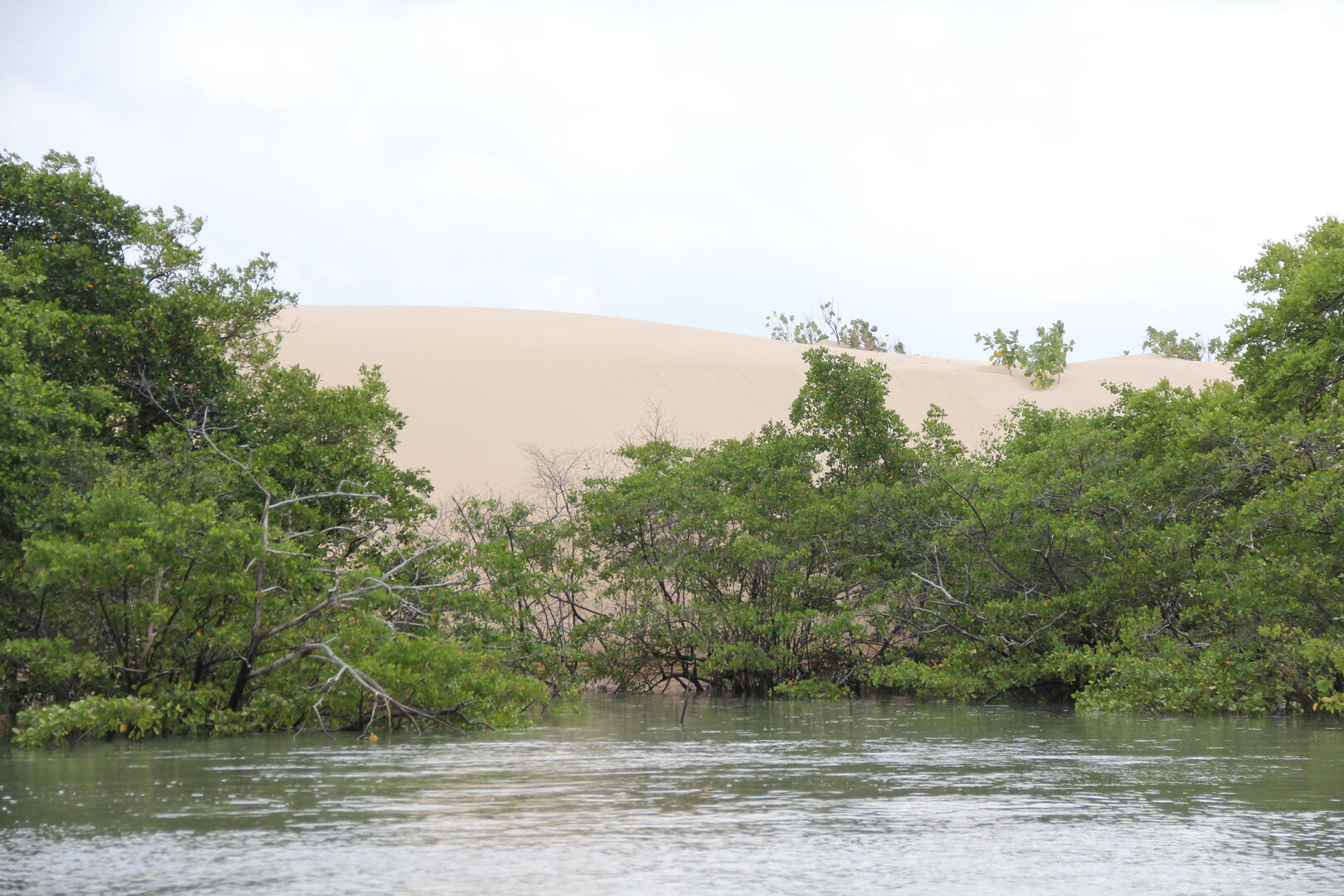
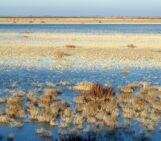
Narrow mangrove tree strip next to a dune in the semi-arid coast of Brazil. Arid and semi-arid mangroves are among the most endangered ecosystems facing climate change and sea-level rise.
Photo credit: Guilherme Abuchahla.
The stakes of losing mangroves go beyond what the eyes can see. Mangroves are among the most carbon-dense ecosystems on Earth, rivalled only by peatlands, because they bury organic carbon in waterlogged, oxygen-poor sediment where it can persist for centuries. Global stocks are estimated in the billions of tons of carbon, and losing mangroves can liberate that buried (blue) carbon back into the atmosphere as disturbed sediment oxidizes (Macreadie et al. 2021). Mangroves also form a living buffer against storm surges, besides slowing down shoreline erosion, and providing nursery habitat for marine and estuarine life. Grey or green-grey nature-based solutions cannot match the ecosystem services that a healthy mangrove can provide.
That message has finally started to come across to some policymakers, at least on paper. The Global Mangrove Alliance’s 2024 State of the World’s Mangroves report set out goals to halt net mangrove loss, restore half of degraded mangrove area, and double the extent under formal protection by 2030 – with more than 40% of remaining mangroves already under some form of protected status. Nevertheless, there is a caveat pointed out by the report: “protected” does not mean “safe.” Protection status varies between countries, from 5 to 75%. Besides, a park boundary drawn on a map does little against a hypersaline pulse delivered by an El Niño-driven sea-level drop. It is important to question ourselves whether protection on paper survives human needs (e.g., palm oil concessions, shrimp ponds, coastal development) as well as an increasingly erratic ocean.
A frontline in both directions
Frontline conservation battles are still being lost in some areas even as they’re being won in others. Some of that pressure hasn’t let up. In the Niger Delta, Nigeria, the largest mangrove system has lost over 2,500 square kilometers in the past 38 years, representing more than a quarter of the historic extent. That massive loss was driven by oil pollution, urban expansion and unsustainable harvesting layered on top of the delta’s own subsidence (Wang et al. 2025).
However, not all is lost. In fact, a recent study based on four decades of satellite imagery, found that global mangrove cover, after a steep decline through the late twentieth century, turned a corner around 2010 and has been in net expansion since, driven by natural regeneration, active restoration, and mangroves recolonizing abandoned aquaculture ponds and freshly formed mudflats across Asia and Latin America (Zhang et al. 2026). Still, the net change across the full 40-year record works out to roughly a 1% decline. Mangroves in Southeast Asia have changed from historic loss to measurable net growth, while West and Central Africa continue to lose area. But the headline finding corrects the doom narrative that has dominated mangrove news for over two decades.
Cautious optimism, not complacency
I don’t think the optimism here is misplaced, but it comes with a condition attached (Friess et al. 2020). The recovery documented by Zhang and colleagues largely reflects decades of restoration investment, community-led replanting, and improved monitoring. Also, the Global Mangrove Watch platform that underpins so much of this research is itself a product of that effort (Bunting et al. 2022). None of it was automatic, and none of it guarantees mangroves can absorb what a strengthening El Niño and a warming mean state mean synergistically to them. The Gulf of Carpentaria and Maldives diebacks both happened in systems that looked stable right up until they didn’t (for more on resilience and collapse thresholds, refer to Gunderson 2000 and Dahdouh-Guebas et al. 2021).
The good news in this Mangrove Day 2026 is that mangroves have now more capacity to recover globally than we thought a decade ago, and the policy frameworks to keep restoring them already exist. Whether that capacity is enough depends on whether the current El Niño behaves like a stress test the ecosystem can pass, or like Carpentaria in 2016 and the Maldives in 2020 – a threshold some estuaries quietly cross.
Watching the consequences of that, in real time, may be the most relevant mangrove science question of the year.
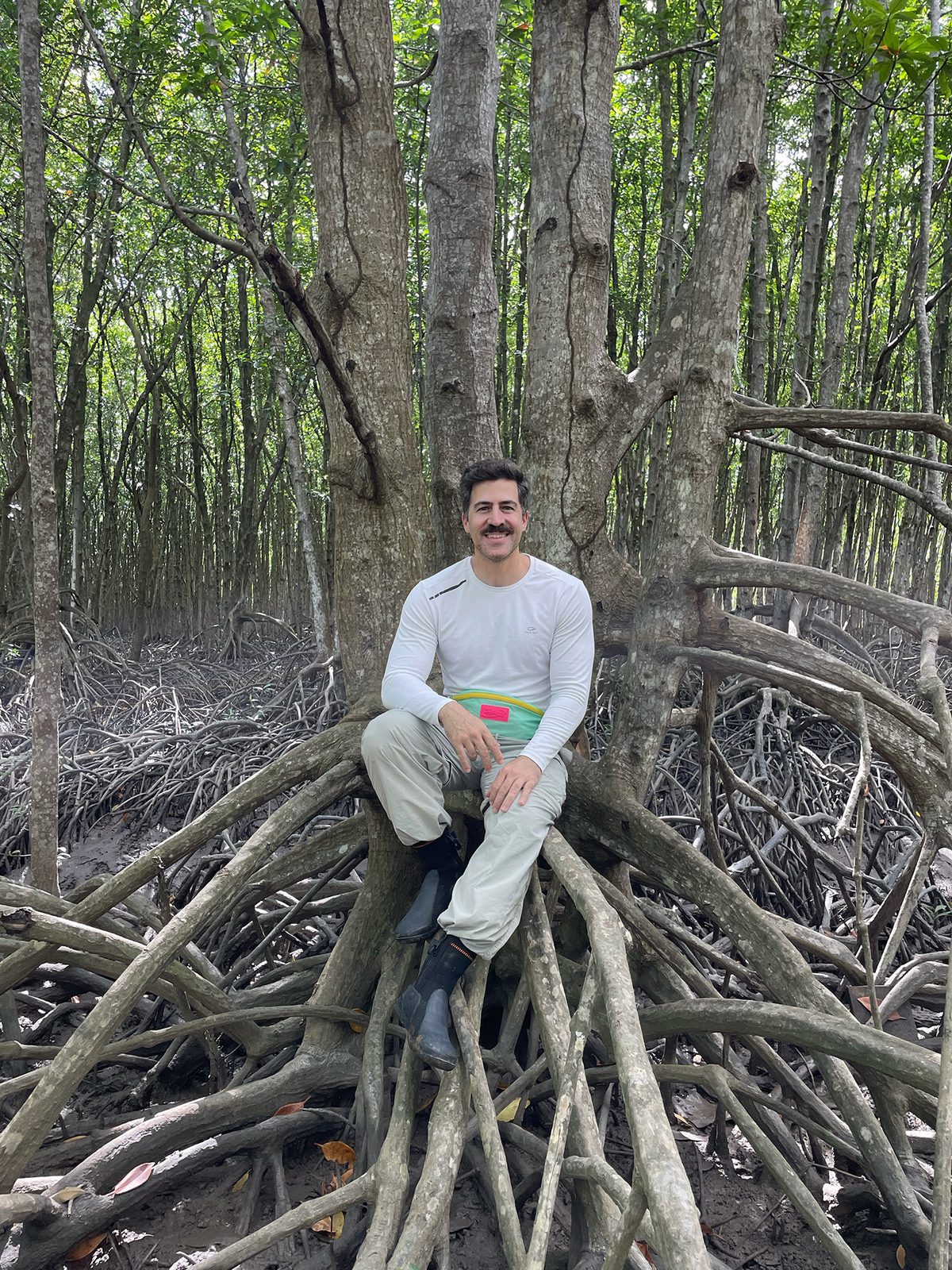
Author, Guilherme Abuchahla, in Vietnam.
The distinction between resilience and inevitability is very important. A rebounding global trend line is good news, but it is an average built from thousands of local stories, some of recovery and some of continued collapse.
Furthermore, as discussed in the recently concluded largest mangrove conference in the world, the Mangrove, Macrobenthos and Management Meeting (MMM7), increase in mangrove area does not automatically correspond to healthy and permanent mangroves. Some restoration efforts are based in planting seedlings disregarding reference sites for diversity, density, and biodiversity. Furthermore, the ongoing losses in the Niger Delta, for example, are part of the same dataset as the Southeast Asian gains.
For coastal communities living behind a thinning mangrove fringe this El Niño season, the global trend line does not mean much for their livelihoods if their particular stretch of coast is the one crossing a threshold. That is exactly why consistent monitoring, rapid-response restoration funding, and local-scale early warning for salinity and heat stress need to be highlighted alongside the global success story.
References
Bunting P, Rosenqvist A, Hilarides L, Lucas RM, Thomas N (2022) Global Mangrove Watch: Updated 2010 Mangrove Forest Extent (v2.5). Remote Sens 14:1034. doi:10.3390/rs14041034
Carruthers L, Ersek V, Maher D, Sanders C, Tait D, Soares J, Floyd M, Hashim AS, Helber S, Garnett M, East H, Johnson JA, Ponta G, Sippo JZ (2024) Sea-level rise and extreme Indian Ocean Dipole explain mangrove dieback in the Maldives. Sci Rep 14:27012. doi:10.1038/s41598-024-73776-z
Dahdouh-Guebas F, Hugé J, Abuchahla GMO, Cannicci S, Jayatissa LP, Kairo JG, Arachchilage SK, Koedam N, Nijamdeen TWGFM, Mukherjee N, Poti M, Prabakaran N, Ratsimbazafy HA, Satyanarayana B, Thavanayagam M, Velde KV, Wodehouse D (2021) Reconciling nature, people and policy in the mangrove social-ecological system through the adaptive cycle heuristic. Estuar Coast Shelf Sci 248:106942. doi:10.1016/j.ecss.2020.106942
Friess DA, Yando ES, Abuchahla GMO, Adams JB, Cannicci S, Canty SWJ, Cavanaugh KC, Connolly RM, Cormier N, Dahdouh-Guebas F, Diele K, Feller IC, Fratini S, Jennerjahn TC, Lee SY, Ogurcak DE, Ouyang X, Rogers K, Rowntree JK, Sharma S, Sloey TM, Wee AKS (2020) Mangroves give cause for conservation optimism, for now. Current Biology 30:R135-158. doi:10.1016/j.cub.2019.12.054
Gauthey A, Backes D, Balland J, Alam I, Maher DT, Cernusak LA, Duke NC, Medlyn BE, Tissue DT, Choat B (2022) The Role of Hydraulic Failure in a Massive Mangrove Die-Off Event. Front Plant Sci 13:822136. doi:10.3389/fpls.2022.822136
Global Mangrove Alliance (2024) Global Mangrove Alliance: The State of the World’s Mangroves 2024. Available at: https://www.mangrovealliance.org/mangrove-forests
Gunderson LH (2000) Ecological Resilience — In Theory and Application. Annu Rev Ecol Syst 31:425-439
Macreadie PI, Costa MDP, Atwood TB, Friess DA, Kelleway JJ, Kennedy H, Lovelock CE, Serrano O, Duarte CM (2021) Blue carbon as a natural climate solution Nat Rev Earth Environ 2:826–839. doi:10.1038/s43017-021-00224-1
Wang D, Dai Z, Long C, Liang X, Xiong Y, Cheng J (2025) The serious loss of mangrove forest over the largest delta of Africa, Niger Delta: causes and reasons. Mar Environ Res 210:107350. doi:10.1016/j.marenvres.2025.107350
Zhang Z, Murray NJ, Song X-P, Bunting P, Worthington TA, Fatoyinbo L, Mao D, Jia M, Arifanti VB, Aung T, Htay SS, Friess DA (2026) Unexpected expansion and regrowth in Earth’s mangrove forests over the past four decades. Science 2026. doi:10.1126/science.aec9773