
Another General Assembly has come to an end, and perhaps, many would agree on how inspiring and enriching the week was. Yet this year, being inside the EGU bubble felt particularly strange while the world outside is quite literally on fire. Wars, systemic violations of international laws and the acceleration of environmental crises continue to unfold across the globe In this context, geoscientists have increasingly been called to step outside the ivory tower and reflect on their role, responsibility, and influence.
This raises uncomfortable but necessary questions about our role as scientists: what responsibilities do we have towards society? Are we fully aware and informed of the implications of the research we carry out, the collaborations we establish, and the institutions we legitimise through our work?
More broadly, it invites reflections on a long-standing assumption within academia: that science can operate as a neutral enterprise, detached from political and ethical implications.
In the current geopolitical landscape, this notion is increasingly revealing its limitations. This debate is not new, yet as geoscientists we have often struggled to take a clear stand, even as the urgency to do so has become impossible to ignore.
This was the topic we discussed during the Townhall Meeting The Myth of Neutrality: Geoscience Responsibility in Times of Global Conflict at this year’s EGU General Assembly.
As organisers, we initially worried about the level of engagement from the geoscience community. For many of us, these are not abstract issues but realities we confront daily: through the collaborations we build, the research questions we choose to pursue, the places where we conduct our analyses, and the people who ultimately have access to the knowledge we produce. Yet discussions around ethics, complicity, and responsibility still often remain at the margins of mainstream geoscientific spaces, and in some cases have been actively constrained, silenced or discouraged, particularly in relation to the gross human rights violations against the Palestinian people systematically perpetrated by Israel.
What we witnessed that evening, however, exceeded our expectations. On the conference’s busy first day, at 7pm, the room slowly began to fill until it eventually reached maximum capacity. Researchers from across disciplines, institutions, and 11 countries from 3 continents joined what became a deeply engaged, critical, and necessary discussion.
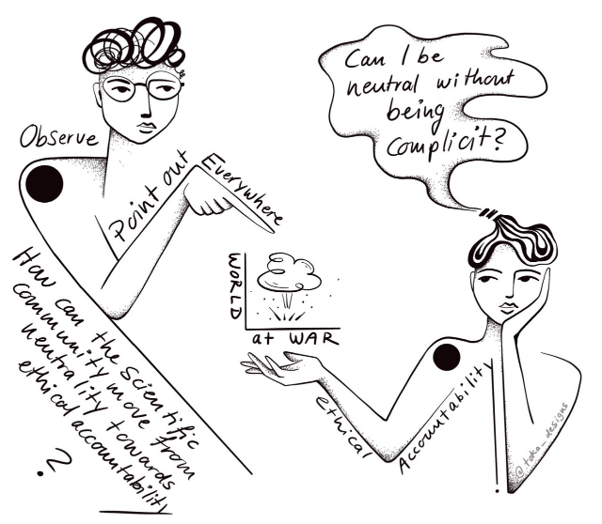
Fig. 1. Illustration by Greta Dekker, a participant of the Townhall Meeting, reflecting the discussion on the myth of neutrality in science and its role within geoscience at the Townhall Meeting.
Three topics were discussed:
- Beyond neutrality. The discussion explored the meaning of scientific neutrality and its limits, examining the ethical responsibilities of researchers both working in contexts shaped by conflict, colonial legacies, and political power, also in relation to their own national and institutional settings. Participants debated how research agendas, funding structures, and institutional collaborations are never fully detached from geopolitical interests and inequality, while also reflecting on how to define ethical boundaries without undermining scientific exchange, individual agency, while avoiding the reproduction of exclusionary forms of knowledge production.
- Ethical procurement and institutional due diligence. Participants discussed how goods, services, data, and collaborations are sourced in ways that uphold ethical principles, especially with respect to human rights, environmental sustainability, and social responsibility throughout the entire supply chain. In the context of global conflicts and threats to human rights, participants also discussed on how and by whom due diligence should be carried out, to avoid complicity in harm, increase awareness of dual-use and potential misuse, and promote transparency and accountability of research institutions.
- The dilemma of cooperation and conscientious objection. Participants debated whether continuing collaborations with institutions implicated in human right violation risks normalising or legitimising violence, while also reflecting on how to support dissenting scholars within those same institutions and protect researchers who take ethical or political positions from retaliation. The debate highlighted broad support for collective forms of protest, including petitions, refusal of funding linked to human rights violations, and institutional pressure.
What emerged from the Townhall was a shared recognition that the geoscience community can no longer hide behind the myth of neutrality. As scientists, our role is not only to study environments and societies, but also to care for them. Principles such as humanity, objectivity, independence, impartiality, and “do no harm” remain fundamental to scientific and ethical practice. Yet neutrality is not equivalent to these principles: neutrality itself is not an absence of politics, but often a political position disguised as absence.
Research choices are rarely neutral. They are driven by funding schemes, institutional priorities, and geopolitical interests. In these contexts, claiming neutrality is not without consequences: it can mean overlooking how scientific collaborations, infrastructures, and technologies become entangled with systems of violence, exclusion and exploitation (see Figure 2).
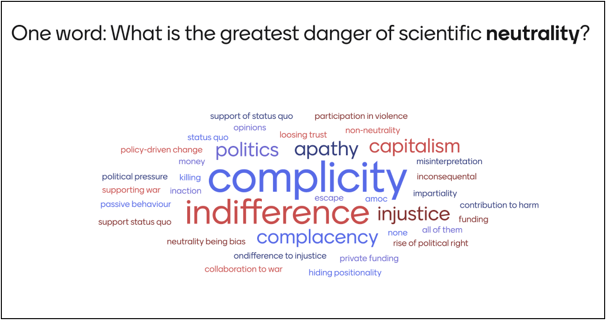
Fig. 2. Mentimeter word cloud during the Townhall Meeting, showing participants’ responses to the question: “In one word, what is the greatest danger of scientific neutrality?” Almost all the participants agreed on the urgent need to create collective spaces to openly discuss ethics, responsibility, and the political implications of our research practices, while taking clearer public stances in the face of systemic violence and injustice.
For instance, participants expressed support for promoting or signing petitions to protest against war crimes, as well as for refusing funding from public or private entities involved in human rights violations. In particular, it was argued that scientific institutions, rather than only individual researchers, should take a stand by suspending collaborations and funding with human rights violators, while also adopting shared responsibility for monitoring dual-use procurement and investigating the environmental legacy of wars.
These discussions reinforced the importance of recognising that research is never detached from the world it describes, and that this entanglement demands explicit ethical responsibility rather than assumed neutrality. Perhaps this is what it means to finally step outside the ivory tower.
The question is no longer whether geoscience is political, but whether we are willing to openly engage with the ethical and political responsibilities that already shape our work. Are we ready, as a community, to engage with these responsibilities?
This blog post was written by the following scientists:
Stefano Corradini
Stefano Corradini is a Senior Researcher at the Istituto Nazionale di Geofisica e Vulcanologia (INGV) in Italy. He holds a Ph.D. in Geophysics from the University of Genova (Italy). Specialized in the physics of atmospheric remote sensing, his primary research focuses on developing satellite- and ground-based algorithms for the volcanic cloud monitoring. Stefano leads national and international research projects and is a co-founder and organizer of the Convective and Volcanic Clouds (CVC) international training school.
Marco Cervino
Marco Cervino, physicist, is researcher at the Institute of Atmospheric Science and Climate (ISAC-CNR). His first research question (degree thesis) regarded the so-called ozone hole, followed by atmospheric pollution detection and measurements from satellites and in situ; then he developed the interest on health effects of pollution. Now he brings his expertise in climate mitigation and adaptation public debates, with special attention to climate justice, wars and policrisis, advocating the public interest.
Claudia D’Oriano
Claudia D’Oriano is a researcher in volcanology and petrology at the National Institute of Geophysics and Volcanology (INGV) in Pisa (Italy). She holds a PhD in Earth Sciences from the Department of Science and Technology of the University of Cagliari. Her research aims to understand all the processes that occur from magma formation to eruption, up to the dispersal of the products, in order to derive eruptive dynamics and risk assessments. She is particularly dedicated to disseminating knowledge among small communities and ethnic minorities living near volcanoes, to reduce their vulnerability to phenomena related to volcanic activity
Alessia Matanó
Alessia Matanó is a researcher in the Water and Climate Risk group at the Institute for Environmental Studies (IVM), VU Amsterdam. In her work, Alessia explores the intersection between hydrological extremes and society with a specific focus on migration, food security and conflict. Alessia holds a PhD in drought and flood risk dynamics from IVM – VU Amsterdam.
Tomaso Esposti Ongaro
Tomaso Esposti Ongaro holds a degree in Physics from the University of Pisa and a PhD in Physical Modeling for Environmental Protection from the University of Bologna (Italy). His research focuses on the physics of granular media and multiphase flows, applied to the numerical simulation of volcanic explosive eruptions. He has applied his research to volcanic hazard assessment, as part of activities under agreement with the Italian Department of Civil Protection, focusing on Italian (Vesuvius, Stromboli, Campi Flegrei, Etna) and worldwide volcanoes (La Soufrière de Guadeloupe – FR; Soufrière Hills, Montserrat – UK; Mount St. Helens – USA). He is currently the Director of the Pisa Division of the National Institute of Geophysics and Volcanology (INGV) and a member of the Board of Directors of the INGV Center for Computational Geosciences.

Giuseppe Civitarese
This is a timely and important reflection. It gives clear expression to a conviction that has also guided much of my own writing (www.breakingpoints.blog): scientific objectivity must be rigorously defended, but it should not be confused with ethical or political neutrality.
Scientists do not work outside society. The questions we decide to investigate, the problems we consider worthy of funding, the institutions with which we collaborate, and the possible uses of the knowledge and technologies we produce are all shaped by social priorities and power relations. Remaining silent about these conditions does not remove politics from science; it merely leaves the prevailing political and economic assumptions unexamined.
This is especially evident not only in times of war and systematic violations of human rights, but also in the ecological crisis. Research can help question destructive systems, or it can provide them with new instruments, greater efficiency and renewed legitimacy. Technologies presented as neutral solutions may reinforce extractivism, militarisation, inequality or the illusion that unlimited economic expansion can continue on a finite planet.
Taking responsibility does not mean adapting scientific results to a political cause. It means being transparent about evidence, uncertainty, interests, funding and consequences—and being prepared to say clearly when robust knowledge shows that particular policies or practices are causing unacceptable harm.
The real choice, therefore, is not between political science and neutral science. It is between a science conscious of its position and responsibilities, and a science that risks serving existing power while claiming to stand outside it.
Thank you for opening this necessary discussion within the geoscience community.