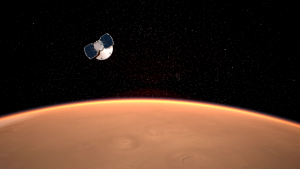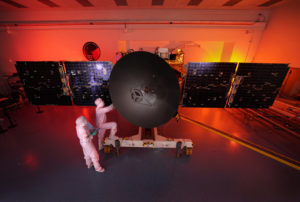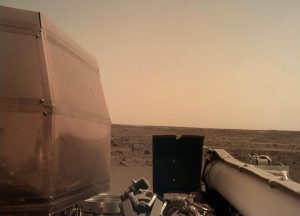
On July 20, 1976, a machine of steel and titanium dropped through a thin atmosphere and touched the dirt of Chryse Planitia. Scientists at NASA held their breath, since five years earlier, the Soviet Union’s Mars 3 probe had died less than two minutes after touchdown. To mitigate this nightmare, engineers programmed Viking 1 to scan its own footpad first. If the lander sank into oblivion, humanity would at least understand the mechanism of its failure.
Instead, the line-scan camera did send back some data. Just a few minutes after Viking 1 landed, an alien landscape emerged on television screens across Earth. There stood the footpad, and for the first time, humanity looked at the surface of another world from the ground up.
As we mark the fiftieth anniversary of those first images this July 20, 2026, the emotional resonance of that moment remains undiminished. It shifted our place in the cosmos which traded science fiction fantasies for a harsh, beautiful reality.
First things first: Why is humanity interested in Mars in the first place?
The short answer is: we look to Mars because it is similar to Earth’s own history and potential future. In our solar system, Mars can be described as our closest environmental relative. It possesses a solid surface, an atmosphere, polar ice caps, and a day-night cycle that mirrors our own. To study Mars is to investigate how planetary bodies evolve, how atmospheres erode, and how climates collapse. In other words, studying Mars means we can maybe, just maybe, learn about what turned what may have once been a habitable environment to a barren land, and hopefully prevent Earth from a similar demise.
In addition to learning, there is an existential yearning that drives the entire mission: the search for our cosmic origins. The main objective of the Viking program was to answer a question that has haunted human philosophy for millennia: Are we alone in the universe? Scientists tested the Martian soil because they sought to learn whether life is a miraculous anomaly unique to Earth, or a natural, inevitable consequence of chemistry when given the right planetary conditions. Mars, a preserved time capsule from a period billions of years ago when both planets were warm, wet, and brimming with potential, is perhaps the most suitable environment – for now- to understand the origins of life as we know it.
So, why did these images taken by Viking 1 matter?
Before Viking 1 sent back its first photos, Mars existed largely in the world of science fiction and grainy, low-resolution orbital mapping (Mariner 9: no shade, you did great for a first-timer!). The lander’s eye-level images gave humanity a horizon to look toward, grounding our species in an entirely new wilderness.
The media frenzy following those initial transmissions highlighted how these images stirred the public. When the first colour composites arrived, technicians calibrated the color balances to mimic Earth’s environmental tones. This led to morning newspaper headlines showcasing a reassuring, bright blue Martian sky.
“Look at that sky—light blue sky—and the reddish hue! It’s a very exciting thing to see, this distinct reddish coloration to the surface. These are subtle hues. It’s a geological scene, a natural scene. Even in the deserts here on Earth the reds are not crayon reds as painted by a child. This is a surprisingly terrestrial‐like desert scene.” said Dr. Thomas A. Mutch of Brown University, a geologist and leader of the picture‐making team.
When NASA scientists corrected the data hours later, revealing a pale, salmon-pink horizon tinted by suspended iron dust, the shift triggered a wave of public astonishment: The true Martian sky defied human expectations.
Years later, a photograph captured from the Viking 1 orbiter over the Cydonia region generated a decades-long media storm. The image showed a rocky mesa that, due to low resolution and low sun angles, resembled a massive human face staring up into space. Tabloids ran wild with theories of ancient alien civilizations after the Face on Mars, proving the desperate human instinct to find fragments of ourselves in the cold dark of the universe. Though advanced rovers later proved the Face on Mars was simply a trick of light and shadow, the photograph demonstrated the immense cultural power of planetary imagery.
50 years late: A renaissance?
This anniversary arrives at a moment of spectacular scientific revision. For decades, textbooks taught that Viking’s biology experiments yielded a definitive negative result for life, which rendered Mars as a self-sterilizing wasteland. However, a recent perspective indexed on PubMed argues that the scientific community spent a half-century misinterpreting the mission’s gas chromatography data.
The 2026 study highlights that when the Viking instruments heated the Martian soil to look for organic compounds, they inadvertently triggered a destructive chemical reaction with native perchlorates: oxidizing salts (like perchlorate) that were entirely unknown to scientists in 1976. This reaction incinerated the very organic molecules the mission sought to find and left behind chemical residues that the original teams dismissed as terrestrial contamination. The authors suggest that the positive metabolic signals Viking recorded are completely compatible with a specialized ecosystem of Martian microbes, a hypothetical model named BARSOOM (Bacterial Autotrophs that Respire with Stored Oxygen on Mars).
Concurrently, researchers publishing with European Geosciences Union (EGU) have breathed new life into the mission’s data. Climate scientists publishing research in EGU’s journal Geoscientific Model Development have combined Viking’s historic, multi-year atmospheric baselines with modern satellite observations to create 3D global climate models. These simulations trace the movement of dust storms and water-ice clouds across the planet and demonstrate that Mars possesses seasonal dust and an atmospheric cycle that continuously shapes its surface features.
The road ahead
In 2026, Mars exploration is transitioning to a commercial and international era. Following recent domestic budget constraints that left the initiative unfunded, private and international alternatives are accelerating. China is steadily advancing its Tianwen-3 Mars Sample Return mission for a 2028 launch. Concurrently, NASA announced last month that is set to launch the Aeolus atmospheric orbiter on a commercial rocket. Engineers are also testing advanced deep-space infrastructure, including a nuclear electric fission prototype outlined under NASA’s Space Reactor-1 Freedom pathfinder to shorten transit windows for future crewed expeditions.
These modern exploration models would probably not have been possible without the data established by Viking 1. The atmospheric density profiles captured during Viking’s 1976 descent still calibrate the entry, descent, and landing systems used by modern rovers and upcoming commercial spacecraft alike. The climate models tracking Martian dust cycles expand upon the continuous atmospheric baseline that Viking started fifty years ago. Viking 1 remains the genesis, the mission that provided the foundational proof that landing on Mars was achievable, and supplied the data that makes current plans for human exploration viable.
My brain is blowing with questions right now: “Did terrestrial life as we understand it originate in Mars”? Did Mars have oceans and rivers? Will Mars ever be habitable by Earthlings?
Maybe one day, I’ll return to this blog, with a smirk, thinking: It’s an honour to be alive in times where these questions have solid answers.