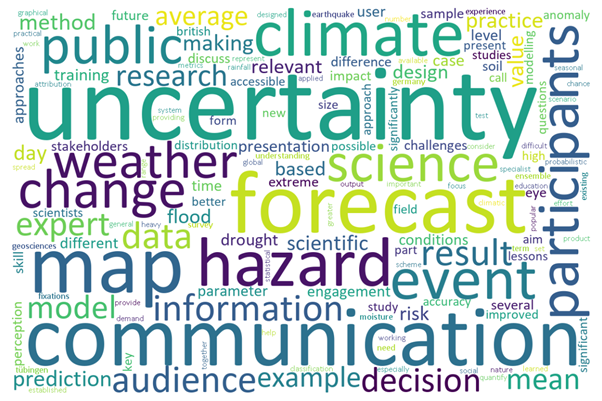
Uncertainty in geosciences is an inherent part of scientific processes and assessments, propagating throughout the entire workflow (Pérez-Díaz et al., 2020). As scientists, we are used to seeing error bars, confidence intervals, or statistical indicators that tell us how robust our models or measurements are (Padilla et al., 2021). The challenge arises when we need to communicate these scientific results outside our circle of peers. We may hesitate, worrying that non-experts will misunderstand or misinterpret our uncertainty statements, and therefore prefer to omit them from reports or presentations. This hesitation becomes even stronger when our audience includes stakeholders who must make important decisions, such as those made during a crisis. In this case, the pressure to “not get it wrong” increases. Yet withholding uncertainty can have worse consequences: choosing not to communicate uncertainty means accepting the risk that decision makers will have to guess, instead of using our best (though imperfect) judgment.
Interestingly, behavioural research shows that people can understand scientific uncertainty better than we often assume, although good practices, such as well-designed visualisations or combining numbers with clear verbal explanations, do help (Fischhoff and Davis, 2014). So yes, communicating uncertainty remains a challenge, but avoiding it may make the problem even bigger. Therefore, developing research and evidence-based guidelines on how to communicate uncertainty is essential, not only to support better decision-making but also to give scientists the tools and confidence they need to communicate uncertainty clearly and responsibly.
Communicating uncertainty to non-experts at EGU25
Despite the early schedule (8:30 on Thursday), the EOS PICO session “How to communicate uncertainty to non-experts” was jam-packed at the EGU General Assembly 2025. A total of 12 presentations were delivered with topics ranging from methodologies for communicating and quantifying uncertainty across different geoscientific applications (hazard assessment, weather and climate forecasting, extreme event attribution studies, and the design of flood-related infrastructure) to education and training in uncertainty.
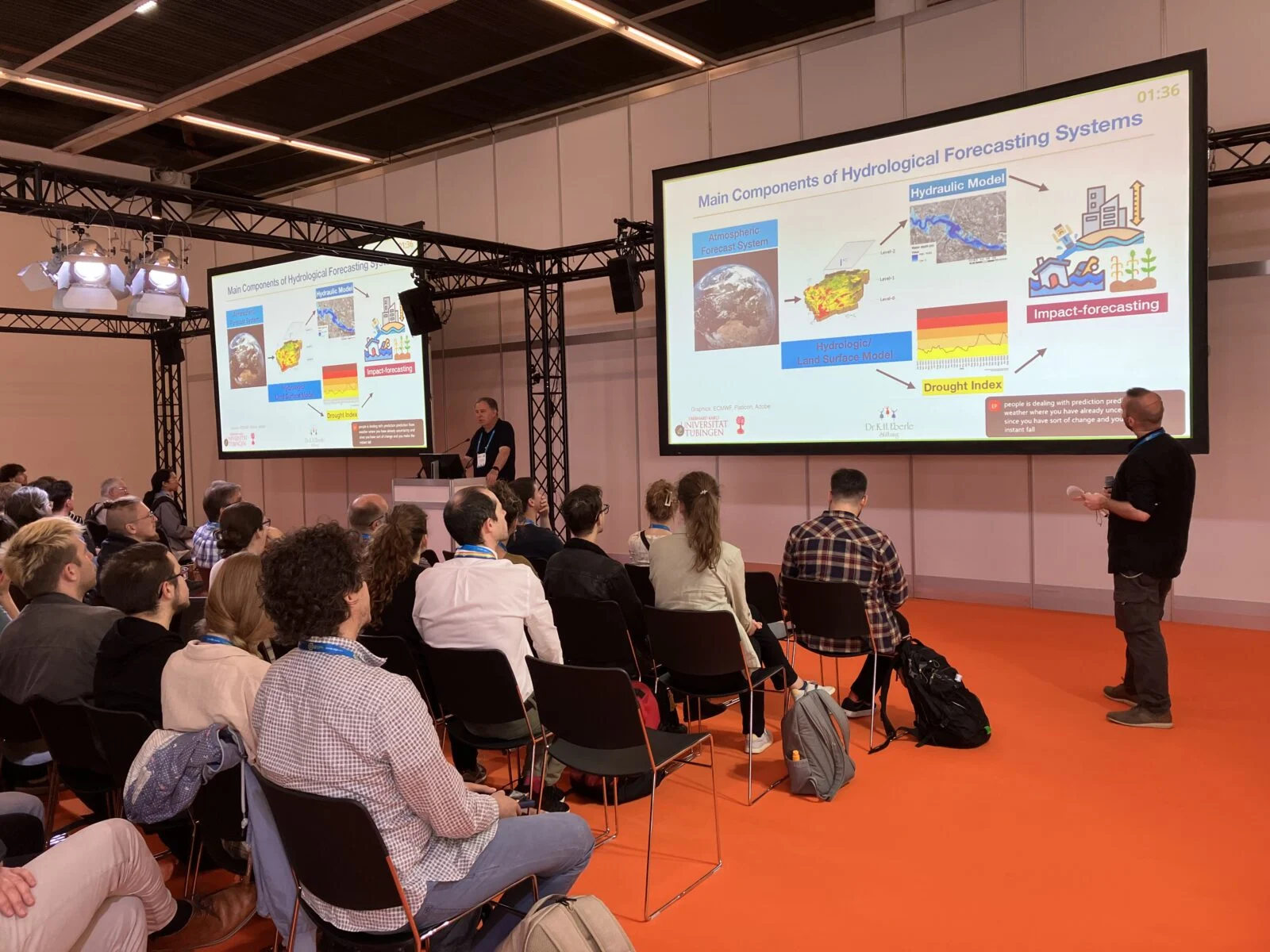
EGU25 PICO session: Communicating uncertainty to non-experts.
Photo credit: Solmaz Mohadjer
Key messages:
- Communicating uncertainty starts with being honest about what’s known and unknown. How uncertainty is communicated can shape whether (and how) the information is used for decision-making.
- Communicating uncertainty requires interdisciplinary work, needing insights from fields like visual rhetoric, science communication, design, multimedia, and psychology alongside the originating scientific discipline.
- Differentiate between uncertainty types. Objective uncertainty (statistical or factual) and subjective uncertainty (personal beliefs or socio-economic vulnerability) require different responses. Recognizing these layers adds complexity to uncertainty assessment, but is essential to tailor uncertainty communication to the audience, the topic, and the timing.
- Before communication, identifying the sources of uncertainty and quantifying them where possible remains a key step.
- There are many ways to communicate uncertainty effectively, including visualization in hazard maps, forecasts, or other two-dimensional images, impact-based communication, and interactive activities.
- It is important to evaluate how uncertainty communication is perceived and to quantify its impact, using methods that are often borrowed from other disciplines such as psychology and cognitive science, which include surveys, interviews, focus groups or eye-tracking.
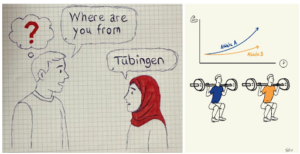
- Raising awareness of the importance of quantifying and communicating uncertainty should start early in geoscientific careers. This can be achieved through dedicated training schools. One such example is the course “Understanding the Unknowns: Communicating Uncertainty as a Driving Force for Geosciences”, held from 17–19 March 2025 at the University of Tübingen, funded by an EGU grant, and led by the Dialogue in Communication and Engagement with Uncertainty group.
Back by popular demand: Uncertainty communication at EGU26
Did you miss the session on communicating uncertainty with non-experts at EGU25? No worries. You will have a chance to participate in it at EGU26, so keep an eye out for it in the EOS program and consider submitting an abstract before Thursday, January 15, 2026, 13:00 CET.
Does this topic intrigue you? Feel free to reach out to us: https://dice-uncertainty.org/ or contact me directly at iriscaterina.schneider@autonoma.cat
References
Fischhoff, B., and Davis, A. L.: Communicating scientific uncertainty, PNAS, 111, 13664–13671, https://doi.org/10.1073/pnas.1317504111, 2014.
Padilla, L., Kay, M., and Hullman, J.: Uncertainty Visualization, Wiley StatsRef: Statistics Reference Online, 1–18, https://doi.org/10.1002/9781118445112.stat08296, 2021.
Pérez-Díaz, L., Alcalde, J., and Bond, C. E.: Introduction: Handling uncertainty in the geosciences: Identification, mitigation and communication, Solid Earth, 11(3), 889–897, https://doi.org/10.5194/se-11-889-2020, 2020.