
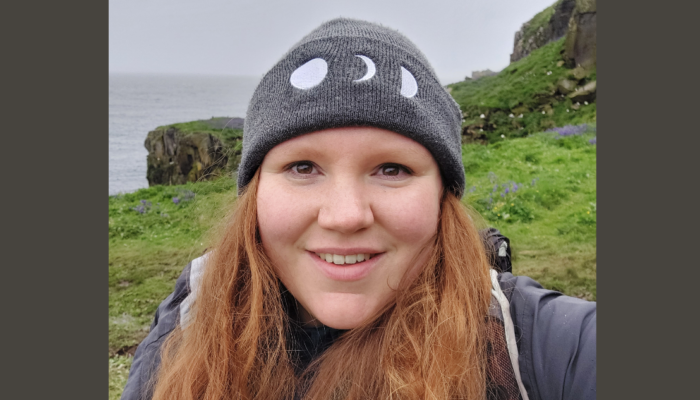
Hello Silke and welcome to GeoTalk! Before we dig into your topic of expertise, could you introduce yourself to our readers?
Hello, Simon. My name is Silke Asche, and I am a chemist in astrobiology and part of the Agnostic Biosignature Collective led by Dr Heather Graham at NASA’s Goddard Space Flight enter. My Ph.D. focused on Origins of Life (OoL) research and the automation of such experiments. During that time, it became clear to me that there was a lack of a framework to define success in OoL, and developing that framework is a major challenge by itself. This realization led me to look into how other disciplines, such as planetary science, distinguish abiotic from biotic processes.
My current research focuses on developing experimental methods to detect life as we do not know it, particularly using mass spectrometry. I hope to develop a biosignature framework that can be applied not only to other planets but also to the OoL questions explored in laboratories on Earth.
When we look for evidence of life beyond our planet, it is often imagined to be similar to ourselves. For example, we might hold a hydrocentric view and assume that, because we are water-based, all life must be water-based also. How do these assumptions shape our search for extraterrestrial life?
It’s definitely easier to look for things that we already know. Our search for life elsewhere is heavily shaped by the one example of life that we know: life on Earth. When we explore other planets and planetary bodies, we apply this bias and often look for the kind of molecules that are critical for our known life: amino acids, sugars, and peptides. We are also experts in finding these very familiar molecules, even while being limited to space flight heritage instruments.
By moving beyond these known molecules, we are proposing that any unknown life would still share certain general functions such as selectivity and the ability to store information, functions that can be measured on a molecular level.
To help mitigate against the assumptions we might make about extraterrestrial life, your research uses an investigative framework – Assembly Theory. Can you tell us about how Assembly Theory supports space exploration?
Assembly Theory, which was first introduced by Professors Sara Walker and Lee Cronin, is a biosignature framework that could be used to look for life agnostically. The underlying theory is an object classification system where the Assembly Index reflects the minimum number of steps required to build a specific object, as well as how abundantly that object occurs.
I work specifically with molecular assembly, where the objects in question are molecules. The key idea is that if a molecule is both highly complex and found in abundance, it is more likely to have been produced by a living system. On Earth, this could be any molecule that is not made in a natural abiotic geochemical process, for example, DNA, but also vitamin B12 and countless drugs that we produce synthetically in laboratories.
What do you think is next for the development of Assembly Theory?
I am especially excited to see developments on the experimental site of molecular assembly. It has already been experimentally shown that biotic samples can be distinguished from abiotic samples via direct injection electrospray mass spectrometry.
Unfortunately, that technique is not currently deployable on other planets, so I am currently running extensive experiments to demonstrate that this measurement is possible on mass spectrometers that are space flight suitable, for example, a gas chromatography mass spectrometer. Instruments like this have already been deployed with Curiosity on Mars and will also be deployed with Dragonfly on Titan.
Another direction I would really like to see would be how robust molecular assembly is to classify the success of different prebiotic reaction systems. Being able to compare those systems in a quantitative way would be pretty interesting.
Research into the origin of life agrees on a few fundamentals – life emerges from abiotic processes involving some type of matter and energy source, for example – and yet the opinions on what extraterrestrial life may be like are diverse, and occasionally in disagreement. How does this influence the future of the field?
While there are still many unknowns regarding the agreed-upon basics in the origin-of-life field, there has been impressive progress in terms of understanding the underlying processes and reaction mechanisms on how we get from simple molecule building blocks to complexifying chemical systems.
I hope that this growing knowledge will pave the way for bold, large-scale experimental studies of messy, long-term reaction systems, using a diverse library of building blocks and selection pressures. Even though designing, funding, and analyzing those experiments will be a real challenge, the outcome could be very interesting.
You also founded an early career network for researchers studying the origins of life. What advice do you have for people looking to build a community?
Co-founding the Origin of Life Early-career Network (OoLEN) had a hugely positive impact on my Ph.D. experience. It all started back in 2020 when a planned in-person conference was cancelled and moved online. This brought together a group of OoL early-career researchers who were all eager to connect.
Building the network was a lot of work at first, but it has since grown into a global research community with almost 300 professional early-career scientists. We have supported the publication of three peer-reviewed scientific papers and hosted four in-person meetings, two in Europe and one in Canada, with the next one planned for Japan next year.
Finding my scientific peer group through OoLEN has been invaluable, and I’m still collaborating on projects that wouldn’t have been possible without it. My advice for anyone looking to build a community is pretty simple: Start talking to people and explore the networks that are already out there. Motivated volunteers are usually more than welcome, and there’s really no better way to connect and find your peers in the field.



Faculté des Lettres et Langues
Your blog never fails to provide valuable content. Thanks